September 14, 2026 · Mochatrade · 9 min read
Mocha Markets Weekly
Oracle’s AI spending, Apple’s foldable surprise, the Fed’s next move, crypto policy, option-chain trading, and the story behind FAMI’s 321% surge.
The goal of MochaTrade Weekly is to give readers as much in-depth value as possible in the simplest way possible, so as to allow them to implement what they learn right away in their trades.
The newsletter runs four fixed sections every week:
The US week behind. The top movers over the week long with the reasoning and what was expected.
The US Week Ahead. What to watch for and what isn’t priced in yet: mergers, earnings, conferences, and more.
One Concept. One thing nobody has bothered to explain to people who already know how to trade.
One Chart. The most interesting thing we saw each week, with a deeper article you can go read if you want more.
01 The US week behind
Oracle’s record quarter was paid for by its shareholders and spent with its suppliers
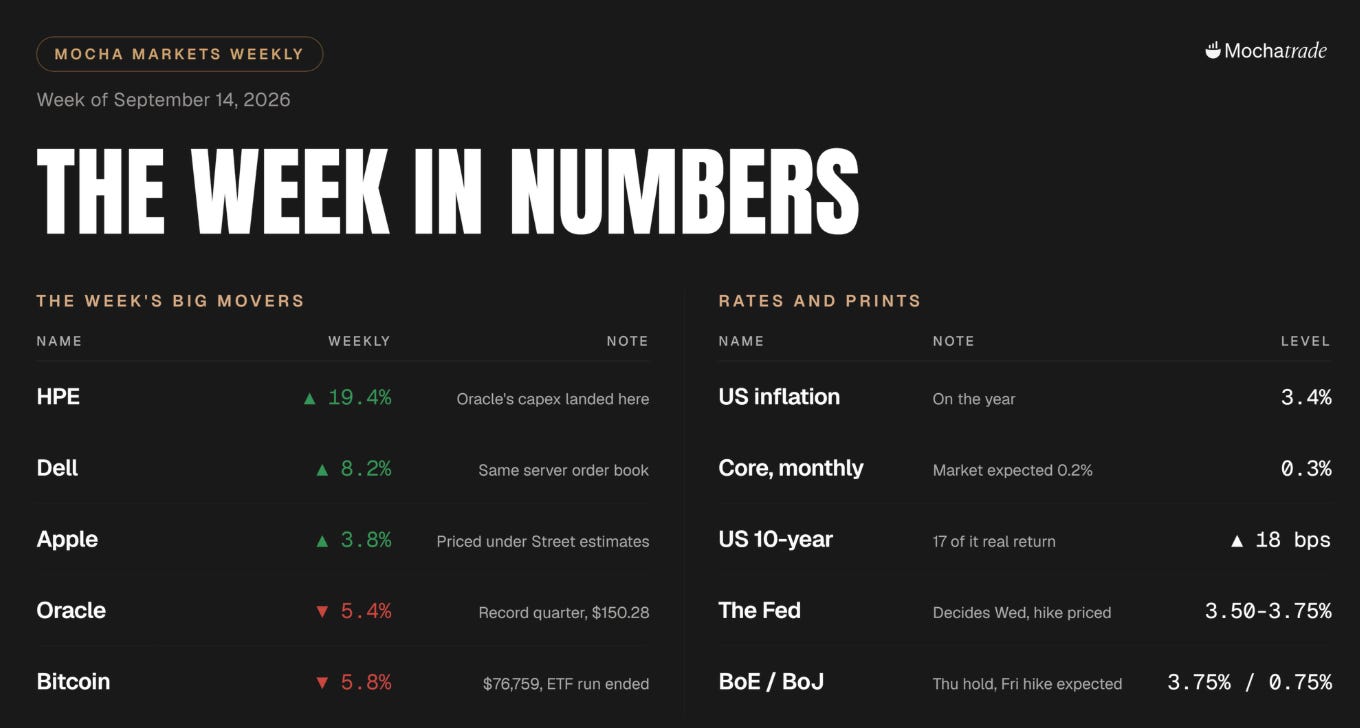
Oracle closed Friday at $150.28, down 5.4% on the week, and the suppliers took the money: HPE rose 19.4% and Dell 8.2%.
Oracle reported its earnings recently and revenue was up 30% and cloud infrastructure up 121%. The same filing shows about $28.5 billion spent on building data centres in the quarter with only $23 billion of cash earned (the $5.4 billion shortfall covered by selling its own stock into the market). Across the last full year it took in $32 billion and spent $56 billion. So the order book grows and shareholders pay for the building, while the software business (the cheapest money making leg they have) shrank 3%.
Apple priced its foldable $300 to $500 below what Wall Street modelled, and the stock rose the day after the event.
The iPhone Duo came in at $1,999 against Morgan Stanley’s $2,300 to $2,500 estimate, at the first keynote under new chief executive John Ternus. The usual launch-day fade did not happen. Apple closed roughly flat on event day, then rose 3.6% Wednesday and 1.8% Friday, up 3.84% on the week.
02 The US week ahead
The Fed decision, 16th September, Wednesday 11:30 PM. Press conference at midnight.
Context The Fed (short for the Federal Reserve) is America’s RBI. It has held its rate at 3.50% to 3.75% all year, and at the July 29 meeting three of its officials voted to raise it anyway. This is one of the four meetings a year where the Fed also publishes its forecasts, which means the dot plot comes with it: every official writes down where they expect the rate to be at the end of the year, and the chart of those guesses gets published. Kevin Warsh (current Fed chair) takes questions from midnight IST.
What’s happening August inflation landed Friday. Prices rose 0.4% on the month and 3.4% on the year, and core (the version with food and fuel taken out) rose 0.3% against the 0.2% the market expected. According to Polymarket and Kalshi odds, the market is expecting a rate hike.
What to look out for Not the hike (everybody already has that). The question that moves your positions is whether Wednesday is one hike or the first of several, and there are two places to read the answer.
The Fed’s own answer is the dot plot. Count how many of the nineteen dots sit above one hike for this year.
The market’s answer is the two-year yield. It is, roughly, where traders expect the Fed’s rate to average over the next two years, and it sits about a full point above today’s rate. A hike is a quarter of a point. So the market has already pencilled in several, and is treating Wednesday as a direction, not an event. Watch whether the two-year moves at all after 11:30 PM. If it does not, the Fed said what the market expected.
Why this matters Because the thing hurting your US stocks (or even Indian stocks) is not the Fed’s rate. It is the ten-year yield, which is what every profit years away gets measured against, and last week it rose for a reason a hike does not fix.
A yield has two parts: payment for the inflation lenders expect, and a real return on top. If yields rise because people fear inflation, a hike helps, because a hike fights inflation. If yields rise because lenders want more real return, a hike does not bring it down. Last week the ten-year rose 18 basis points (a basis point is 0.01%), and seventeen of them were real return. The inflation part did not move, on the hottest inflation print of the year. So the bond market is not scared of inflation. It wants to be paid more to lend to the US government, and nothing said on Wednesday changes that.
You can check this yourself in a minute. The US Treasury publishes both curves, the normal one and the real one, on its site every day. Subtract one from the other and what is left is the market’s inflation forecast.
Two more in the forty hours after. The Bank of England, Thursday 4:30 PM, is expected to hold at 3.75%, though three of its nine voted to raise in July and UK inflation lands the day before at 11:30 AM. The Bank of Japan, Friday around 12:00 noon, is at 0.75%, and all 52 economists in Bloomberg’s survey expect a hike.
September 15th to 17th, Crypto’s week in Washington, and one morning in Delhi.
Context The US market structure bill, the one that decides which American regulator owns which crypto asset, cleared committee 15 votes out of 24 on May 14 and has been sitting since. The text runs 616 pages. The arguments still open are the ethics title, whether stablecoins (the currency in which most assets settle) can pay you a yield, and anti money laundering.
What’s happening Three things. Tuesday, the Senate holds a vote on that bill, which needs 60 votes to move forward; if it fails, market structure legislation is probably finished for this Congress. Thursday, the SEC (America’s SEBI) holds a roundtable on 24-hour and overnight equity trading, looking at whether the plumbing can survive a market that never closes. And on Wednesday at 11:00 AM IST, India’s Department of Economic Affairs appears before the Parliamentary Standing Committee on Finance on crypto policy, in Committee Room D at Parliament House Annexe, about twelve hours before the Fed decides.
What to look out for Whether the DEA says anything about a legal framework rather than only about tax and enforcement. It would be the clearest signal in years. On September 9 the FIU (the Financial Intelligence Unit) issued takedown orders against platforms for anti money laundering failures, which is enforcement, not a ban, and the difference between those two is the whole question.
Why this matters Bitcoin ETFs lost $462.7 million over the four sessions, with outflows every single day, ending the longest run of inflows this year. Bitcoin fell 5.8% on the week to $76,759. Strategy ended a ten-week pause on September 8 and bought 4,603 more coins for about $370 million. And if you trade perps (if you don’t know what a perp is, watch this reel: xxxx), funding on bitcoin has flipped negative on Hyperliquid and Bybit, meaning shorts are paying longs, while it is still positive on Binance. That is the same venue-by-venue gap we wrote about last week, sitting there in the open (look at the previous weekly newsletter here
03 One Concept
The option chain: how to know where the price will stop before it gets there
Open interest is the number of option contracts that exist at a strike right now. The NSE option chain shows it for every strike, free, no login, and the two biggest numbers on that page are the only ones you need.
Here is why they matter. When you buy an option, somebody sold it to you, and most of the time that somebody is a market maker, a firm that sells options for a living and does not want to bet on the price. To protect himself he buys or sells the stock itself, and he has to keep adjusting that as the price moves. Where thousands of contracts sit at one strike, his adjusting is large enough to move the stock.
Now for the trade, the strike above the price with the largest call OI is a wall: the price struggles to get through it. The strike below with the largest put OI is a floor. Take profit on longs at the wall, buy near the floor, and keep your stop just past whichever one you are leaning on. If the price breaks cleanly through a wall, flip, because the market maker is now forced to buy with the move instead of against it, and that is what turns a break into a run.
This way, you are essentially trading his hedge, not your own opinion of the stock.
All of this is education, not advice. We do not know your situation, your size or your risk, and nobody here is telling you what to trade.
04 One Chart
$FAMI On September 2 a Nasdaq listed company with fifteen employees traded more than 720 million shares. It normally trades about 5 million. The company announced nothing that day, because none of it was about the company.
Farmmi sells dried mushrooms and farm commodities out of Lishui, Zhejiang, and is worth a few million dollars. It closed Tuesday at $0.1187, touched $0.50 on Wednesday, up 321%, and closed back at $0.15.
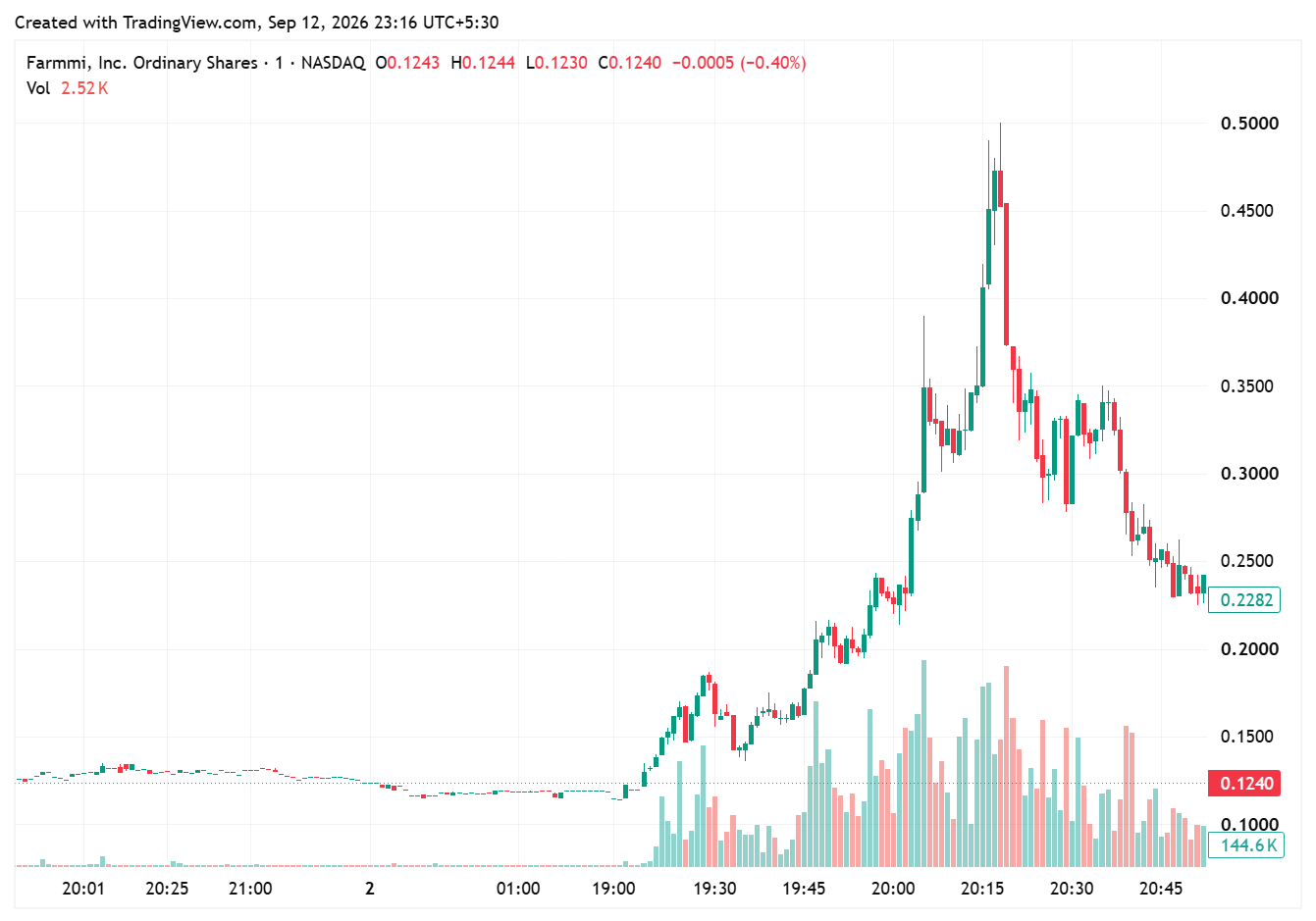
It started with a meme coin. Somebody launched JINQIAN, named after a mushroom variety listed in Farmmi’s own annual report, and priced it against a copy of Farmmi’s stock on Robinhood Chain (Robinhood’s own ledger, where copies of US shares trade around the clock). The coin reached about $60 million within the hour, ten times the company it was named after.
Now the mechanism, because the mechanism is where the trade came from. A Robinhood copy is backed one for one by a real share held in custody. Only one appointed firm is allowed to create new copies, and to create one it has to go buy the real share first. So when a meme coin priced in copies gets bought hard, it pulls those copies into its pool and locks them there, supply on the ledger runs short, and that firm has to buy real stock to make more.
Two days before Farmmi moved, a trader laid the plan out in public (
): pair a meme coin against a copy of a small Nasdaq company, and let the buying travel through the copy into the real shares. So when JINQIAN started running, people bought real Farmmi on the Nasdaq to get ahead of the buying that was supposed to follow.
That chart is worth your time because the buying was real and the machine it was getting ahead of did not exist. The check that would have caught it was public the whole time: who issues the copy, and whether anyone can hand it back for the share.
These markets now price a mechanism hours before anyone confirms it is plugged in, and all of it runs on New York’s clock, which is your night. Trade those hours, in rupees, at Mochatrade. Join the waitlist.