October 24, 2026 · Mochatrade · 6 min read
CoreWeave Lost 25% of Its Value in One Week
Bonds yielding nearly 15% erased a quarter of the stock's value in a week, and the rest of the AI cloud sector felt it too.
On October 13, investor Chamath Palihapitiya posted a chart showing that the interest rate investors demanded on a $1.25 billion CoreWeave bond had hit 15%. Elon Musk replied, "yikes!" Within a week, CoreWeave's stock (CRWV) had lost about 25% of its market value, and its stock plunged.
This post explains how a bond chart could do that, even if you have never read a balance sheet. CoreWeave is a major player in AI infrastructure, so its trouble exposes cracks in how the current AI boom is being financed.
Who Builds The Machines Behind AI?
AI chatbots run on chips called GPUs. Thousands sit in warehouse-sized data centers, and the processing power they produce is called compute. Most AI companies rent it.
Nvidia CEO Jensen Huang splits AI into five layers, and this story sits in the third:
Energy: the power that runs everything.
Chips: the GPUs that do the calculations.
Infrastructure: data centers and rented compute, where CoreWeave sits.
Models: the AI systems built on that compute.
Applications: the products people actually use.
Hyperscalers, the giant cloud providers such as Amazon, Microsoft and Google, fund it from profitable businesses elsewhere. Neoclouds, newer companies built around renting out GPUs, such as CoreWeave, Nebius and Lambda, have no second business and borrowed heavily to buy chips. CoreWeave is the best-known neocloud, so it tests whether that model works.
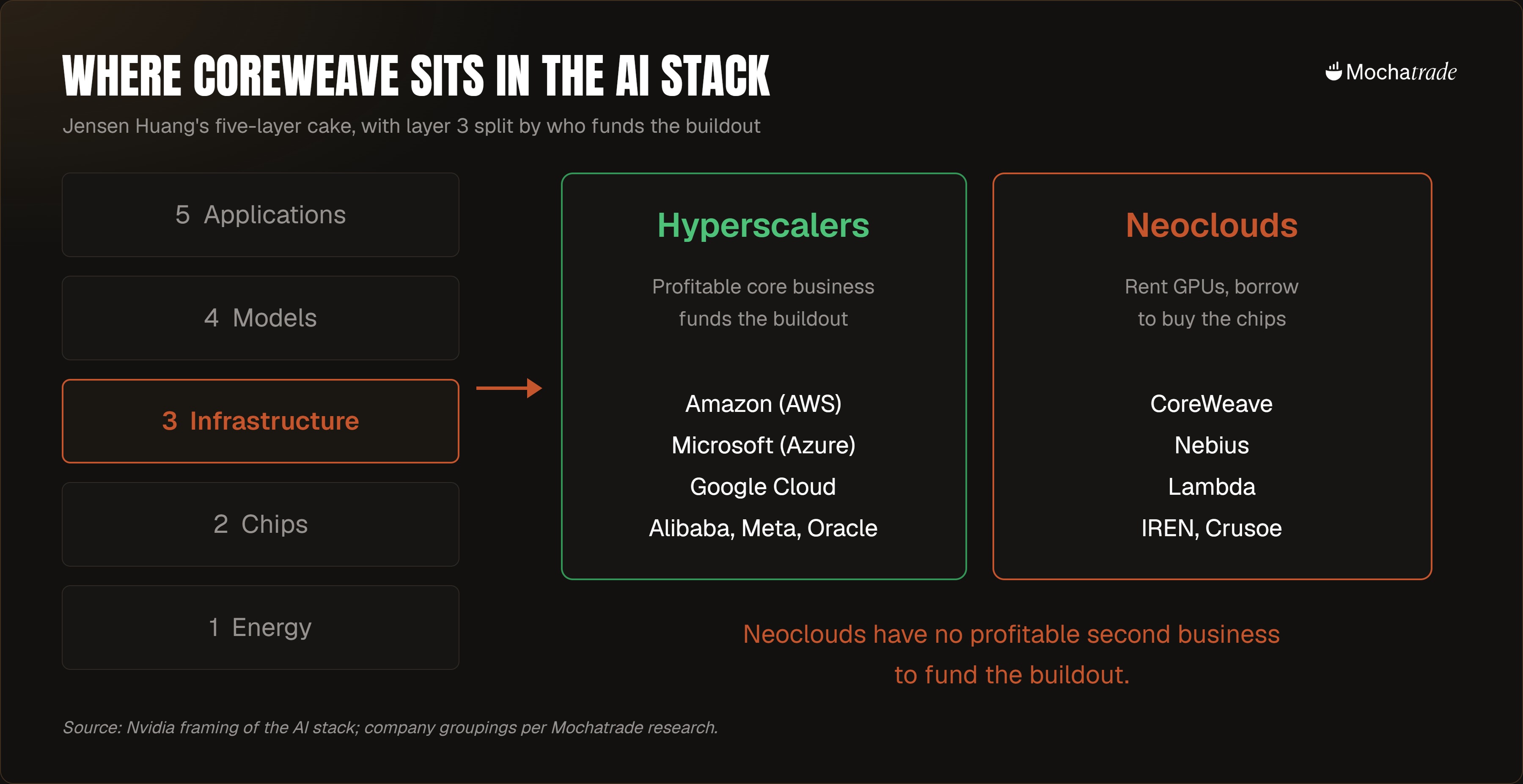
Layer three of the AI stack, split by who funds the buildout.
What Is CoreWeave?
CoreWeave buys Nvidia GPUs, houses them in more than 50 data centers, and rents the compute to AI developers including Microsoft, OpenAI, Meta and Anthropic. Think of a landlord who rents out processing power. Many contracts are take-or-pay, meaning the customer owes the money whether or not it uses the capacity. Signed contracts not yet delivered are the backlog, and CoreWeave's was $104.2 billion at June 30.
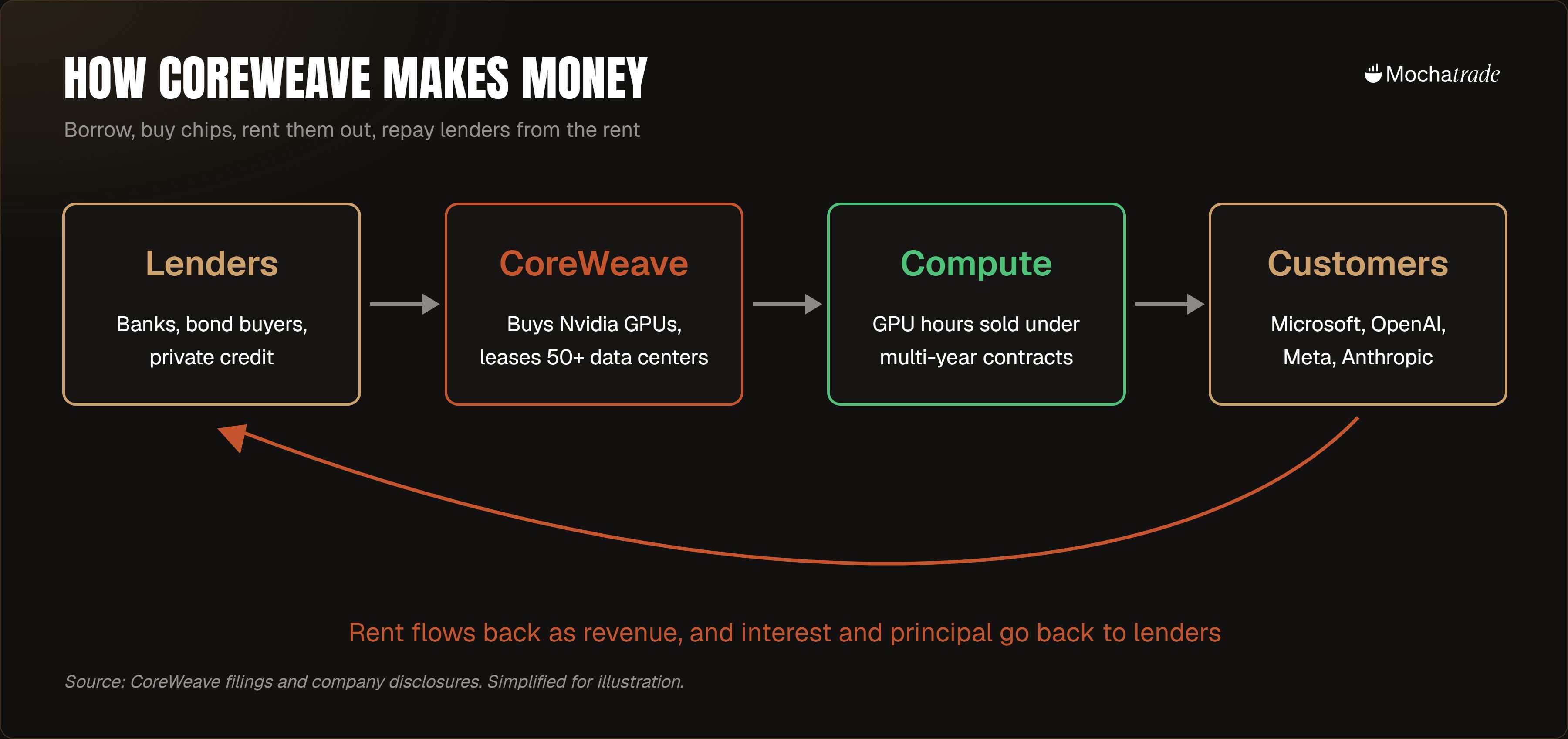
CoreWeave's business model, simplified.
The catch is that renting out chips means buying them first. That spending is called capital expenditure, or capex. CoreWeave guides to $35 billion to $39 billion of capex in 2026, nearly three times the roughly $13 billion of revenue analysts expect. Hyperscalers spend far more, but they have profits behind them. That gap has to be filled by borrowing.
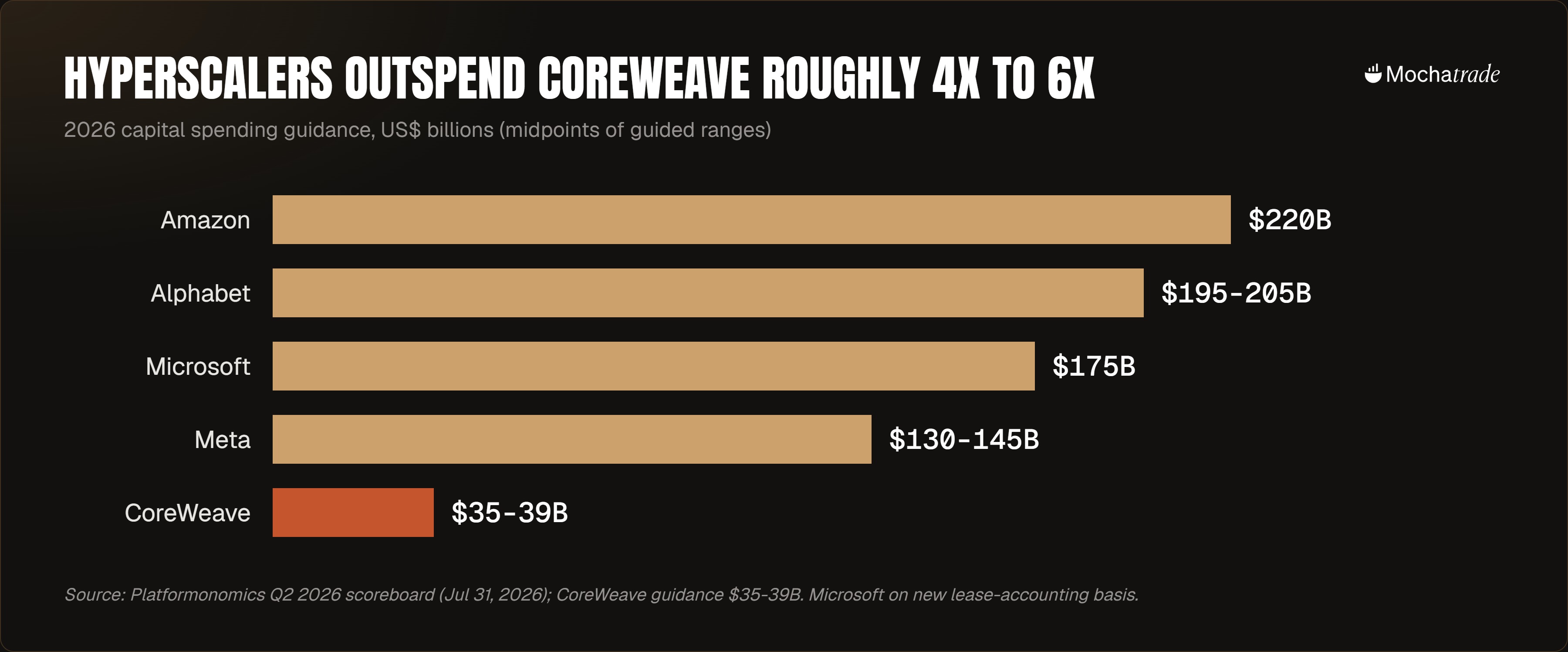
2026 capex guidance, US$ billions. Source: Platformonomics (July 31, 2026), CoreWeave.
How Much Debt Does CoreWeave Have?
CoreWeave’s sales are growing fast, and its borrowing bill is growing faster. Revenue more than doubled last quarter, but net interest expense, the cost of borrowed money, rose even more steeply, and the company still lost money. That interest now costs about $7 million a day, every day. The cash tells the same story: in the first half of 2026 CoreWeave spent almost four dollars on equipment for every dollar its operations brought in. New borrowing and stock sales filled the gap.
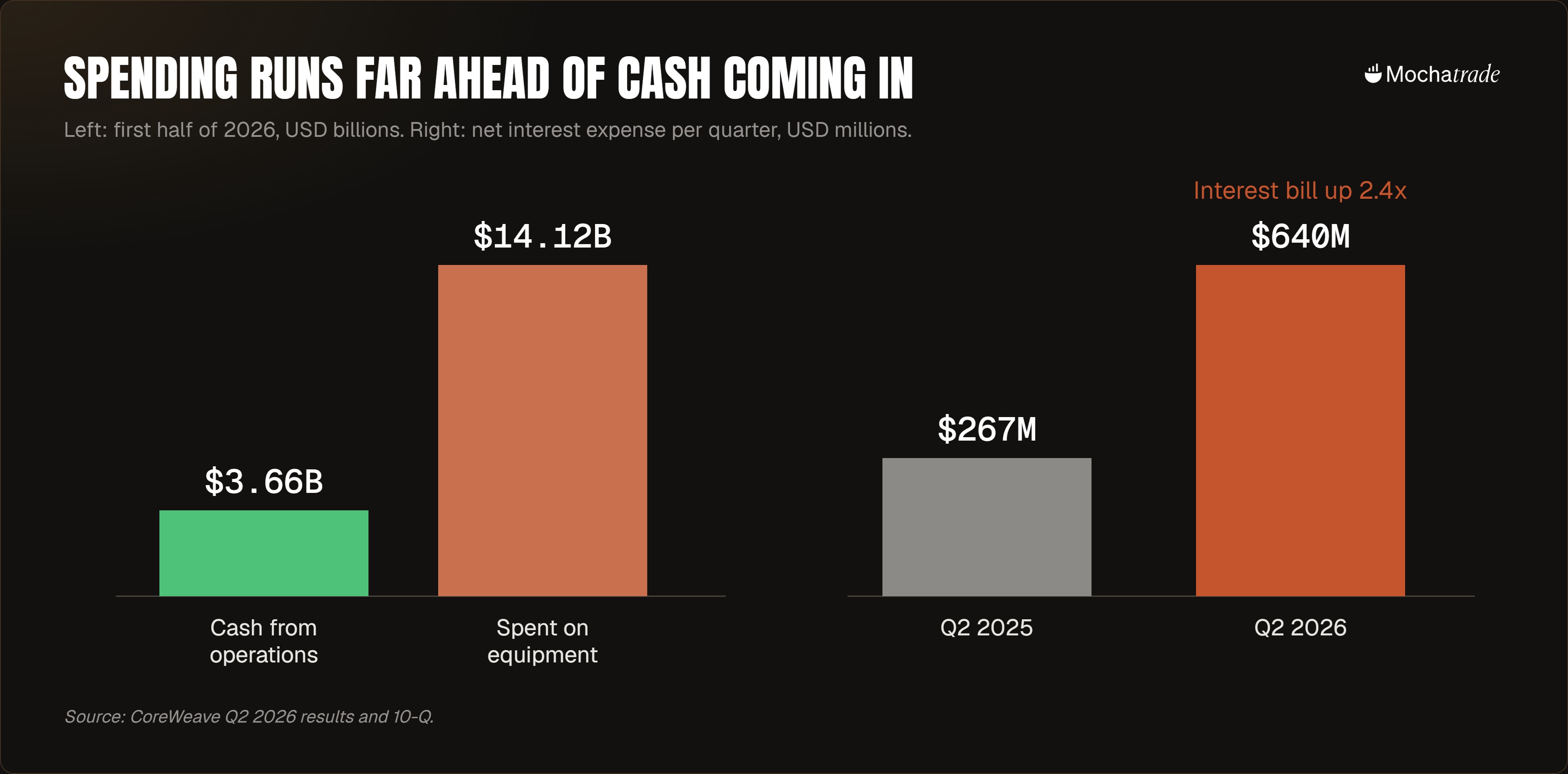
Source: CoreWeave Q2 2026 results and 10-Q.
Headlines say CoreWeave has $52 billion in debt, which is nearly Bolivia’s entire yearly economic output ($54 billion).
The headline figure combines two things:
Borrowed money: about $35 billion, up from roughly $21 billion at the end of 2025.
Lease obligations: the rest, promises to keep paying for rented buildings and equipment.
CoreWeave holds only about $5.5 billion in cash, and its whole stock market value (market capitalization) is about $34 billion. On the wider count, it owes more than the company is worth.
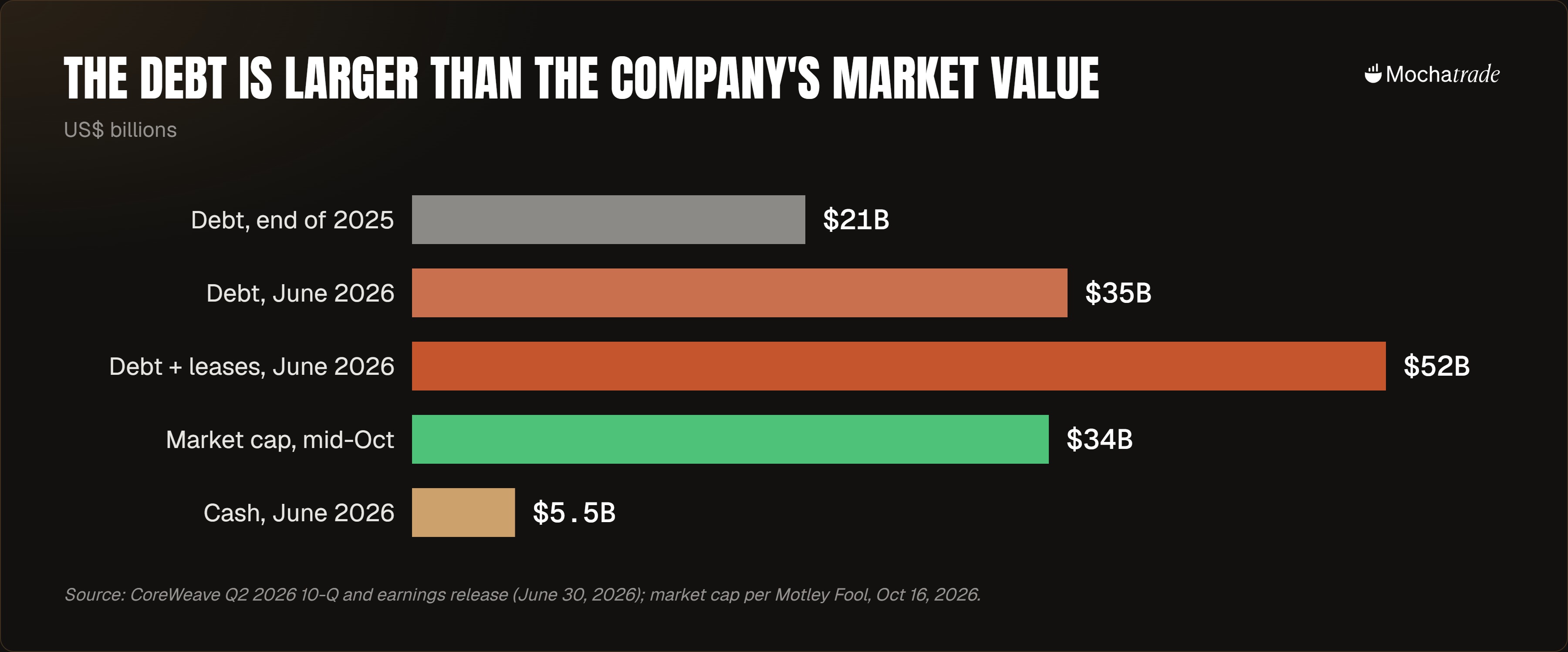
Source: CoreWeave Q2 2026 10-Q and earnings release; market cap per Motley Fool, October 16, 2026.
What The Bond Market Said
A bond is a loan that investors can trade. The borrower pays a fixed yearly interest rate, the coupon, and repays the face value on a set date. The bond in Palihapitiya's chart is a $1.25 billion issue of 9.625% notes due July 2032.
Here is how the yield got so high:
When investors worry, they will only buy at a discount, and Reuters reported these notes trading below 80 cents on the dollar.
A new buyer pays 80 cents for a note that returns $1 in 2032 and keeps paying its interest along the way.
That buyer’s annual return comes to roughly 15%, far above the 9.625% printed on the note.
The yield touched 15% on October 13. CoreWeave still owes only the original coupon, so what changed is the likely price of new money.
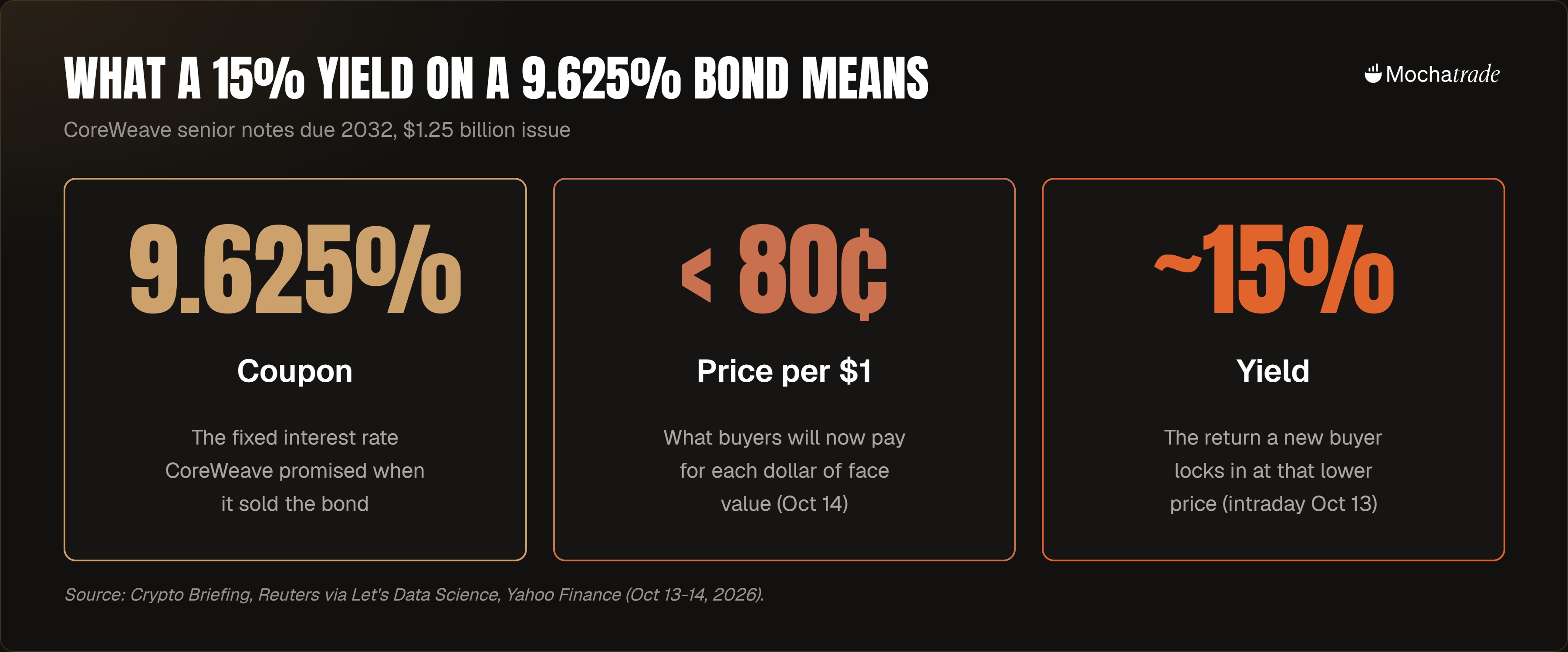
Source: Crypto Briefing, Reuters via Let's Data Science, Yahoo Finance.
Why Did CoreWeave Stock Fall 25% In A Week?
CoreWeave fell 15.5% on October 14, the day after the chart circulated, then bounced, then fell almost 12% more on October 16. That is a 25% loss in five trading days, its worst week since November. It now trades about two thirds below its June 2025 peak, but still 55% above its IPO price.
Other AI infrastructure stocks fell with it on October 14:
Dell: down 11.3%
Nebius: down 10.1%
Oracle: down 8.8%
AMD: down 5.7%
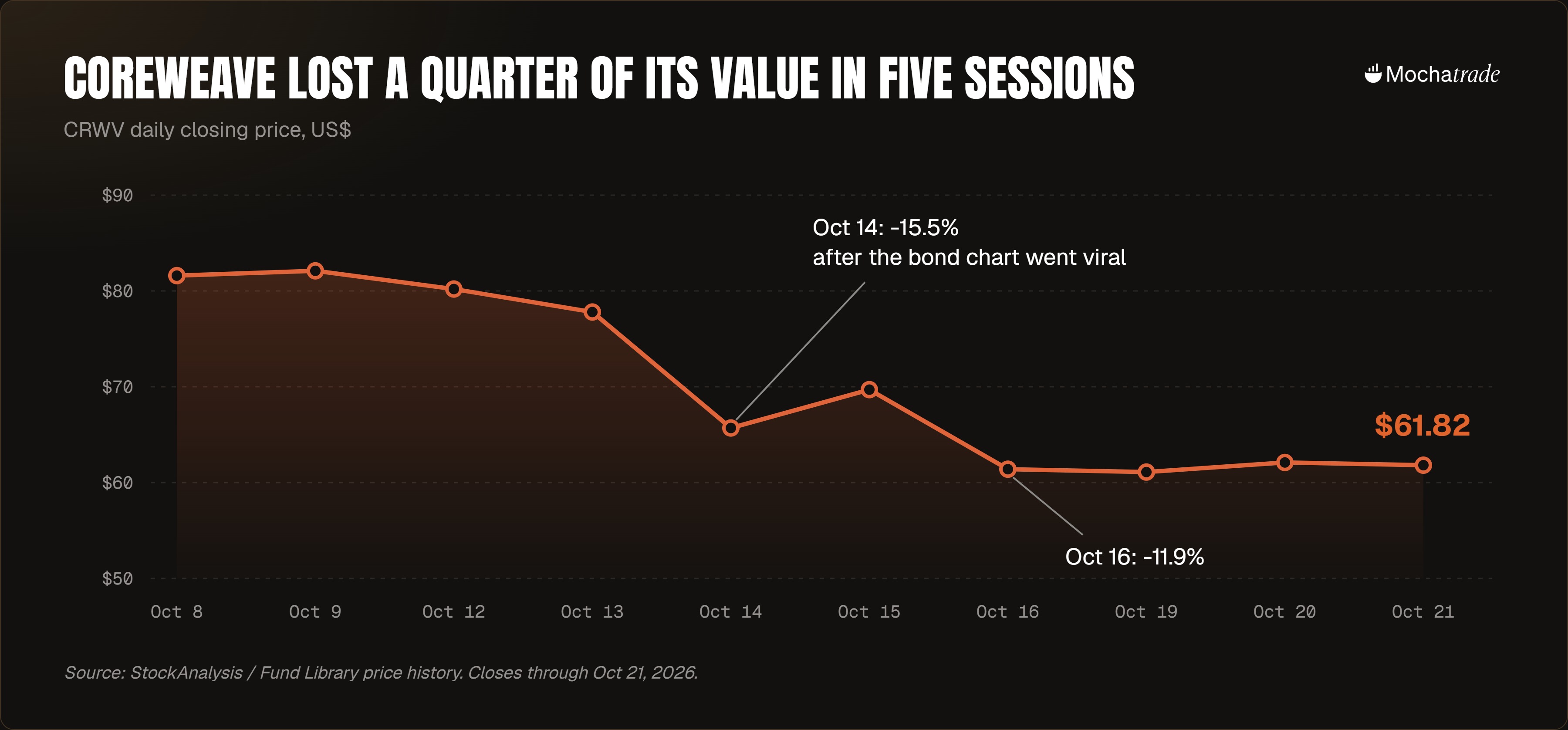
CoreWeave (CRWV) daily close, October 8 to 21, 2026. Source: StockAnalysis, Fund Library.
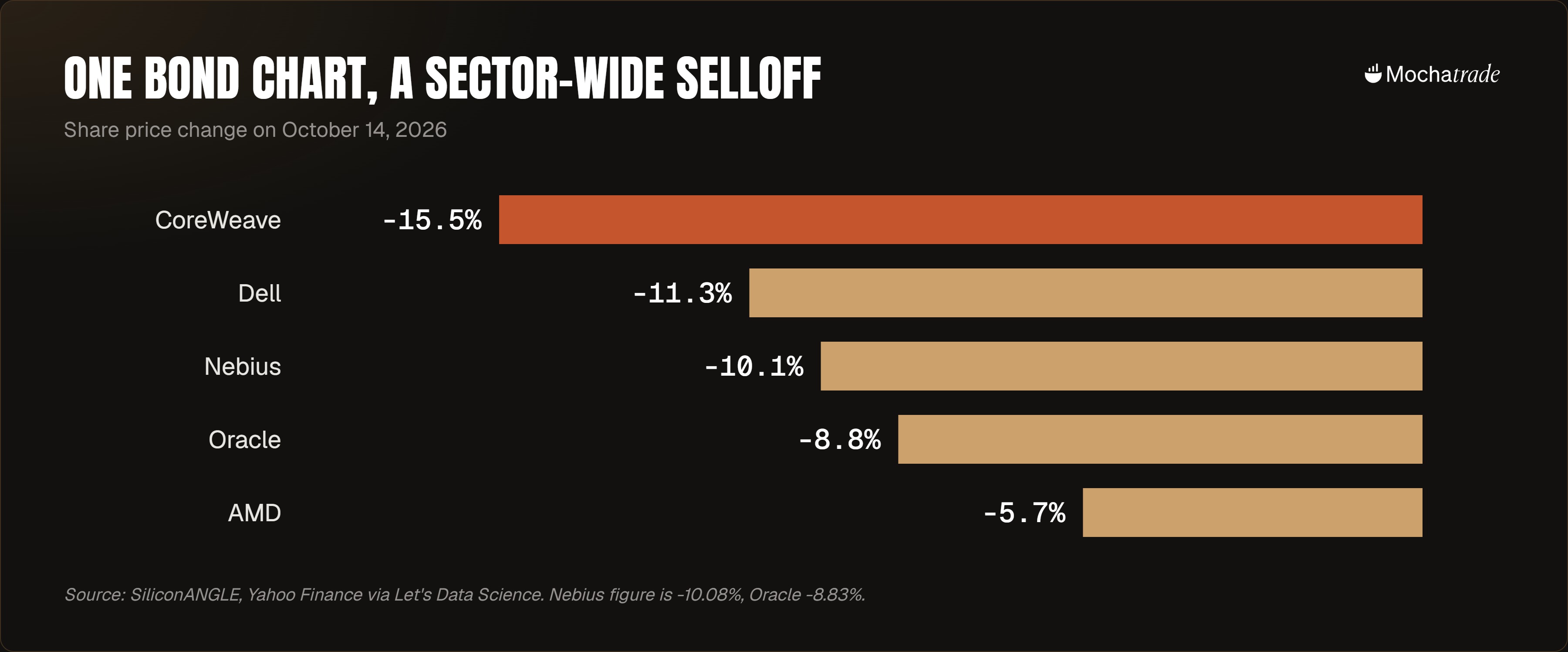
Share price change on October 14, 2026. Source: SiliconANGLE, Yahoo Finance via Let's Data Science.
Pressure came from two directions. The Fed raised rates by 0.25 percentage points on September 16, its first hike since July 2023, and the 10-year Treasury yield, the benchmark for long-term borrowing, is near 5%. On October 14, research firm Gartner warned that more than 80% of neoclouds will stop operating independently by 2030 if spending keeps its pace.
Can CoreWeave Pay Its Debt?
CEO Mike Intrator said the backlog "more than supports all of our debt obligations." The catch is timing: interest is due now, while backlog becomes cash only as data centers come online. Nvidia sided with the company, and Jensen Huang said on October 15 that its cost of capital is "actually decreasing."
Analysts are split. A price target is an analyst’s 12-month estimate of a stock’s price.
Here is where four of them stand, against a price near $62:
HSBC: $39, and it kept its Reduce rating.
Goldman Sachs: $139, after upgrading to Buy on October 19.
Cantor: $176.
Evercore: $200.
That spread runs from a fall of more than a third to a more than threefold gain.
Is CoreWeave A Warning Sign For The AI Boom?
The chain runs like this: AI needs chips, chips need cash, CoreWeave borrowed the cash, and lenders now charge more for it. Demand looks solid, since revenue doubled and the backlog keeps growing. The financing is where we would look for trouble, because capex runs near three times revenue and interest is growing faster than sales.
A 15% yield does not prove CoreWeave cannot pay its debts. It does tell us lenders want compensation for that possibility. Watch its next financing. If it prices near the 9.625% coupon, the defenders have a point. If it prices near 15%, the bonds were right.
Educational content only. Not investment advice.
MochaLearn is a free A to Z course on understanding and trading US stocks and commodities, built for Indian traders.
Terms in this story
- RevenueRevenue is the total money a company takes in from sales before any costs, the top line. Growth companies are judged…
- Market capitalizationMarket capitalization is share price times shares outstanding, the market's price for the whole company. Index weights…
- 10-year Treasury yieldThe ten-year Treasury yield is the benchmark long rate that mortgages, company debt and stock valuations are priced…
- Treasury yieldA Treasury yield is the annual return on a US government bond at today's market price; when the price falls, the yield…