October 12, 2026 · Mochatrade · 7 min read
Mocha Markets Weekly
12 OCT 2026
01 The US week behind. The first big consumer company of the season cut its year and got paid for its quarter, the AI trade moved from the chip to the plug, and a beat came with a silence in it.
02 The US week ahead. America's biggest banks report into the highest long-term rates since March, the two oil forecasters publish into a strait carrying seven ships a day, and the futures regulator starts writing rules in public.
03 One concept. Why you can be right about the stock and still lose money on the option, and the one sum to do before your next results trade.
04 One chart. The S&P 500 at a record, and hedge funds betting against it harder than at any point in a month.
01 The US week behind
PepsiCo changed "affirms" to "updates", the update was a cut, and the stock rose 3.7%
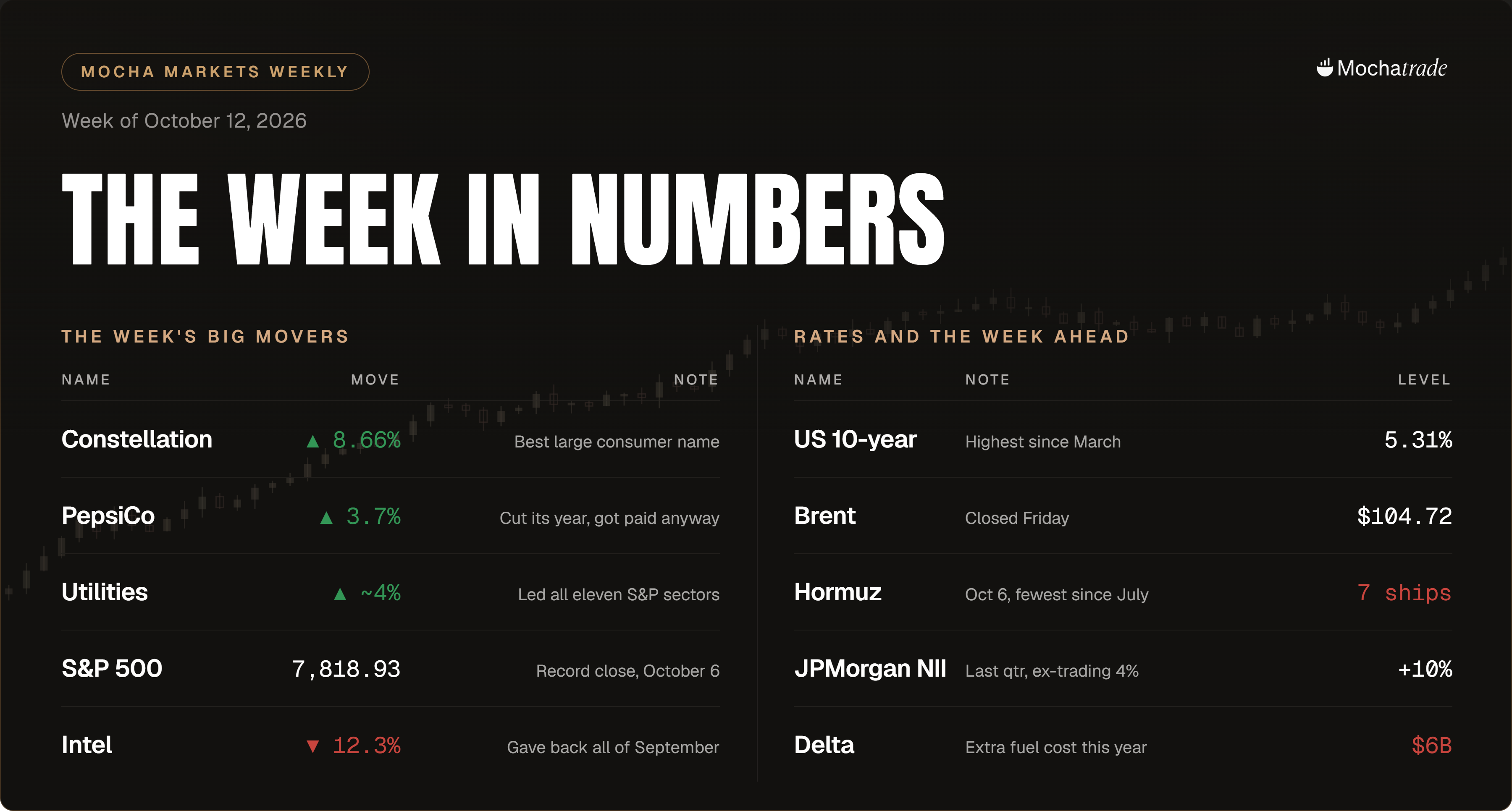
PepsiCo ($PEP) beat on Thursday October 8, $2.34 a share against $2.30, but cut its profit growth forecast for the year to 2.5% to 3.5%, from at least 5%. Four points of the quarter's 3% profit growth were tariff refunds, so without them the quarter went backwards.
If this doesn’t make sense, here is a lecture on US earnings that we launched.
https://youtu.be/9_Y6n4Wl188?si=fjc4atcCLMs5XFzv
The S&P 500 hit a record on the power companies, and Intel fell 12.3%
Utilities led all eleven S&P sectors, up almost 4%, and technology came last, yet the index closed at a record on Tuesday October 6. Intel gave back its whole September rally, falling on three days of other companies' news. The AI trade moved from the chip to the plug.
Constellation Brands rose 8.7% on a ban on Canadian alcohol, and its results never said "Canada"
A US ban on most Canadian alcohol took effect on September 29. Constellation ($STZ), the Corona and Modelo brewer, beat on Tuesday October 6 and rose 8.66% for the week, the best of any large consumer name. Its results release does not contain the word "Canada".
02 The US week ahead
Tuesday, October 13, 4:30 PM IST. JPMorgan and three more big US banks report.
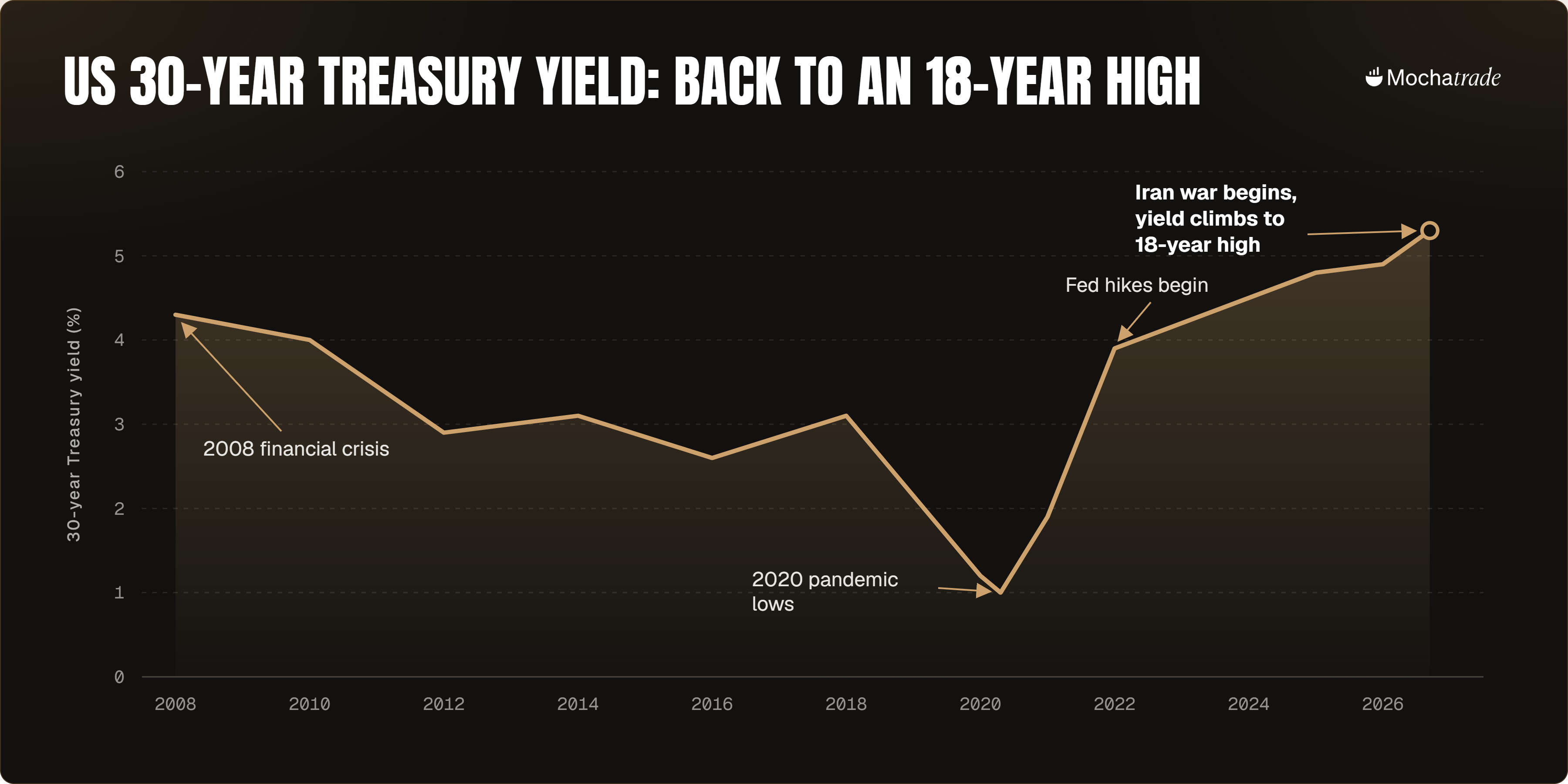
Context. JPMorgan is the largest bank in America. A bank earns the gap between what it pays depositors and what it charges borrowers (net interest income or the NII). When long-term rates rise, lending pays more, but the bonds the bank already holds lose value. The US 10-year rate closed at 5.31% on October 5 (its highest since March) so both effects land in the same quarter.
What's happening. JPMorgan is scheduled for about 4:30 PM IST, with its call at 6:00 PM IST. Goldman Sachs, Citi and Wells Fargo report the same morning. Last quarter JPMorgan's NII grew 10%, but take out its trading desk and the lending business alone grew 4%.
What to look out for. JPMorgan's NII forecast for the next quarter, and the figure without trading. That gap tells you whether the profit is coming from lending or from a good quarter on the trading desk.
Why this matters. "Higher rates hurt" and "higher rates help" have been argued about banks since the Fed hiked in September and Tuesday will be the first time they meet real numbers. Here is an all inclusive and end-to-end lecture on the Fed or the Federal Reserve: https://youtu.be/TynMuXa-p3Y?si=f7g1P2D4XS93Odbo
Tuesday, October 13 and Wednesday, October 14, 1:30 PM IST. OPEC and the IEA publish their oil numbers.
Context. OPEC is the club of oil producing countries. The IEA is the energy watchdog for oil buying countries, based in Paris. Each publishes a monthly report on how much oil the world will use and produce.
What's happening. OPEC reports Tuesday, the IEA Wednesday at 1:30 PM IST. On October 6 just seven ships crossed Hormuz, the fewest since July, per Kpler (a tanker tracker). The US government's own forecaster has already raised its Brent call to $105. Brent closed Friday at $104.72.
What to look out for. The IEA's forecast for how much oil the world uses this quarter. If the IEA cuts demand in the same week the EIA raised its price, the two forecasters are describing two different wars.
Why this matters. Delta said last week that fuel cost it an extra $6 billion this year. Oil feeds the US inflation number on Wednesday, inflation feeds the Fed, and the Fed meets on October 28. Tuesday and Wednesday set the oil numbers the whole market trades on until November.
Tuesday, October 13. America's futures regulator publishes its first notice on a new set of rules.
Context. The CFTC regulates every futures contract in America. In September a US exchange asked it to list perpetual futures (check this reel out:https://www.instagram.com/reel/DdZGPnfzdbG/?utm_source=ig_web_copy_link&obrf=MzRlODBiNWFlZA==&srtk=MzRlODBiNWFlZA== on single US stocks, and the request is still pending. An advance notice is a regulator's first formal step, India's version being a SEBI consultation paper.
What's happening. The CFTC's notice on digital asset markets comes out Tuesday, with public comments due December 14.
What to look out for. Whether it mentions perpetual futures or single stock contracts. If it does, those pending filings have a rulebook coming. If not, they stay stuck.
Why this matters. This is the agency that decides whether perps on US stocks get listed in America, and from Tuesday it is writing its thinking down in public.
03 One concept
Right about the stock, wrong about the option
Most people who buy a call (a bet the stock rises) before results think they are betting on direction: if the stock goes up, the call goes up. On a normal day that is mostly true. The morning after results, it often is not.
An option's price (what you pay upfront) has two parts. One is what it would be worth if it expired right now. The other is a charge for not knowing what happens before it does expire. Before results nobody knows the number, so that charge is at its highest. Once the number is out, the charge goes, and the price drops with it. Traders call this IV crush (the uncertainty charge collapsing).
Say a stock is at ₹4,000 before results and the ₹4,000 call costs ₹150. The stock opens 3% higher at ₹4,120, and the call is now worth about ₹130: ₹120 from the move, plus a little time left on it. You got the direction right and lost ₹20, because you paid for a bigger move than you got.
So before you buy, check the size of the move you are paying for. Add the call and the put (a bet the stock falls) at the same strike (the agreed price, ₹4,000 here), ₹150 each, and divide by the stock price. ₹300 on ₹4,000 is 7.5%, and that is the move the market already expects. If you expect less than that, buy the stock, not the option. NSE's option chain (its free price list) shows both prices.
04 One chart
S&P 500 futures ($ES)
The S&P 500 closed at a record on Tuesday October 6. That same day, hedge funds were betting against it harder than at any point in a month, and they had spent the week before adding to it.
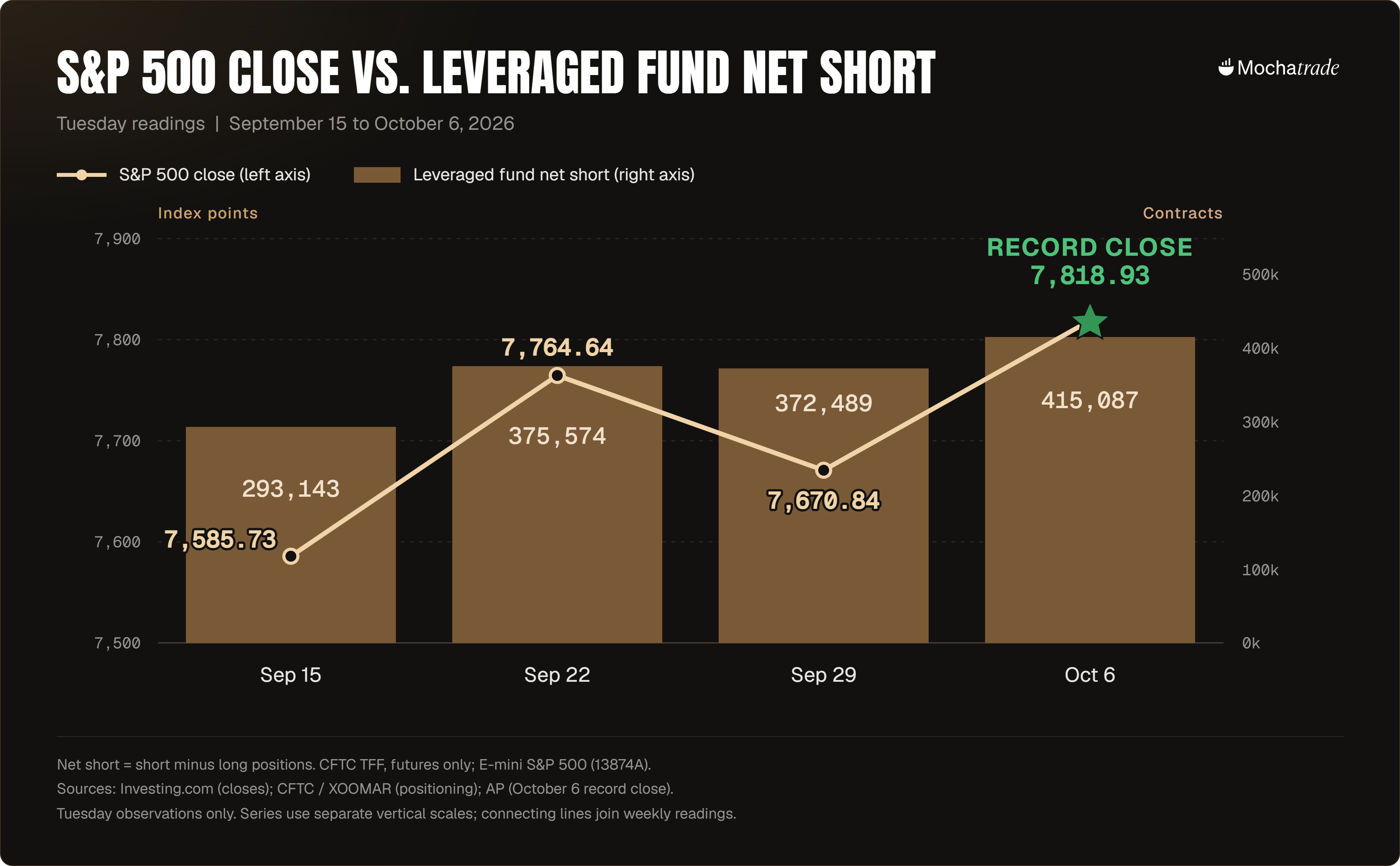
Two issues ago we showed these same funds betting against the Nasdaq. Since then that bet has shrunk, which looks like the bears giving up. They did not. They moved the bet from the tech index to the whole market, and made it bigger.
The market rose anyway, on power and food companies rather than tech, and this time most stocks rose together. That is the worst kind of week to be betting against the whole index.
Every bet against a future has to be bought back one day. So the bigger it grows while prices rise, the more forced buying is waiting above the price. The CFTC (America's futures regulator) publishes the next file on Friday, free on its site, and it will show whether that buying has started.
The file that shows who is betting against American stocks lands at 1:00 AM on Saturday, Indian time, while you sleep. Trade those hours, in rupees, at Mochatrade. Join the waitlist.