October 19, 2026 · Mochatrade · 9 min read
Mocha Markets Weekly
19TH OCT , 2026
This week is mostly three things: earnings results, since Netflix and Meta report and the banks just did, inflation, since oil is running into the US number, and the Fed, which meets the week after. Here we explain each word as it comes up, in brackets, and that is all. On MochaLearn each of the three gets a full lecture, built for Indian traders, from the first definition to the last thing you need before you trade it: US earnings, US inflation and how the Fed moves markets. And if you have never traded a US stock at all, Start here.
01 The US week behind. Oil closed near $110 in the week the IEA said the world will use less of it, and JPMorgan missed its numbers and still beat every other big bank.
02 The US week ahead. Netflix reports against a bar set above its own forecast, Meta's options are priced for a smaller move than Meta usually makes, and Japan's inflation lands on hedge funds that just bet against the yen.
03 One concept. Why oil went up on the news that the world wants less of it, and how to tell a supply shock from a demand collapse before the forecasters do.
04 One chart. Two this week. On the same morning, one bank missed and one bank beat, and by Friday the market had rewarded the wrong one.
01 The US week behind
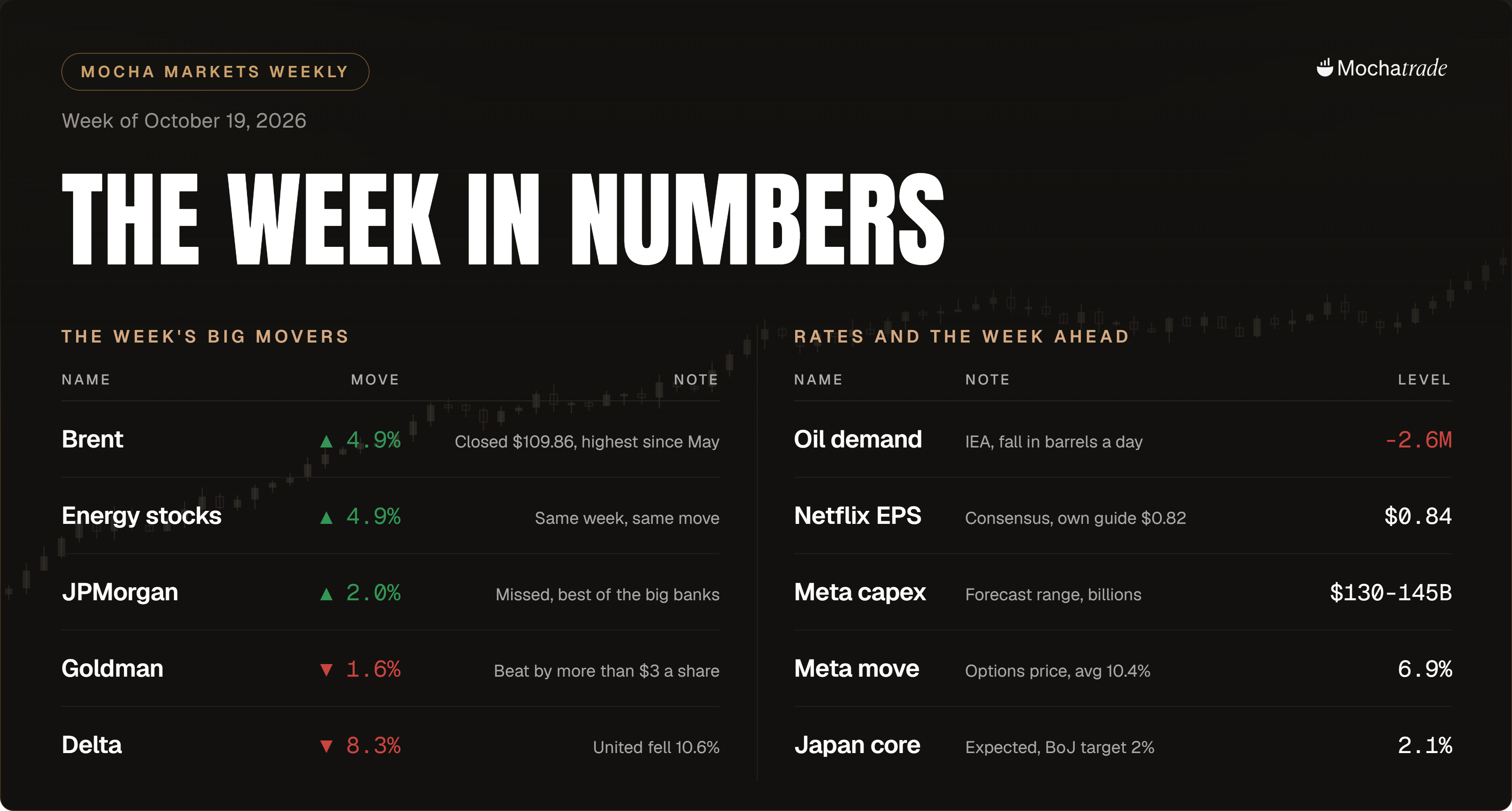
Brent closed at $109.86, its highest since May, in the week the IEA said the world will use less oil
Brent (the world's benchmark oil price) rose 4.9% on the week and 3.7% on Friday alone, after a ship was sunk near Hormuz and Saudi and Russian facilities were hit. The same week the IEA (the energy agency for oil-importing countries) said world demand will fall 2.6 million barrels a day this year and the two go together. When oil cannot get through, the price rises until buyers give up, and the buyers giving up is the demand fall. Energy stocks rose 4.9%. Delta fell 8.3% and United 10.6%.
JPMorgan missed on profit and revenue, and finished the week up 2.0%, the best of the big banks
On Tuesday, October 13, JPMorgan reported $5.57 a share against about $5.90 expected, a miss on both lines. The stock rose anyway, because what it earns on loans minus what it pays depositors (net interest income, the line Bank Nifty traders read first in an SBI result) grew 6% and the bank raised its full-year forecast for it. Goldman beat by more than three dollars a share and fell 1.6%. The market here actually paid for lending and marked down trading.
02 The US week ahead
Tuesday, October 20, 1:31 AM IST Wednesday. Netflix ($NFLX) reports.
Context. Every quarter a company tells the market what it expects to earn next (its guidance), and analysts publish their own number (consensus). Usually the two sit close. This time consensus is above what Netflix promised, about $0.84 a share against the company's own $0.82. So Netflix can hit its own target and still be reported as a miss.
What's happening. Netflix has fallen after four of its last five reports and is down about 25% this year. Yet last week, while the Nasdaq 100 fell 5.5%, Netflix rose 0.3%. It buys no chips and builds no data centres, so it was where money hid.
What to look out for. Not the quarter. The full-year revenue range, $51.0 billion to $51.4 billion (about ₹4.9 lakh crore, a tenth of what the Union Budget spends in a year). Netflix's growth has slowed every quarter for a year. If the range is kept or raised, the slowdown has stopped. If it is trimmed, it has not.
Why this matters. If the year holds, the one big tech stock with no AI bill stays a refuge. If it is cut, the Nasdaq has nowhere left to hide. The letter goes up on ir.netflix.net at 1:31 AM IST.
Wednesday, October 21, after the US close, call at 2:00 AM IST Thursday. Meta ($META) reports.
Context. Meta (Facebook, Instagram, WhatsApp) is one of the five companies spending the most on AI data centres. Last quarter its business brought in $31.9 billion of cash and it spent $31.1 billion of that on buildings and chips (capex). What was left, free cash flow, was $784 million, against $8.5 billion a year earlier. This year's capex forecast is $130 billion to $145 billion, about ₹13 lakh crore at the midpoint, a quarter of what the Union Budget spends in a year.
What's happening. Meta fell 8.6% after its April report and 8.0% after July's. Do the sum from last week's concept, call plus put divided by the stock price, and options now price a move of about 6.9%, against a 10.4% average over past reports. The market is paying for a calmer night than Meta has given it all year.
What to look out for. Everyone will quote EPS against a consensus somewhere between $6.50 and $7.02. Watch the capex range instead, whether it moves above $145 billion or comes down, and whether free cash flow comes in above $784 million.
Why this matters. Meta's capex is someone else's revenue: chips, memory, power. Those suppliers fell hardest last week, semiconductors down 10.5%. A higher range supports them and squeezes Meta's own cash. A lower range does the opposite. Either way, Meta's guide sets the tone for the AI trade into the Fed meeting the week after. The call is on investor.atmeta.com.
Friday, October 23, 5:00 AM IST. Japan's September inflation.
Context. For years Japan's interest rate was near zero, so funds borrowed yen for almost nothing and bought things that paid more, US stocks included. That is the carry trade. Same idea as margin trade funding: when the interest on borrowed money rises, the positions bought with it get trimmed. The Bank of Japan (Japan's RBI) raised its rate to 1.25% in September and meets again on October 29 and 30.
What's happening. Japan's core inflation (fresh food removed, energy kept in) is expected at 2.1%, the first reading above the BoJ's 2% target since December. Tokyo, which reports weeks before the whole country, already surprised at 3.0% against 2.4% expected. And the CFTC's file shows hedge funds have flipped from betting on the yen to betting against it, four weeks in a row.
What to look out for. Whether core prints above 2.1%, and where the yen sits an hour later, at 6:00 AM IST. The TV will quote headline inflation near 3%. That is a different measure, and the BoJ watches core.
Why this matters. A hot print makes an earlier BoJ hike more likely, yen borrowing dearer, and the yen stronger. A fund that borrowed yen to buy US tech now owes more yen, so it sells the US tech to pay the loan back. The market calls that a carry unwind, and it hits crowded large-cap tech first. A soft print changes little, since the market prices only about 10% odds of an October hike. A hot one lands on a fresh hedge-fund short.
03 One concept
Demand destruction: why the price goes up on the news that people are buying less
Think about onions in a bad monsoon year. The crop fails, onions go from ₹30 a kilo to ₹120, and within a month every household is buying half of what it used to, so imagine a newspaper running the headline "onion demand falls 50%" as if that were bad news for the onion price. It is not, because the fall in buying is the price doing its job. Nobody wanted fewer onions, they were simply priced out of them.
That is what happened to oil this week, since the IEA said the world will use 2.6 million barrels a day less this year while Brent closed at $109.86, its highest since May. Read together they look like a contradiction, but they are the same event seen from two ends. Ships cannot get through Hormuz, so there is less oil to go around, and the price rises until enough buyers give up, and those buyers giving up are the 2.6 million. The market calls this demand destruction, which is a dramatic name for people doing the sum and saying no.
The useful part is that it tells you which kind of fall you are looking at, because the two trade in opposite directions. When demand falls because of the price, the price stays high while the forecast drops, which is a supply shock and it stays expensive until the ships move again. But when demand falls because the economy is slowing, the price and the forecast fall together, and then the oil stocks that rose this week are the ones that get sold.
So the check is whether the price and the forecast are moving apart or together. This week they moved apart, and the day they start falling together is the day the war stops being the story. How the war got into the oil price in the first place is the subject of crude oil, war and slippery slopes.
04 One chart
JPMorgan ($JPM) and Goldman Sachs ($GS), October 9 to 16.
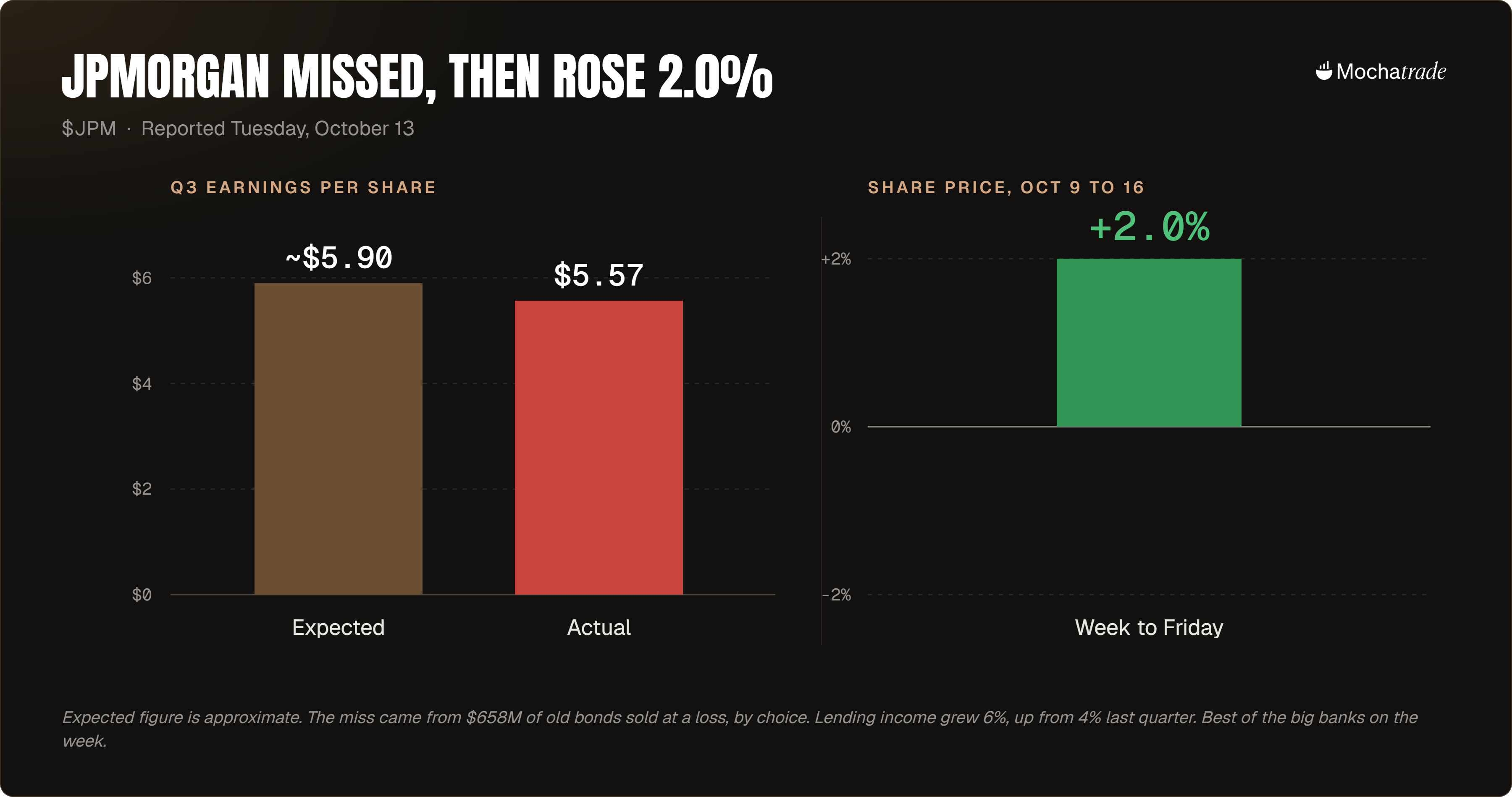
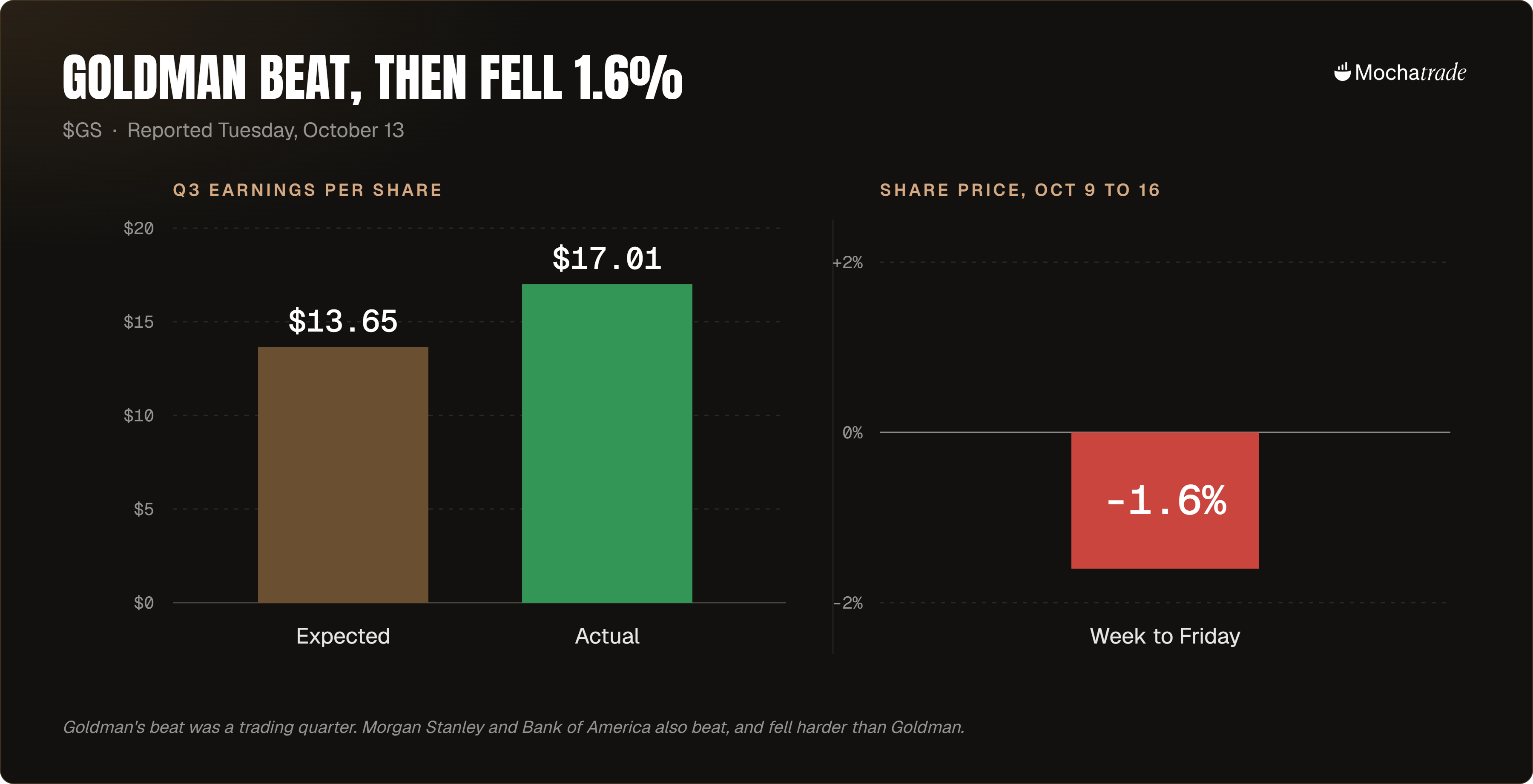
Instead of one chart like every week, this time we have two charts and one idea.
JPMorgan and Goldman Sachs reported in the same hour on Tuesday, October 13. JPMorgan missed, $5.57 a share against about $5.90 expected and Goldman beat by more than three dollars a share, $17.01 against $13.65.
By Friday JPMorgan was up 2.0% on the week, the best of the big banks. Goldman was down 1.6%. Morgan Stanley and Bank of America also beat, and fell harder than Goldman.
So the bank that missed was the only one that got bought. That only makes sense if the market was not reading the profit line.
It was reading where the profit came from. Goldman's beat was a trading quarter, and a trading quarter says nothing about the next one. JPMorgan's miss came from $658 million of old bonds it sold at a loss, by choice. Under that, its lending income (what it earns on loans minus what it pays depositors, with the trading desk taken out) grew 6%, up from 4% last quarter, and the bank raised its forecast for the year. One number was a cost paid once. The other is a line that pays every quarter.
JPMorgan's results landed at 4:30 PM IST, and the three days of buying that followed ran until 1:30 AM each night. Trade those hours, in rupees, at Mochatrade. Join the waitlist.
Terms in this story
- IEAThe IEA is the International Energy Agency, the Paris-based watchdog for oil-buying countries. Its monthly report…
- RevenueRevenue is the total money a company takes in from sales before any costs, the top line. Growth companies are judged…
- Net interest incomeNet interest income is what a bank earns on the gap between what it pays depositors and what it charges borrowers.…
- NASDAQNasdaq is the American exchange that began in 1971 as one screen showing every dealer quote side by side, the first…
- Nasdaq 100The Nasdaq 100 is an index of the hundred largest non-financial companies listed on Nasdaq, weighted by market value…
- Free cash flowFree cash flow is the cash a business brings in from operations minus what it spends on equipment and buildings.…
- EPSEPS is earnings per share: net profit divided by shares outstanding. On results day it is compared with the published…
- CFTCThe CFTC is the Commodity Futures Trading Commission, the US referee for futures, swaps and anything shaped like a…