September 21, 2026 · Mochatrade · 10 min read
Mocha Markets Weekly
The goal of Mocha Markets Weekly is to give you as much in-depth value as possible in the most unintimidating way possible, so you can use what you learn in your very next trade.
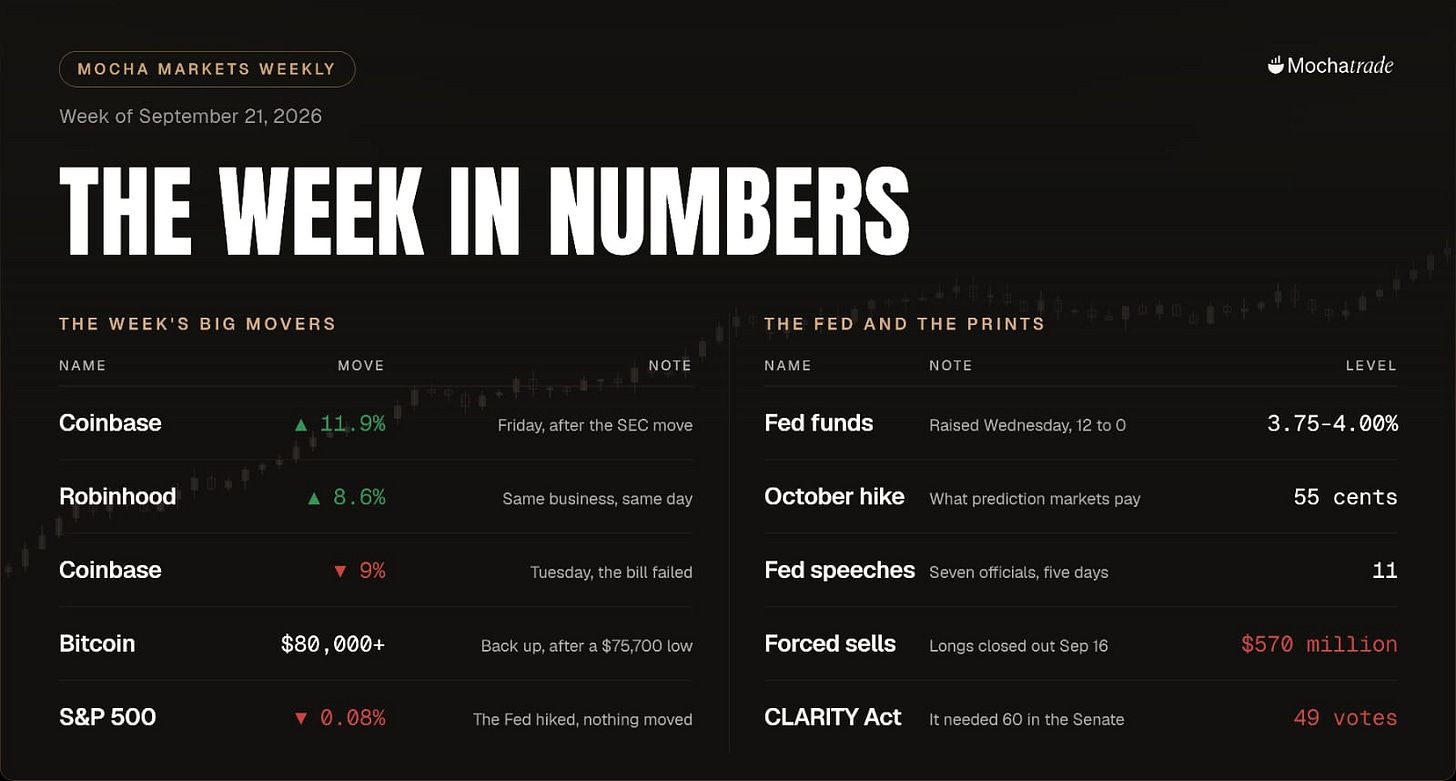
01 The US week behind. The Fed raised rates 12 to 0, and the S&P 500 finished the week 0.08% lower than it started.
02 The US week ahead. Eleven Fed speeches in five days, three companies join the S&P 500 on Monday, and Costco reports Thursday.
03 One concept. Liquidation cascades: why forced sellers create the next forced seller, and how traders on the other side use published stop levels as a magnet.
04 One chart. Coinbase fell 9% when the crypto bill failed, then closed the week up 11.9% — because the SEC, not Congress, holds the pen on the rules that matter
01 The US week behind
The Fed raised rates and the S&P 500 ended the week down 0.08%.
On Wednesday, September 16, the Fed (America’s RBI) raised its rate a quarter point to 3.75% to 4.00%. The vote was 12 to 0.
The market had done its work before the vote. The S&P 500 closed the week within a tenth of a percent of where it opened. The VIX, the index that tracks how much traders pay for insurance against a fall in the S&P (India VIX does the same job for Nifty), rose into Wednesday and was back below its Monday level within a day. Insurance was bought for the event and sold the moment it passed.
Positioning says the same. Every week the CFTC (the regulator for every futures contract traded in America) publishes who holds what. By September 15, one day before the decision, hedge funds had already closed four fifths of their bet against the Nasdaq. They had stopped doubting the hike, so they did not wait for it. That is what a fully priced event looks like: the news lands, and nothing happens.
A vote that failed by one cost about 570 million dollars, and Coinbase rose 11.9% two days later.
On Tuesday, September 15, the Senate needed 60 votes to move the CLARITY Act, the bill that decides which American regulator owns which crypto asset. It got 49. Reporting puts the block on ethics language about officials’ own crypto holdings, not on the market rules. Bitcoin fell to about 75,700 dollars on September 16, and roughly 570 million dollars of long positions were force-closed.
Then it reversed. On Friday, September 18, the SEC (America’s SEBI) granted an exemption for tokenized stocks. Bitcoin went back above 80,000 dollars, Coinbase closed up 11.9% and Robinhood up 8.6%.
02 The US week ahead
Monday, September 21, before the US open at 7:00 PM. Three companies join the S&P 500.
Context. The S&P 500 is America’s Nifty, with 500 names instead of 50. Index funds must hold exactly what the index holds, so when the index changes they buy the new names and sell the old ones on the date, with no choice in it.
What’s happening. S&P Dow Jones announced the change on September 4. Bloom Energy ($BE), Everpure and Illumina ($ILMN) enter before Monday’s open. Molson Coors ($TAP), The Trade Desk ($TTD) and Builders FirstSource ($BLDR) drop to the SmallCap 600. In the S&P 100, Dell ($DELL), Palo Alto Networks ($PANW), Arista ($ANET) and SanDisk ($SNDK) come in, and Nike ($NKE), Colgate ($CL), Simon Property ($SPG) and Honeywell Aerospace go out.
What to look out for. Whether volume in the three new names stays high after Monday’s close, or drops straight back to normal on Tuesday.
Why this matters. This is forced buying with a published date, so the move usually happens before the date and not on it. The open question is what the price does once the buyers who had no choice are done.
Monday, September 21 to Friday, September 25. Eleven Fed speeches in five days.
Context. The Fed’s rate is set by a committee of twelve voters. Between meetings they give public speeches, and traders listen the way Indian traders listen to the RBI governor’s press conference, except this happens several times a week. For the ten days before a meeting everyone at the Fed goes silent. That silence ended on September 16.
It matters more than usual this time. Normally the Fed tells the market roughly what it plans to do next (forward guidance). On Wednesday, Chair Kevin Warsh said he will not. So the only way to build a view on October is to listen to each official and add it up.
What’s happening. Eleven appearances by seven officials. Williams speaks three times, Barkin and Hammack twice each.
Day IST Speaker Mon Sep 21 4:00 PM Goolsbee Tue Sep 22 7:35 PM Williams Tue Sep 22 7:50 PM Jefferson Tue Sep 22 10:30 PM Barkin Wed Sep 23 7:35 PM Barr Thu Sep 24 1:40 PM Williams Thu Sep 24 5:30 PM Barkin Thu Sep 24 6:20 PM Hammack Thu Sep 24 7:40 PM Paulson Fri Sep 25 2:45 PM Williams Fri Sep 25 11:30 PM Hammack
The one to watch is Hammack. In July she voted for a rise and lost. On September 16 the whole committee agreed with her. Now she speaks twice in two days, and she is the most likely to say “one more.” Titles and topics are on the Fed’s own calendar at federalreserve.gov.
What to look out for. Whether any of the seven puts a number or a date on the next move. Prediction markets price an October rise at about 55 cents on the dollar (a bet that pays one dollar if the Fed hikes costs 55 cents today). That is a coin toss. Any speech that moves that price told you something.
Why this matters. Not all seven vote. Seven governors in Washington always vote, and of the twelve regional bank presidents only five vote in a given year (New York always, four in rotation). This week: Jefferson and Barr are governors, Williams runs New York, Hammack and Paulson hold rotating seats in 2026. Goolsbee and Barkin do not vote this year.
So Goolsbee on October is an opinion. Hammack on October is a vote. The quickest read on which speeches mattered is the two-year US government bond yield, roughly the market’s guess of the Fed’s rate averaged over two years. If a speech changes that guess, the yield moves within minutes. If it does not, the speaker said nothing new.
Thursday, September 24, after the US close at 1:30 AM Friday. Costco reports.
Context. Costco is a warehouse retailer, the closest thing America has to a giant DMart where you pay a yearly membership to buy in bulk. Most of its profit is those fees, not the goods. So its results answer a question that has nothing to do with Costco: are ordinary American households still spending?
What’s happening. Analysts expect 6.55 dollars of profit per share on 94.85 billion dollars of sales, about ₹9.09 lakh crore for thirteen weeks of shopping, a bit under a fifth of what India’s Union Budget spends in a full year. Three more consumer names report around it: AutoZone (car parts) Tuesday before the open, call at 7:30 PM; General Mills (cereal) and Cintas (workwear) Wednesday; Darden (Olive Garden restaurants) Thursday, call at 6:00 PM.
What to look out for. Whether any of the four says input costs are rising. US import prices rose 0.7% in August alone. Watch whether they passed it on to customers, or ate it.
Why this matters. On September 16 the US government said retail sales rose 1.2% in August, more than expected. That is a survey. This week the same question goes to four companies that count the cash at the till, and they answer for the first time since the rate rise. If they confirm the survey, the case for one more hike gets stronger and every speech above gets louder. If shoppers are pulling back, it weakens.
03 One concept
Liquidation: why the price goes looking for the stops
You have been squared off before (if you are unaware, read this: https://www.icicidirect.com/faqs/commodities/what-does-squaring-off-a-position-mean). You hold a Bank Nifty future, the market moves against you, the margin in your account falls below what the position needs, and Zerodha’s risk system closes it for you, at market, without asking. That is a liquidation. A perp changes only two things: who does it, and how far ahead everyone can see it coming (if you are unfamiliar with what a perp is, watch this:
)
On a perp, the venue’s engine knows the exact price at which your position runs out of margin, and it prints that price on your ticket the moment you open the trade. When the market reaches it, the engine sells your position into the order book at whatever price the book offers.
Now see what happens when many traders enter near the same level with similar leverage. Their liquidation prices sit within a few dollars of each other. The first one hits, the engine sells at market, that sale pushes the price into the next one, and so on. Each forced seller creates the next. That is a cascade, and it is what “570 million dollars force-closed” in section 01 means: a chain of sells nobody chose to make.
The part nobody explains: because those prices are known in advance, the cluster becomes a magnet. Traders on the other side know that once the first stop goes, the forced sellers do the pushing for them, so the price tends to drift toward the level where the selling will start. The observable is where the nearest cluster sits relative to the current price. Coinglass publishes a free heatmap for most perps. This is education and not advice.
04 One chart
$COIN, September 14 to September 18, 2026.
Coinbase had a strange week. On Tuesday the Senate voted down the bill that was meant to set the rules for its whole industry, and the stock dropped 9% that day. Fair enough. Then it spent the rest of the week climbing, and closed Friday up 11.9%, above where it stood before the vote.
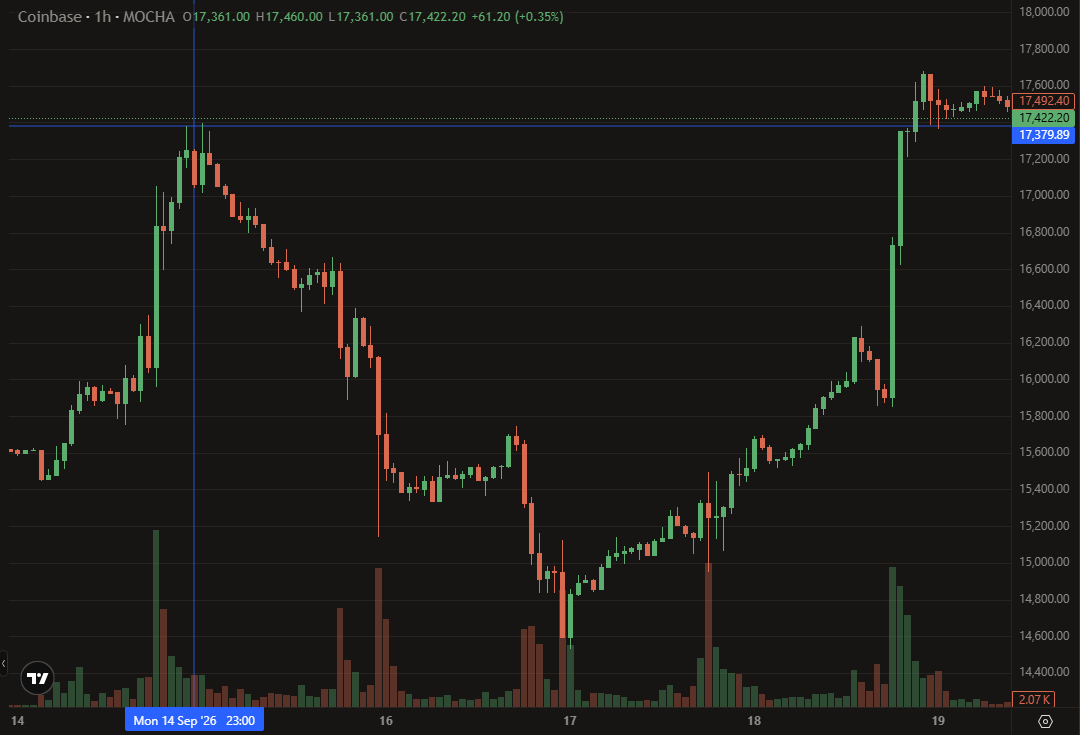
So the thing everyone feared happened, and the stock ended up higher. That only makes sense if the vote was never the thing that mattered.
Think about how this works in India. A bill can sit in Parliament for years. Meanwhile SEBI issues a circular on a Tuesday afternoon and every broker has changed its product by Monday. The rules you trade under come from the regulator far more often than from the legislature. The US is the same, and this week showed it.
On Friday the SEC (America’s SEBI) said tokenized stocks, a share you can hold and trade as a digital token, could trade legally. The same day Coinbase filed to list perpetual futures on more than 50 US stocks. Robinhood, which is in the same business, rose 8.6% alongside it.
See what happened. On Tuesday the market sold a headline about Congress. By Friday it had noticed that the regulator was writing the rules anyway, and that Coinbase’s next products were already in the filing queue. Tuesday priced the news. Friday priced who holds the pen.
That is why this chart is worth your time. When a bill fails and the stock rises, look for the regulator who moved that week. He is usually easy to find.
Those filings describe the instrument you already trade, with US stocks inside it, and the whole move happened after 7:00 PM your time. Trade those hours, in rupees, at Mochatrade. [Join the waitlist : https://mochatrade.com/waitlist?ref=GHCTJLE ]