October 5, 2026 · Mochatrade · 9 min read
Mocha Markets Weekly
05 OCT , 2026
The goal of Mocha Markets Weekly is to give you as much in-depth value as possible in the most unintimidating way possible, so you can use what you learn in your very next trade.
01 The US week behind. Micron's beat moved the stock for one day, oil took a shock from each side and went nowhere, and Accenture answered the AI fear with the biggest order book in its history.
02 The US week ahead. The Supreme Court decides whether to look at the venues this newsletter quotes, the Fed publishes its notes with October priced out and December still priced in, and PepsiCo opens results season.
03 One concept. How Indian traders end up losing with a 55% win rate due to Indian taxes and regulations.
04 One chart. The October rate rise contract fell from 67 cents to 19, and the biggest drop came in an hour when nothing happened.
01 The US week behind
Accenture rose 15.8% in a day on the fear that sank Twilio a week earlier, then gave back 6.3%
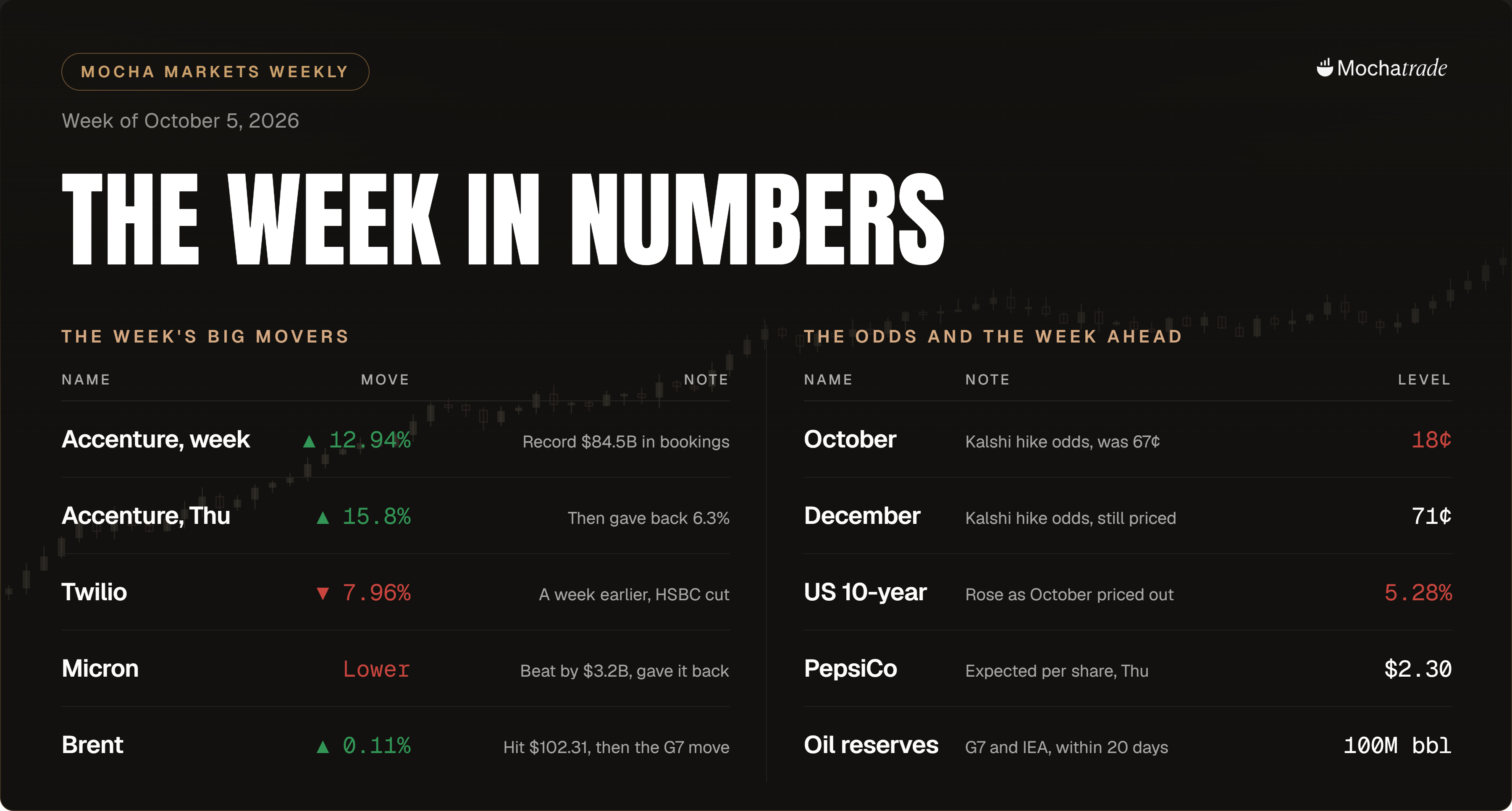
Accenture ($ACN) is the world's largest IT consultancy, the closest thing the US market has to TCS or Infosys. The AI trade had marked it as a victim: if AI does the work, nobody pays consultants to do it. A week earlier HSBC (one of the world's largest banking and financial services organizations ) cut Twilio on exactly that risk and it fell 7.96%. On Thursday October 1 Accenture reported record bookings of $84.5 billion for the year (work signed but not yet done) and 141 deals worth $100 million or more. The stock rose 15.8% that day, and ended the week up 12.94%. This is the first large company to report against the AI fear and win.
Micron beat by $3.2 billion and finished the week lower
Micron ($MU) makes the memory chips that sit beside every AI processor. On Wednesday September 30 it beat what analysts expected by $3.2 billion, and said next quarter would be bigger than even they had hoped. The stock rose 3% on Thursday, gave it all back on Friday, and ended the week lower.
Brent jumped 4.4% when China switched off its fuel exports, and ended the week up 0.1%
Brent is the world's oil price. On Thursday October 1 China suspended its exports of refined fuel (petrol, diesel, jet fuel), and Brent jumped $4.28 to $102.31. On Friday the G7 and the IEA agreed to release up to 100 million barrels from emergency stocks, diesel included, within 20 days, and the US dropped its proposed diesel export ban. Brent finished the week up 0.11%. So one government switched supply off and a group of governments switched it back on.
02 The US week ahead
Monday, October 5, 7:00 PM IST. The Supreme Court opens its term with a prediction market case on its desk.
Context. The US Supreme Court opens its term on the first Monday of October with an orders list: the cases it will hear, the ones it refuses, and the ones it holds for later. It usually takes a case when lower courts have ruled opposite ways on the same question. Prediction markets are legal or illegal state by state. Kalshi and Polymarket are the 2 largest prediction markets in the space as of now.
What's happening. The list comes out at 7:00 PM IST. Waiting on it is a request from New Jersey, asking the court to decide whether a state can regulate Kalshi. Two courts one level below the Supreme Court have already ruled opposite ways, the latest against Kalshi on September 26. Separately, New York has sued Polymarket for $4.6 billion. Neither case is heard this week.
What to look out for. Whether the list mentions the Kalshi petition: granted, denied, or held for later. If it says nothing, the next list is Monday October 12.
Why this matters. A grant means the Supreme Court decides for the whole country whether these markets are legal. Every week we quote them as a gauge of the Fed (so do all secondary sources) This is the week the gauge itself goes up for review.
Wednesday, October 7, 11:30 PM IST. The Fed's minutes, with October at 18 cents and December at 71.
Context. The Fed is America's RBI. Three weeks after each rate meeting it publishes the minutes, a written account of who argued what (the RBI does the same with its MPC minutes, two weeks after). A prediction market sells a contract that pays one dollar if something happens, so the price in cents is the market's probability.
What's happening. These are the notes from the September meeting, where the Fed raised rates and its chair, Kevin Warsh, refused to say what comes next. Since then the market has changed its mind about timing. A week ago the one dollar contract on a rate rise on October 28 cost about 67 cents, roughly a two in three chance. Today it costs under 20 cents. The December contract still costs about 70 cents. Fed governor Michael Barr said last week that "further policy adjustments are likely," which means more rises, without saying when.
What to look out for. Whether the notes show many officials wanting more than one further rise, and where the December odds sit ninety minutes after the release, at 1:00 AM IST Thursday.
Why this matters. If the minutes show most officials wanted one more rise and did not care when, the October drop was only a change of date, and December stays near 70 cents. If they show officials split on whether to raise at all, December falls too, and that is the one that moves the Nasdaq, because higher rates hurt tech stocks the most. Now, you would expect long-term rates to have fallen last week: if a rise in October is off the table, borrowing should get cheaper. They went up. The rate the US government pays to borrow for ten years rose to 5.28%. So something other than the Fed is pushing it, and we do not have a clean answer yet.
Thursday, October 8, 3:30 PM IST. PepsiCo ($PEP) opens results season with a $2.30 bar.
Context. Results season is the three weeks after a quarter ends, when most big American companies report. PepsiCo is usually the first household name, so it writes the season's opening sentence, the way HUL or Nestle India sets the tone at home. Most of its profit comes from brands, and when its costs rise it either passes them on in prices or eats them.
What's happening. Results at 6:00 AM New York (3:30 PM IST), call at 5:45 PM IST. Analysts expect $2.30 a share on $24.98 billion of revenue. In July PepsiCo reaffirmed its full-year guidance, General Mills and has since warned that its input costs are climbing.
What to look out for. Whether PepsiCo's full-year guidance changes from July's "reaffirms," and whether it says it is passing costs on or absorbing them.
Why this matters. Food and household brands are the safe corner of the market. If the safest company opens the season by cutting on costs, the margin worry spreads to everything else. It is also the first read on how fast profits grew from July to September: Zacks expects 23% for the S&P 500, other forecasts run to 30% or more. That gap is the difference between an expensive market and a fair one.
03 One concept
The trader who wins 55 out of 100 and still loses money
In stocks you pay tax on your net profit: wins minus losses, then the rate. Virtual digital assets, the category the Income-tax Act created in 2022, do not work that way. Gains on them are taxed at a flat 30% (plus cess), and a loss cannot be set off against anything.
Now run the numbers. You make 100 trades of equal size, winning or losing ₹10,000 each. You win 55 and lose 45. Before tax you are up ₹1,00,000, a good year. On the strict reading the tax is 30% of the ₹5,50,000 you won, which is ₹1,65,000. You are down ₹65,000. If netting were allowed, the tax would be ₹30,000 and you would keep ₹70,000. The whole profit sits in which reading applies. Work it backwards and this trader needs to win 59 of 100 just to stay flat, before fees, and before the 1% TDS withheld on every sale.
So the tax changes how you trade, not only what you keep. Fewer, larger trades with a high win rate beat many small ones, because each loser costs its full size and each winner keeps 70%.
04 One chart
Kalshi: "Fed raises rates 25bp in October"
On Kalshi you can buy a contract that pays one dollar if the Fed raises rates on October 28, and nothing if it does not. A week ago it cost about 67 cents, so the market thought a rise was likely. By Saturday morning IST, when last week's issue told you to check, it cost 19 cents. Every news report we read puts the fall on Friday's jobs report. The reasoning is standard: the Fed reads the jobs count as a health check on the economy, so the count should decide the price. Kalshi's hour by hour prices say otherwise.
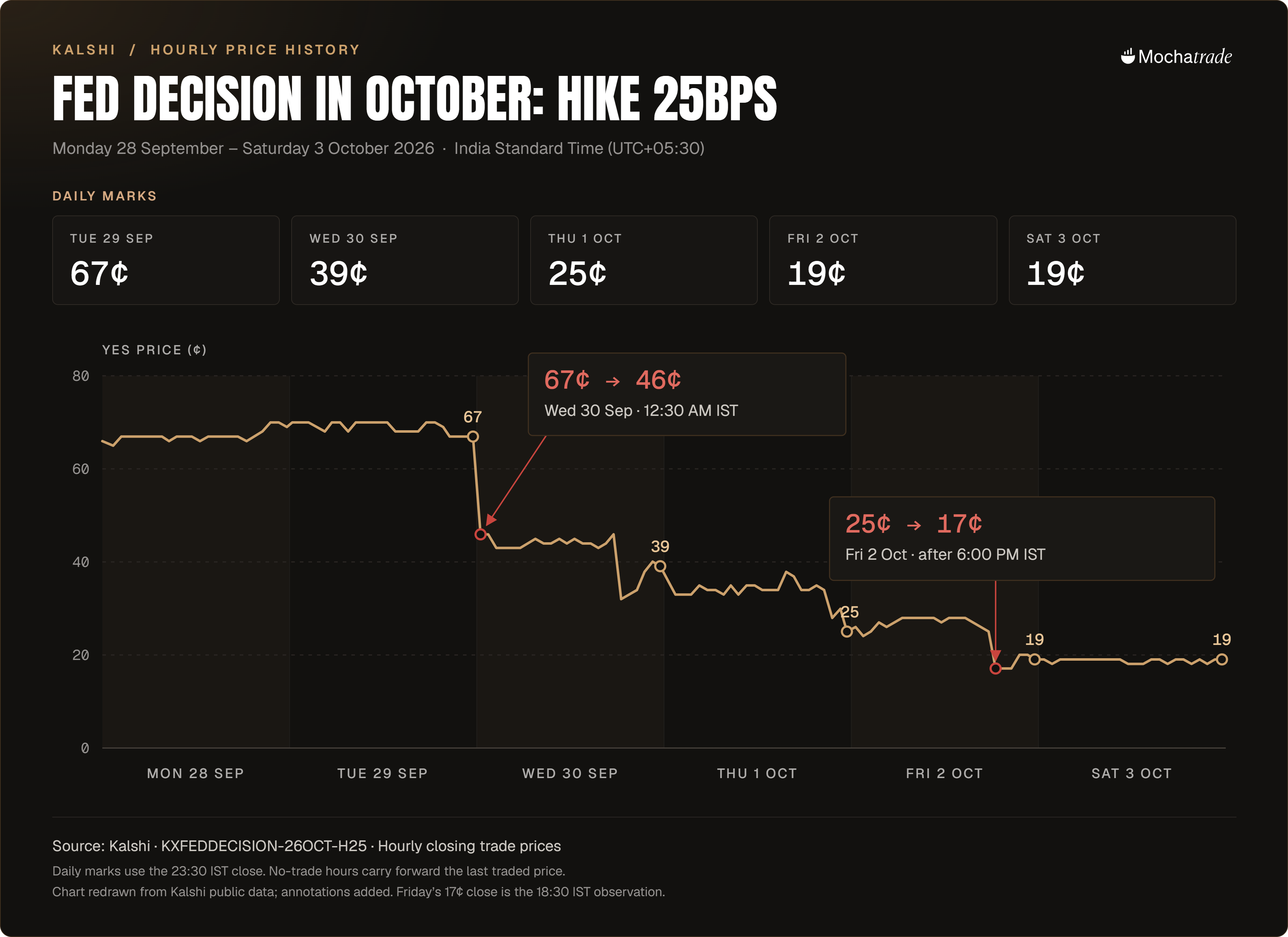
Kalshi, "Fed raises rates 25bp in October," Monday September 28 to Saturday October 3, 2026, IST. Source: Kalshi price history.
Now look at where the fall happened. The jobs report did move the price, from 25 cents to 17 in the hour after it came out at 6:00 PM IST on Friday. That is 8 cents. The biggest fall of the week was 21 cents, from 67 to 46, between 11:30 PM Tuesday and 12:30 AM Wednesday, IST. No data came out in that hour and no Fed official spoke, yet over three lakh contracts traded. We could not find a reason, and we are not going to make one up. So by the time the first real number of the week arrived, the market already saw October as a coin toss.
This is how a price can move before the news. The contract's price is the crowd's running guess at one yes or no question. Every trader who learns something or changes their mind moves that guess a little, whether it is a bank's new forecast or one large trader changing their view. So by the time the official number lands, most of the guessing is done, and the number only settles the last few cents. The hour that matters is often the one before the number, not the one after. Kalshi shows every contract's price history free on its website (and through an API for anyone who codes), so you can check this one yourself.
The biggest move of the week happened while India slept and the US trading day was ending. Trade those hours, in rupees, at Mochatrade. Join the waitlist.