September 28, 2026 · Mochatrade · 8 min read
Mocha Markets Weekly
28 Sep 2026
The market bought the chip the AI trade had written off, sold the company building the data centres, and hedge funds bet against the whole thing while it went up.
01 The US week behind. AMD crossed a trillion dollars on a story about ordinary processors, Oracle’s lenders got scared before its shareholders did, and the largest speculators in Nasdaq futures rebuilt a short they had just closed.
02 The US week ahead. Three days of silence from the Fed, then the one inflation number it votes on, then four governors in a single day, and on Friday the jobs report that settles an argument between the market and Morgan Stanley.
03 One concept. The gap between the price you buy at and the price you sell at is not random .It is the market maker's fear, updated live and it widens before the news arrives.
04 One chart. The Nasdaq 100 going up while the people who trade it professionally bet against it, about five times harder than the week before.
01 The US week behind
AMD rose 12.6% and crossed a trillion dollars, on a story about the chip everybody had written off
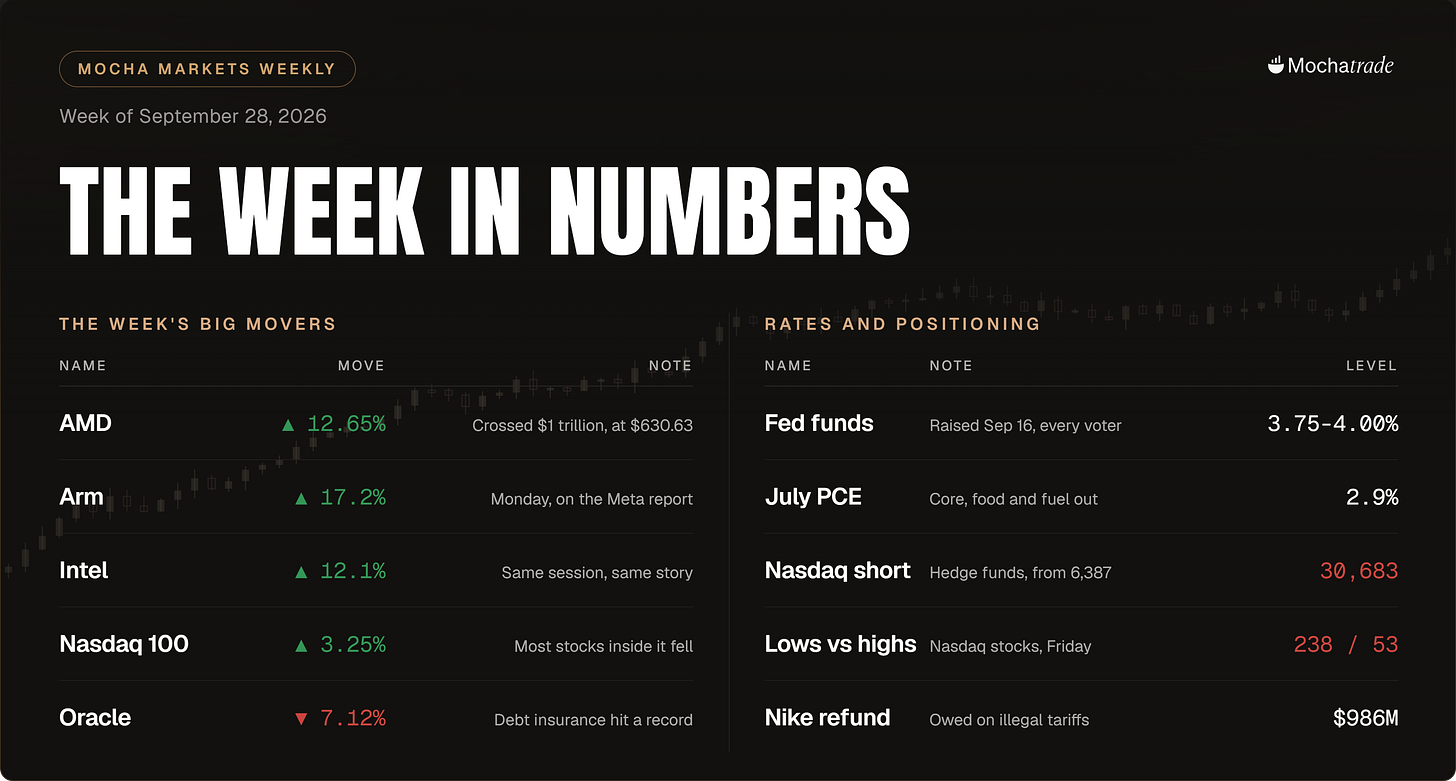
The AI trade assumes AI runs on GPUs, so Nvidia wins and the makers of ordinary processors are finished. On Monday September 21 reports said Meta’s new AI assistant runs largely on ordinary processors, and Intel rose 12.1% in the session, Arm 17.2%. AMD finished the week up 12.65% at $630.63, reported as the fourth American chipmaker worth a trillion dollars.
2.Hedge funds rebuilt a Nasdaq short they had just closed, in a week the Nasdaq rose 3.25%
Every Friday the American futures regulator publishes what the biggest speculators were holding on Tuesday. This week’s file showed hedge funds betting against the Nasdaq about five times harder than a week earlier, when they had almost closed the bet out. On Friday 238 Nasdaq stocks touched a one-year low against just 53 at a high, so a few giants are holding the index up and the funds are betting they cannot keep doing it.
Oracle’s stock fell 7.1% and the cost of insuring its debt hit a record
Oracle is building data centres faster than its own cash can pay for them, so its lenders (so its shareholders) decide whether the next one gets built. On Thursday September 24 it told the developer of its New Mexico site that it cannot go on, blaming delays in getting power, and the stock ended the week down 7.12%.
02 The US week ahead
Wednesday, September 30, 6:00 PM IST. August PCE, the inflation number the Fed votes on.
Context. The Fed is America’s RBI. It raised rates to 3.75% to 4.00% on September 16 with every voter in favour, and its chairperson (Kevin Warsh) does not signal the next move in advance. So every print gets read for clues and nobody from the Fed speaks from Monday to Wednesday.
What’s happening. America measures inflation twice. The number on the news is what a household pays for its shopping basket (CPI). The number the Fed uses is what the whole country spends, businesses and government included (PCE), and that is the one that lands on Wednesday. In July it was 3.7%, and 2.9% with food and fuel taken out.
What to look out for. Whether core comes in above 2.9%, and which of the two figures the wires lead with.
Why this matters. The day after this number comes out, four of the people who vote on Fed rates give speeches (Waller at 7:30 PM IST, Jefferson at 11:00 PM IST, two more on the Fed calendar). If Wednesday’s inflation is high, expect them to say a rate rise in October is likely. Higher rates hurt tech stocks the most, because their profits are years away and each year gets discounted harder. So Wednesday’s number, through Thursday’s speeches, is what moves the Nasdaq.
Thursday, October 1, 1:45 AM Friday IST. Nike ($NKE) reports, with a $986 million refund already flagged.
Context. Nike imports most of its shoes into America and paid import taxes on them. In February the US Supreme Court ruled those taxes illegal, so the government has to pay the money back. Nike is owed $986 million. That refund will show up in Thursday’s profit number, but it is a one-off cheque from the government. It tells you nothing about whether people are buying shoes.
What’s happening. Analysts expect $0.44 a share on $11.35 billion of revenue, about 3% below last year. Bank of America cut the stock to Underperform this month with a $30 target, and it left the S&P 100 on September 21.
What to look out for. How much of any beat is the refund. Subtract it before comparing with $0.44, then read the guidance for next quarter.
Why this matters. AutoZone ($AZO) beat by about two dollars a share on September 22, but its refund was worth $4.43 a share, so without the cheque it would have missed. Costco ($COST) beat by $0.23 on September 24, $0.15 of it refund, and the stock fell 0.9% the next day. The market is already doing the subtraction, so a beat made of refund money does not get paid. Results season starts around October 8, and Nike is the first big test of whether that keeps holding.
Friday, October 2, 6:00 PM IST. The jobs report, and the argument it settles.
Context. Once a month America counts how many jobs it added. It is the most watched number in US markets because the Fed reads it as a health check: a strong count means the economy can handle higher rates, a weak one means the Fed waits. Right now the market puts roughly two in three odds on a rate rise at the October 27 meeting. Morgan Stanley disagrees and thinks the Fed waits until December.
What’s happening. The forecasts for Friday are far apart. Bloomberg’s survey expects about 90,000 jobs added, Trading Economics about 50,000. Last month the count came in at 162,000 when 53,000 was expected, which is a large part of why the October odds have climbed.
What to look out for. Whether the number lands above or below the forecasts, and whether the odds of an October rise move after it.
Why this matters. A strong number makes an October rise close to certain, and higher rates hurt risk stocks the most, for the reason in the Fed item above. A weak number hands Morgan Stanley the argument and lets the Nasdaq breathe. Either way it is the last big print before the Fed meets.
03 One concept
The spread: the one price that tells you what the market maker is afraid of
Every time you buy a stock, someone has to sell it to you that same second. Most of the time that someone is a market maker, and most beginners assume he is betting against them. He is not. He fills your order, hedges it immediately, and earns the small gap between the buy price and the sell price, thousands of times a day. That gap is the spread, and it is the price of the risk he carries in the few seconds before his hedge is done.
When that risk goes up, the gap widens (to adjust for the risk that the MM takes). It happens in the first minute after 9:15 on Bank Nifty because nobody knows where the day is going yet. It happens when someone who knows something starts trading, because the market maker cannot tell which order is the informed one, so he widens for everyone.
That is the useful part. A spread widening with no news is itself news. Look at the order book, not the chart. The gap between the two best prices is the market maker’s fear, live and free.
04 One chart
$NDX
The Nasdaq 100 rose 3.25% in the week to September 22. Most of the stocks inside it fell. On Friday 238 Nasdaq stocks touched a one-year low and 53 touched a high, more than four losers for every winner, in an index at the top of its range. And the hedge funds who trade this contract for a living went from almost no short position to about five times the size in one week, from 6,387 contracts to 30,683.
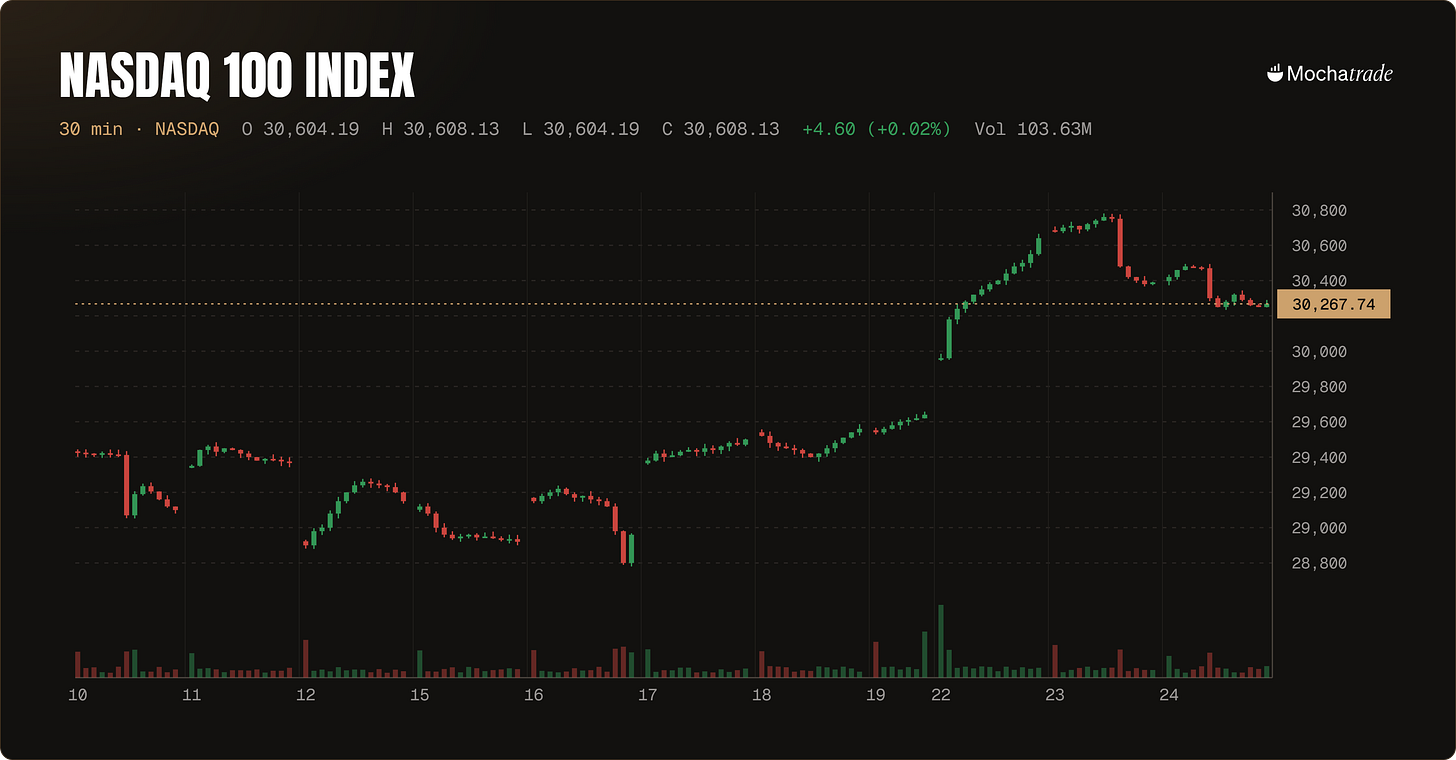
Here is how an index goes up while its members go down. The Nasdaq 100 weights companies by size, so a few giants count for more than the other ninety put together. If those few rise, the index rises, and the other ninety can fall for a month without showing up in the number. The equal-weight version of the S&P, which counts every company the same, is already more than 5% below its peak. That is the correction most American stocks are having, hidden inside an index that is not.
So two things are true at once. The index says the market is fine. The stocks inside it say it is not. The funds have picked the second, and they picked it fast: they closed the whole short into the Fed’s September 16 decision and put all of it back on within a week.
Only one of those two lines can hold. The next CFTC file lands Friday October 2, about 1:00 AM IST on Saturday.
These markets run while India sleeps and while India works. Trade those hours, in rupees, at Mochatrade. Join the waitlist.