November 22, 2026 · Mochatrade · 9 min read
Nvidia After Huang: Earnings, Probes, and Outlook
Nvidia reported a record $115.8 billion quarter, yet its stock fell as a CEO exit and federal probes took over the story.
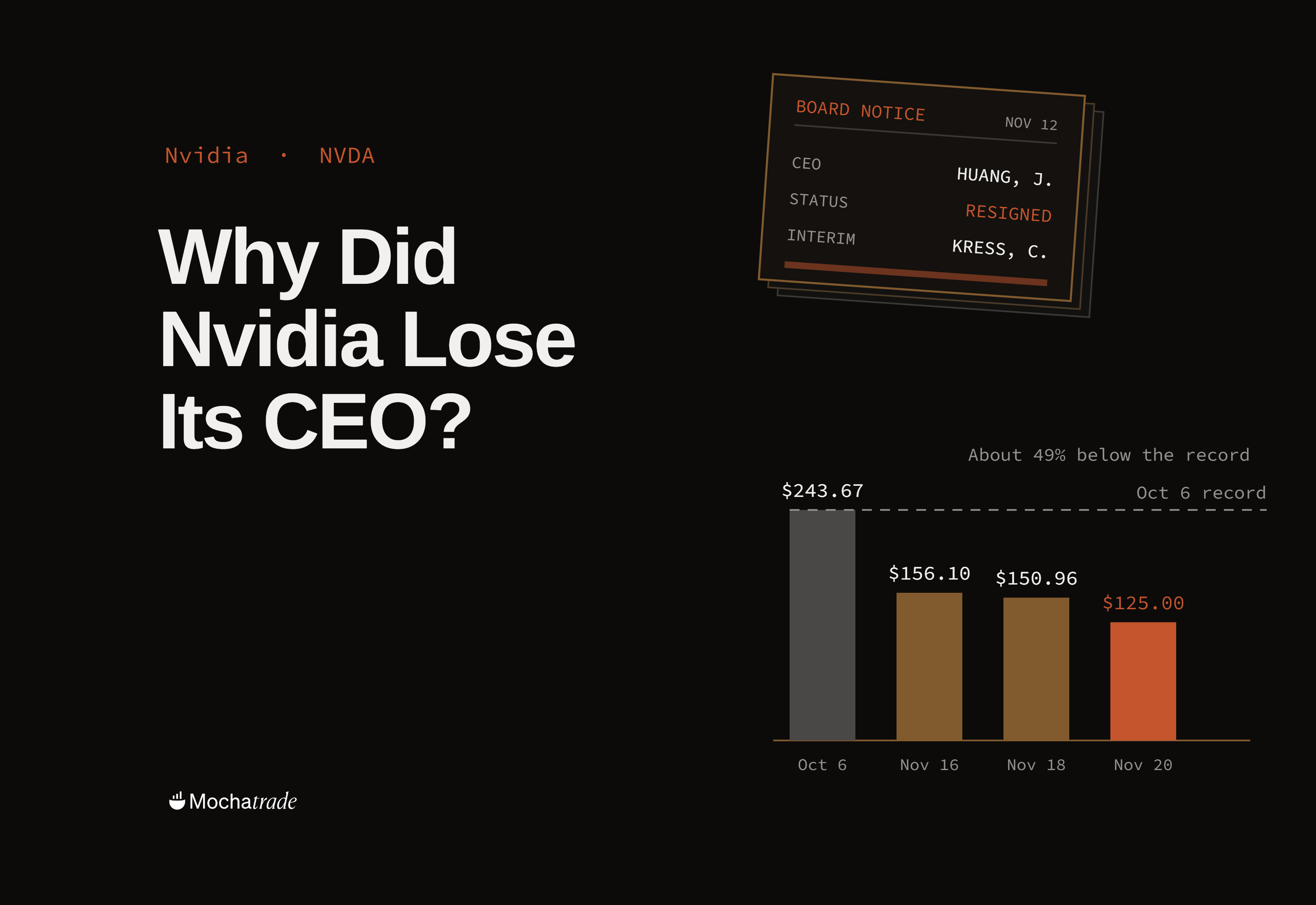
Nvidia reported record results on November 17, 2026, and its shares still closed lower the next day. The earnings numbers (a company's reported sales and profit for a quarter) were strong. A CEO exit and government investigations, called probes, outweighed them, and several paths could follow for Nvidia and AI spending.
What Happened To Nvidia In November 2026?
Nvidia designs the chips that train and run most AI models. In November, it faced a leadership and legal crisis while preparing an earnings report. CBS News, Reuters via Investing.com, and Reuters via Yahoo Finance give this sequence:
November 8: CEO Jensen Huang tells employees of an extramarital affair, and the board opens an independent investigation, one led by outside lawyers. Wachtell Lipton's Joon Kim is retained to lead it on November 10.
November 12: Huang resigns as CEO and director. CFO Colette Kress becomes interim CEO, a temporary leader until a permanent one is found, and Harvey Jones becomes board chair.
November 16: Shares fall 4.1% to $156.10, the lowest close since June 2025 (Kiplinger). A close is the final trading price of the day. That evening, the Commerce and Justice Departments jointly confirm a Megaspeed investigation.
November 17: The board forms a national security committee, the Wall Street Journal reports a civil investigation by the SEC (the Securities and Exchange Commission, the US markets regulator), Commerce announces new chip license rules, and Nvidia reports earnings after the close.
November 18: Shares close down 2.9% at $150.96 (Euronews).
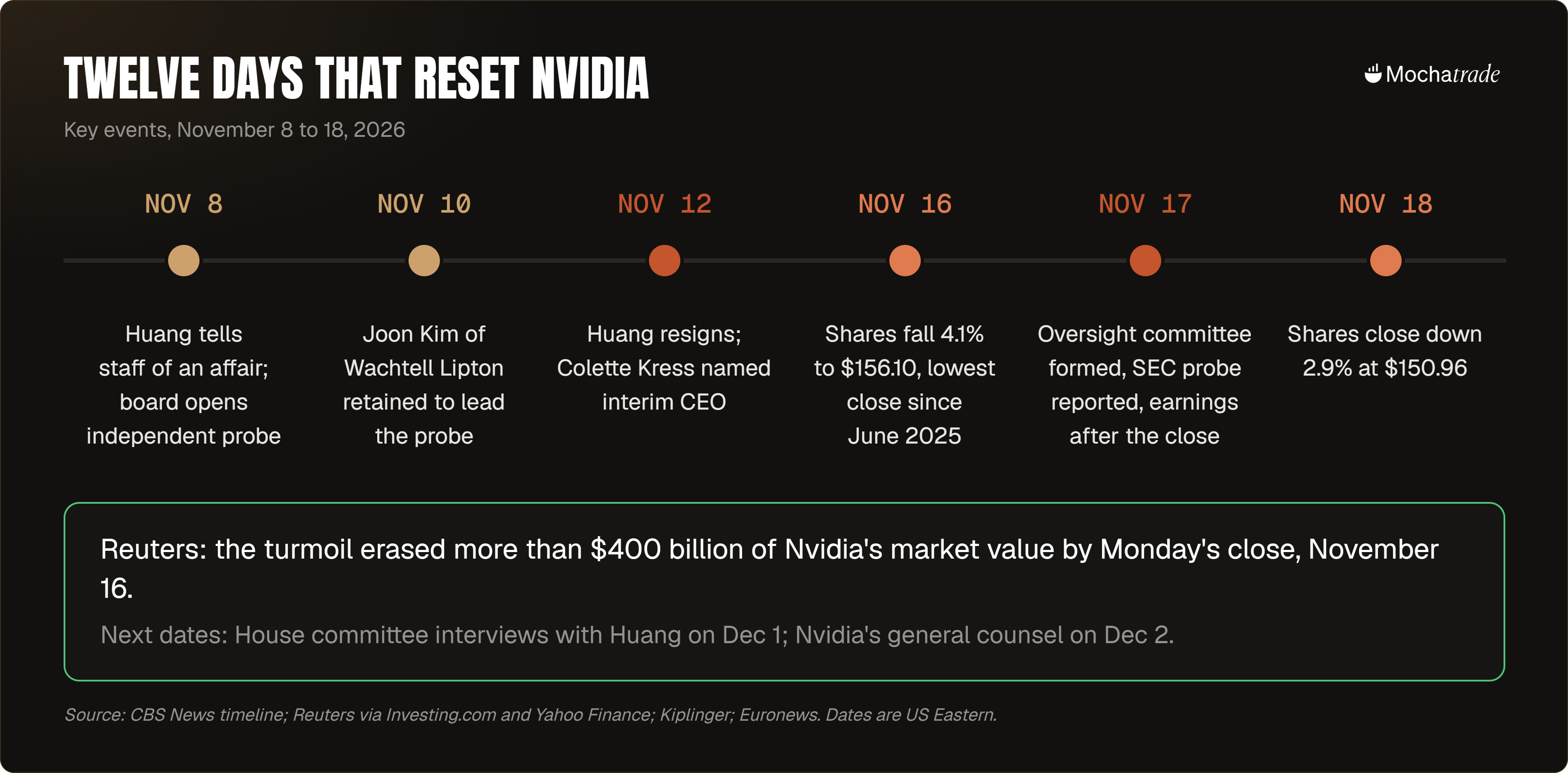
Nvidia timeline, November 8 to 18, 2026
The turmoil erased more than $400 billion (about ₹38 lakh crore) of Nvidia's market value, the total worth of all its shares, by Monday's close, before the earnings report, according to Reuters.
What Does Nvidia Sell, And Why Do Its Numbers Matter?
Nvidia's main product is the graphics processing unit, or GPU, a chip that performs many calculations at once and has become standard hardware for AI. The company reports two segments. Data Center sells AI chips, networking gear, and full server racks. Edge Computing covers PC graphics, workstations, cars, and robots (Jon Peddie Research).
Data Center brought in $107.6 billion of the quarter's $115.8 billion, about 93%. The buyers are hyperscalers, the giant cloud companies such as Amazon, Alphabet, Meta, Microsoft, and Oracle, and neoclouds, specialist companies that rent out chips by the hour. They are the same buyers whose spending strained markets during the November 5 sell-off, a sharp drop across the market, when the S&P 500 (an index of 500 large US companies) fell 4.36%. Nvidia sits at the start of that chain, so cuts in their plans reach it first. Its newest chip platform, Vera Rubin, began shipping in the quarter.
What Did The Earnings Report Show?
Year-over-year (YoY) compares a quarter with the same quarter a year earlier. Consensus is the average forecast of Wall Street analysts, and guidance is the company's own forecast for the next quarter. Nvidia's release and Kiplinger give these figures for the quarter ended October 25, 2026:
Revenue: $115.8 billion (about ₹11 lakh crore), up 103% YoY, against a consensus near $108.7 billion to $108.8 billion
Data Center revenue: $107.6 billion, up 110% YoY
Edge Computing revenue: $8.2 billion, up 42% YoY
Adjusted earnings per share (profit divided by share count, excluding some items that GAAP includes): $2.68 against a consensus of $2.47
Gross margin: 74.9% adjusted, above the 74.0% management had guided
GAAP profit: operating income of $77.5 billion, up 115% YoY, and net income of $65.3 billion, up 105%
Free cash flow: $43.8 billion
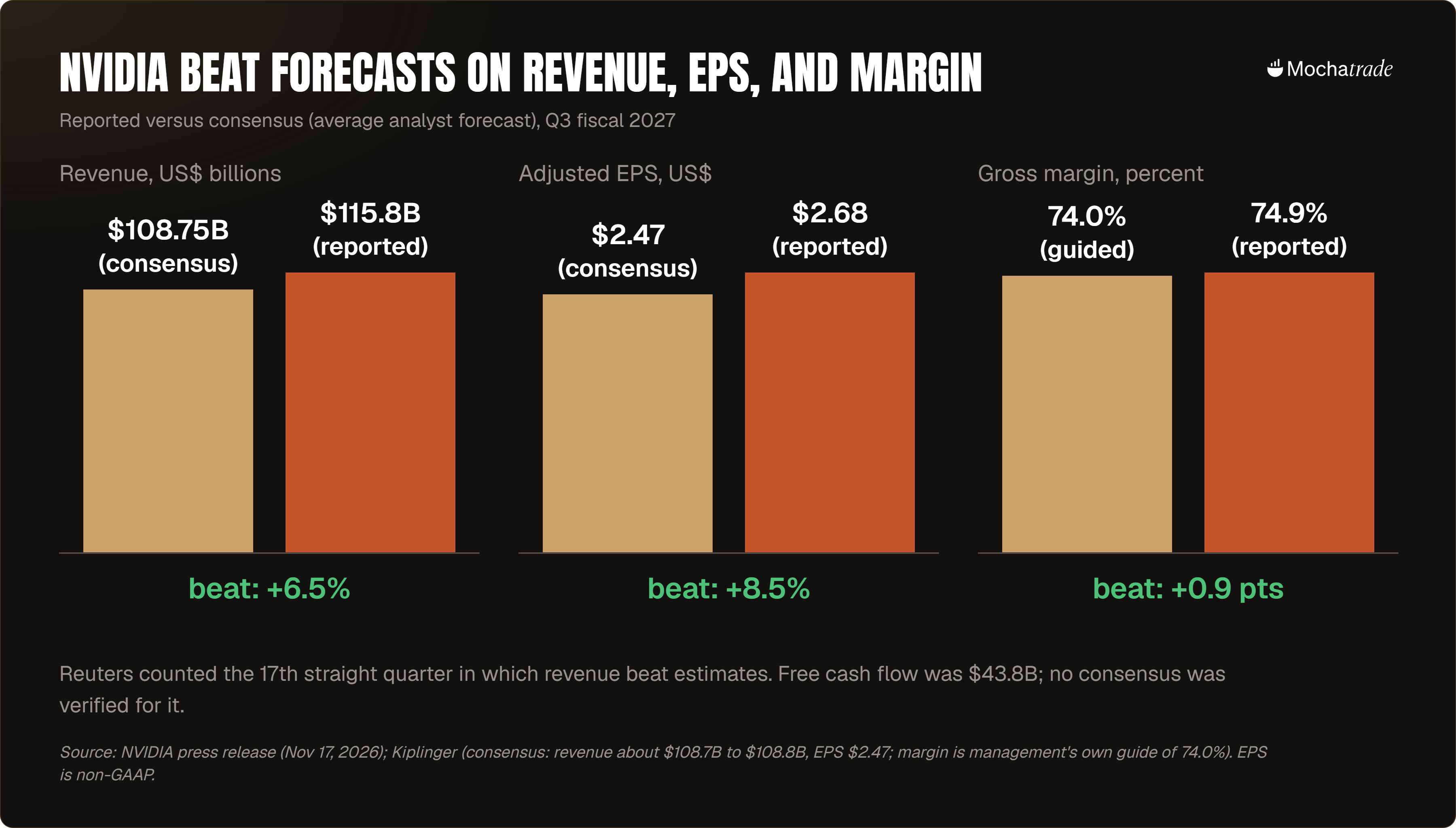
Nvidia reported results versus consensus, Q3 fiscal 2027
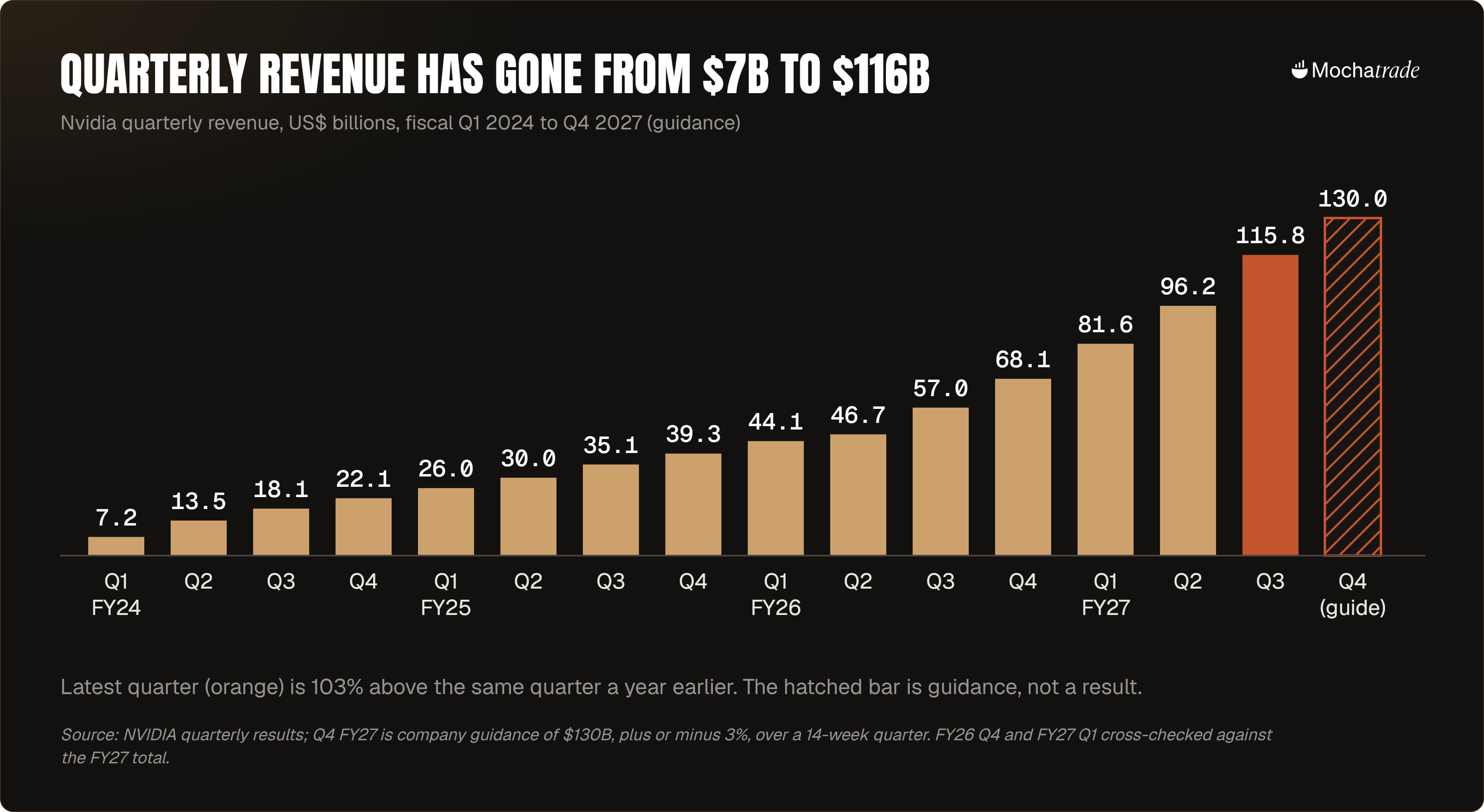
Nvidia quarterly revenue, fiscal 2024 to the Q4 fiscal 2027 guide
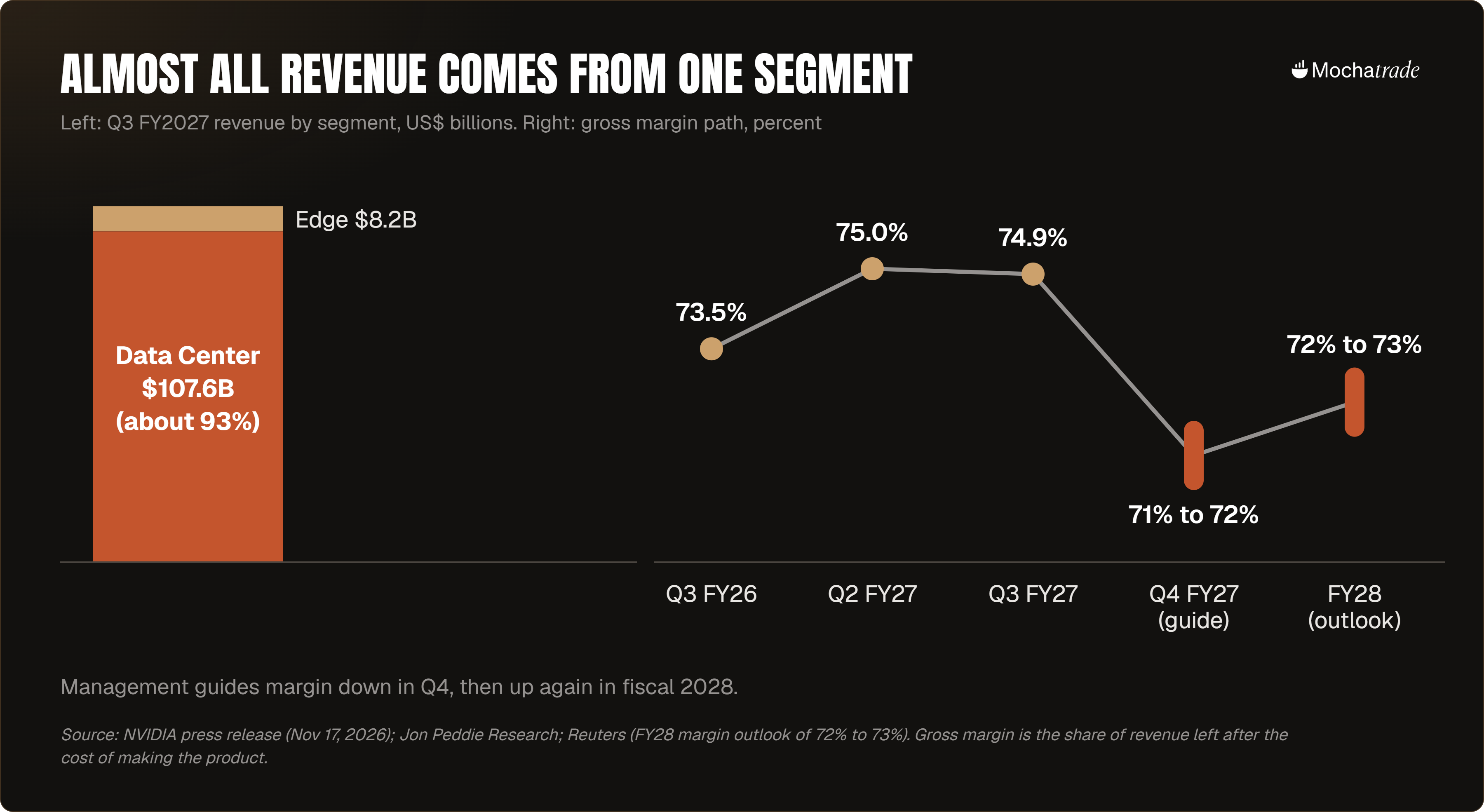
Nvidia segment mix and gross margin path
Why Did The Stock Fall Despite The Beat?
Shares rose as much as 4% in after-hours trading, the session after the regular market closes, on November 17, then closed down 2.9% on November 18. The close was about 36% below the October 6 record close, Reuters said, and Euronews said the stock was on track for a seventh straight weekly loss, its longest since July 2008. Five pressures show up in the reporting:
This was the first report without Huang, and the board is still searching for a permanent CEO. HSBC analysts told Reuters the stock may struggle until one is.
The forecast assumes zero Data Center compute revenue (sales of AI processing chips) from China. Nvidia booked $2.4 billion of Hopper sales to China in the quarter and has stopped shipping them. Reported China sales were about 6% of revenue, which one analyst said may be understated.
Management guided fourth-quarter gross margin down to 71% to 72% from 74.9%, with a recovery to 72% to 73% in fiscal 2028.
Purchase commitments, contracts to buy supplies and manufacturing capacity in the future, rose to $390 billion, and commitments to neoclouds total $32 billion. CFO Kress said they are tied to construction and development milestones.
A new Commerce rule, the SEC investigation report, and Huang's coming appearance before Congress add legal and policy risk, covered below.
A price target is an analyst's estimate of where a share will trade in about a year. The average target fell to $251.74 from $265.70 the day before. Freedom Capital cut its target to $230 from $305 and attributed the cut to governance and policy risk.
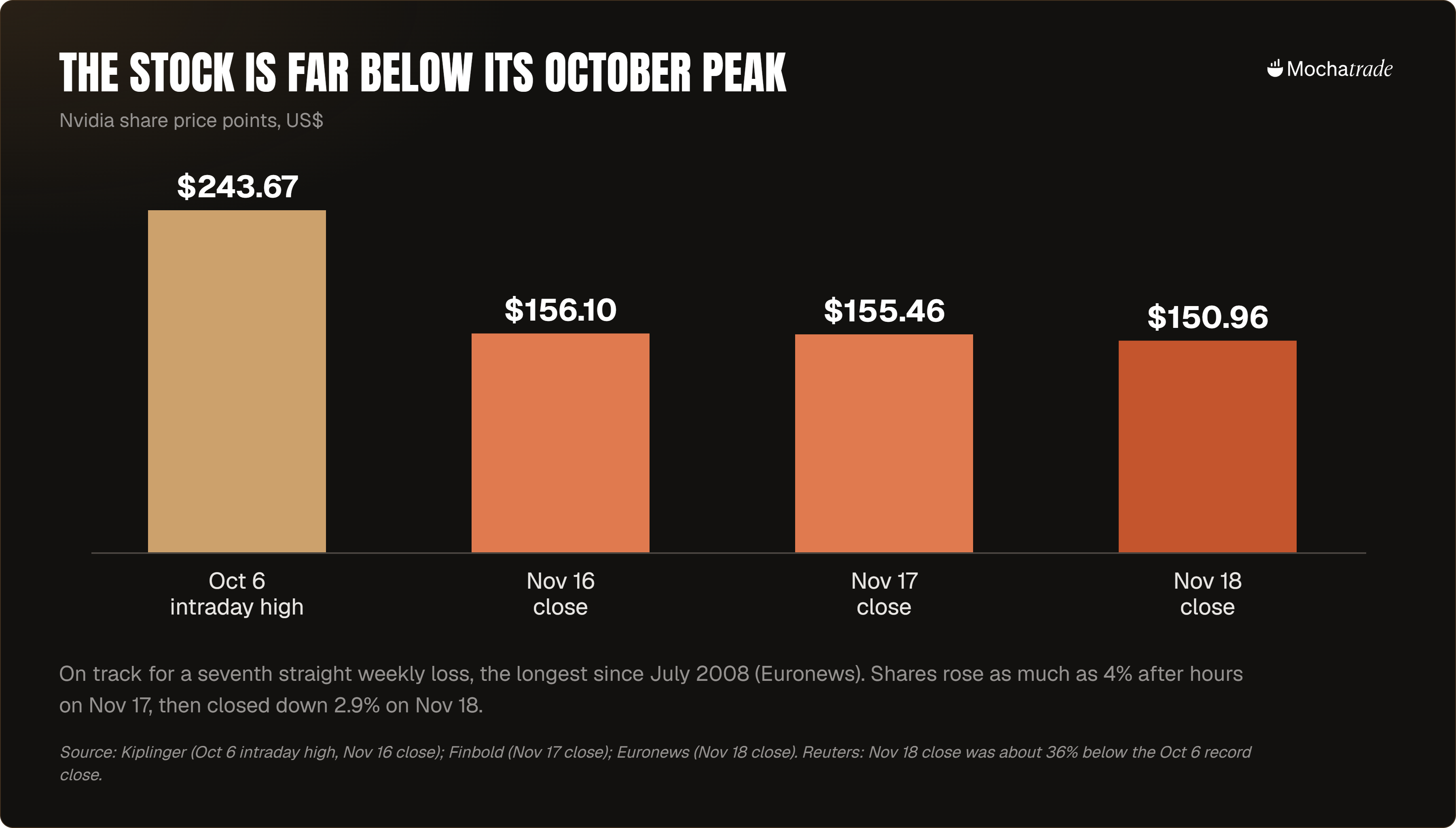
Nvidia share price points, October 6 to November 18, 2026
How Does A Founder's Exit Reshape The Company?
Huang led Nvidia for 33 years, so investors are watching who will now decide on exports and product timing. The current arrangement is:
Kress runs daily operations and said the company's ambition stays the same.
The board hired Heidrick & Struggles, an executive search firm, to consider internal and external candidates. Chair Jones said the board wants to take its time, and outside recruiters estimated a name in early 2027. Huang said he would be honored to return, and the board ruled out reinstating him.
Huang holds about 3.5% of Nvidia, mostly in trusts, with a right to nominate two directors (BigGo Finance).
A new board committee on national security and export controls, chaired by Suzanne Nora Johnson, meets at least quarterly. Export controls are the US limits on selling advanced chips to China and some other countries.
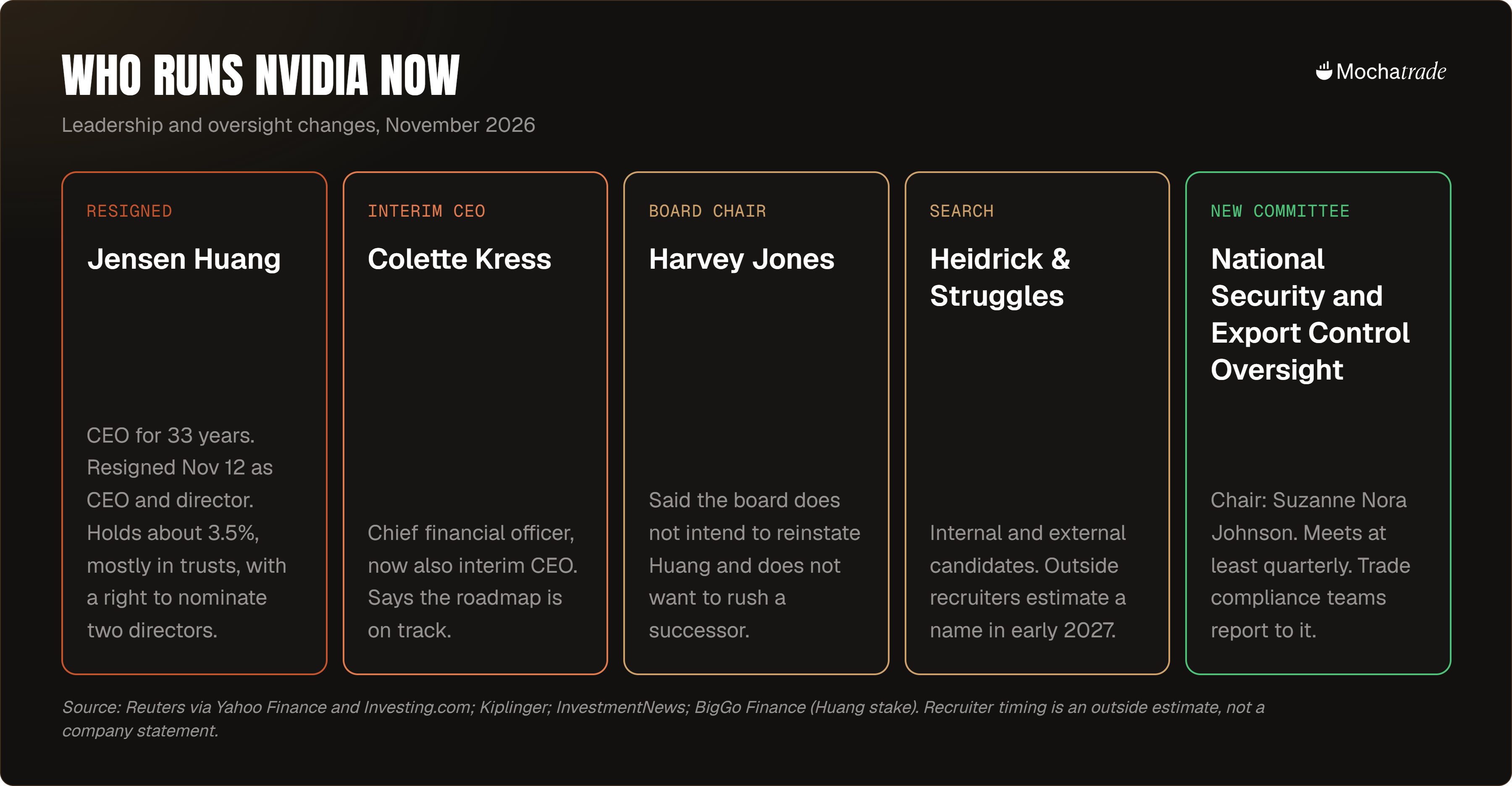
Who runs Nvidia after Huang's resignation
What Legal And Policy Risks Are On The Table?
The legal story centers on Megaspeed, a Singapore-based AI cloud company that Nvidia put on its no-sell list in June 2025. The question is whether chips kept out of China by US export controls reached Chinese firms through it. Megaspeed says it conducts legitimate and lawful business. Whether any of it leads to charges is not known. These items are confirmed or on the record:
The Commerce and Justice Departments said in a joint statement on November 16 that an export-control inquiry into Megaspeed began in 2024 and that the Justice Department leads a criminal investigation (BigGo Finance). The statement did not mention Huang.
Rosen Law Firm filed a proposed class action, a lawsuit brought on behalf of many shareholders at once, in San Francisco federal court. It alleges misleading statements about Megaspeed.
Huang agreed to private interviews with three House committees on December 1. Nvidia's general counsel is scheduled for December 2.
The Commerce Department announced on November 17 that shipments of advanced chips to Indonesia, Malaysia, Singapore, Thailand, and Brazil need export licenses (Al Jazeera).
California Attorney General Rob Bonta said his office is looking into aspects of the matter. No action has been announced.
Treasury Secretary Scott Bessent said on Sunday, November 15, that he needs answers within 10 days from the board and outside counsel, and that Nvidia should look outside the company for its next CEO (investingLive, InvestmentNews).
What Does Nvidia Expect Next?
Nvidia's fiscal year ends in late January, so fiscal 2028 covers February 2027 to January 2028. The company's own forecast:
Fourth-quarter revenue: $130.0 billion, plus or minus 3% ($126.1 billion to $133.9 billion), over a 14-week quarter instead of the usual 13, assuming zero China Data Center compute revenue
Fourth-quarter gross margin: 71.0% to 72.0%
Fiscal 2028 revenue growth: about 75%, up from about 70% in August
Fiscal 2028 gross margin: 72% to 73%
Buybacks and dividend: $227.3 billion of repurchase authorization remained at quarter end (a buyback is when a company purchases its own shares), and a $0.25 quarterly dividend, a cash payment per share, is payable December 23 to holders of record December 2
Growth of 75% on a fiscal 2027 base of about $424 billion (three reported quarters plus the midpoint of the fourth-quarter forecast) works out to roughly $741 billion, or about ₹70 lakh crore. Nvidia published the percentage, so the dollar figure is arithmetic. Analysts' average estimate for next fiscal year's adjusted net income rose to $393 billion from $380 billion, Reuters reported.
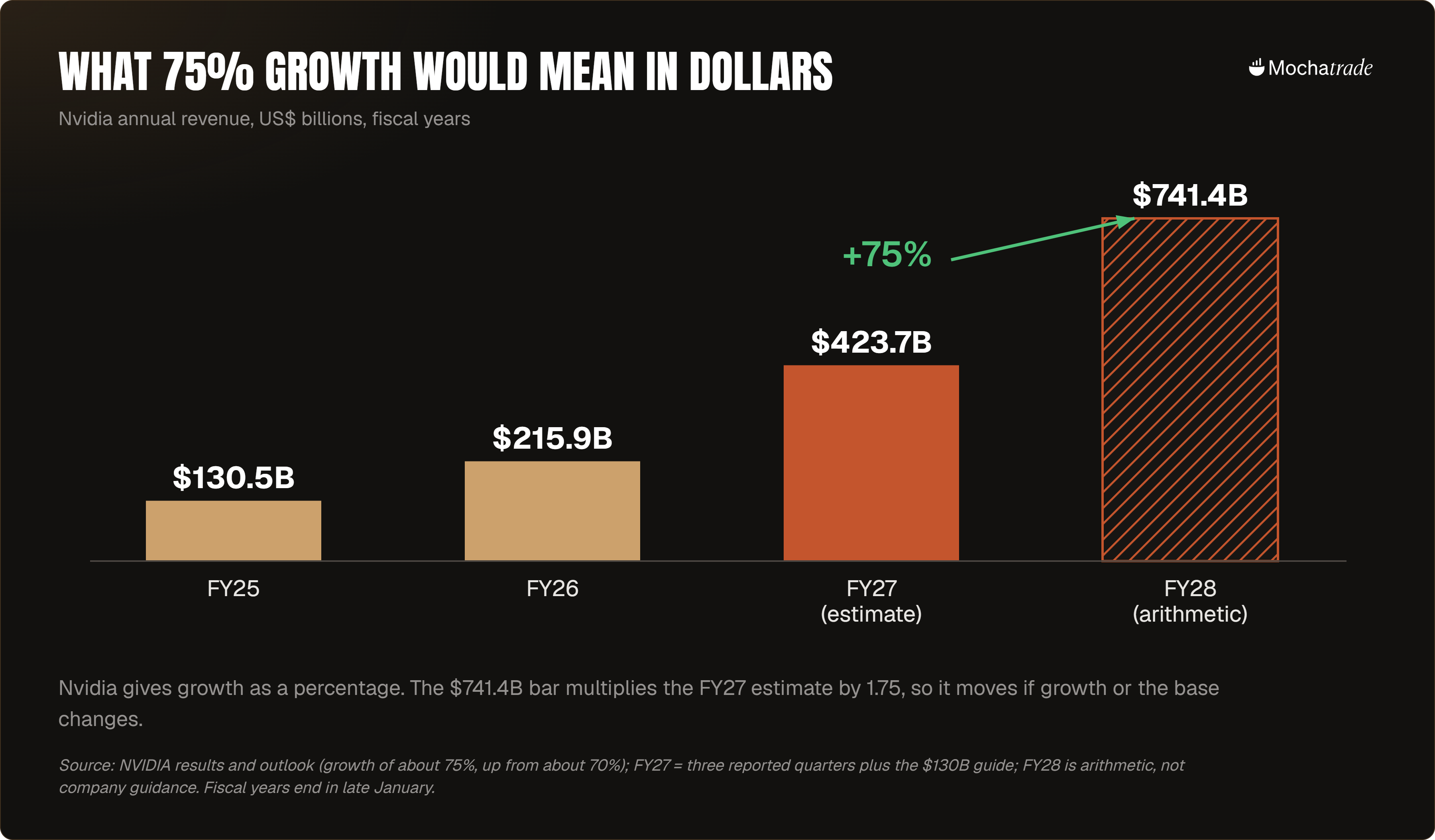
Nvidia annual revenue with the fiscal 2028 arithmetic at 75% growth
How Could This Pan Out For Nvidia And AI?
Which path comes is open. Hyperscaler free cash flow turned negative in the latest quarter, yet money for AI keeps arriving. Anthropic priced its IPO, its first sale of shares to the public, on November 18 at $83 a share. A $26 billion private placement, a sale directly to selected investors, ran alongside it and included about $10 billion from Nvidia (Yahoo Finance, TradingView). Anthropic opened at $111.50 on November 19 and closed its first day at $97.17, up about 17% from the IPO price (Fox News, CNBC). Nvidia shares were up 3.6% on Thursday in early trading (Yahoo Finance). The three scenarios below carry no probabilities. Each lists what to watch for.
Orderly handover. A permanent CEO is named, the probes narrow, Rubin ramps, and growth near 75% holds. Supporting evidence would be a CEO announcement and fourth-quarter revenue inside the $126.1 billion to $133.9 billion range.
Long legal overhang. The probes widen into fines or export limits, and rules like the November 17 license requirement multiply. The problem would hang over the stock for months. Signs include an SEC announcement, charges from the Justice Department, further Commerce rules, and the outcome of Bessent's 10-day request.
Demand digestion. AI buyers pause to use the chips they already bought, which investors call digestion, and the margin dip to 71% to 72% lasts beyond one quarter. Watch hyperscaler capital spending plans (money spent on buildings and equipment), strain in neocloud financing, and Nvidia's $390 billion of purchase commitments.
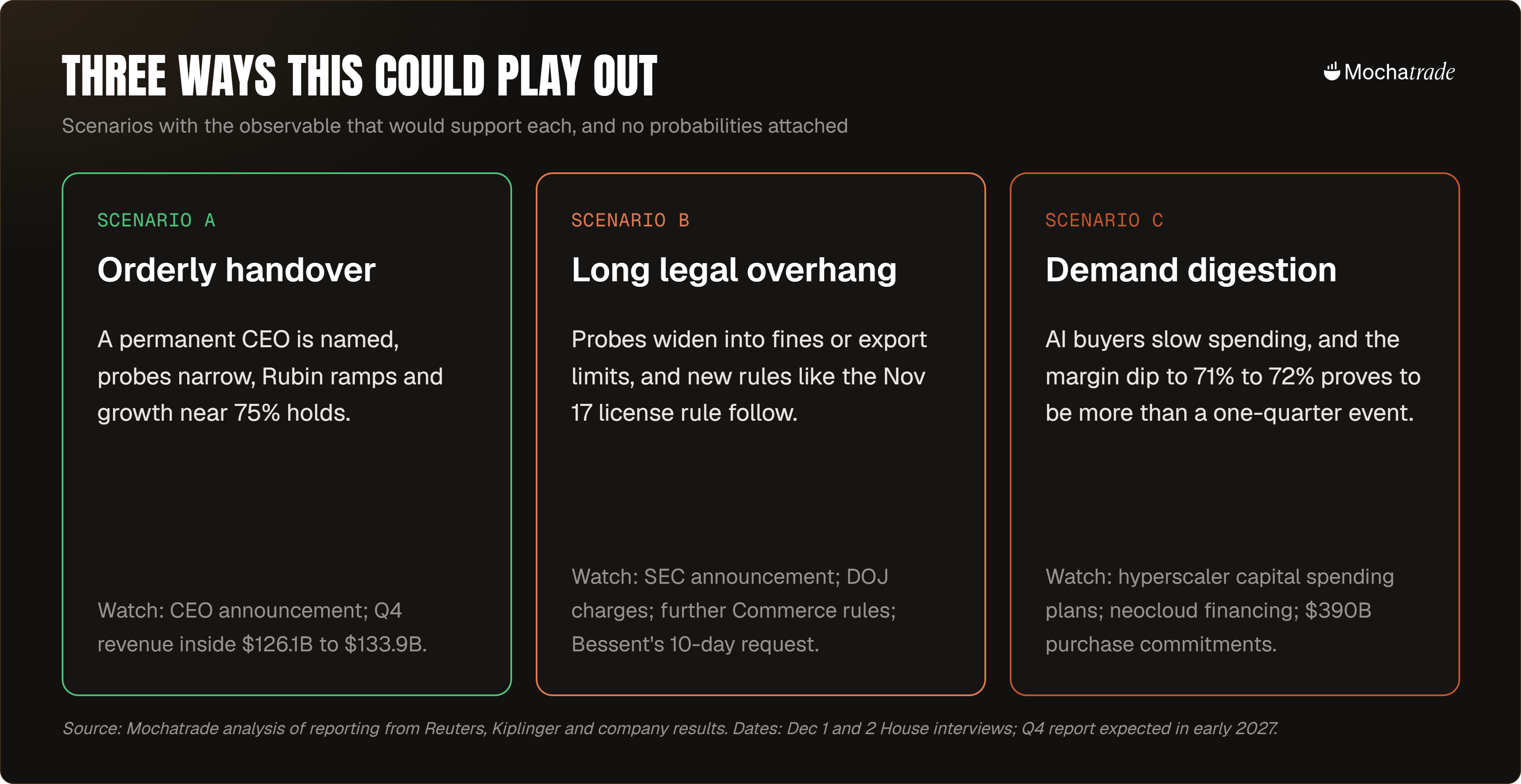
Three scenarios for Nvidia and the observables for each
Educational content only. Not investment advice.
MochaLearn is a free A to Z course on understanding and trading US stocks and commodities, built for Indian traders.
Terms in this story
- SECThe SEC is the US Securities and Exchange Commission, the referee Congress built after 1929 exposed how little buyers…
- S&P 500The S&P 500 is about five hundred of the largest American companies, weighted by market value, and the number money is…
- RevenueRevenue is the total money a company takes in from sales before any costs, the top line. Growth companies are judged…
- Gross marginGross margin is revenue minus the direct cost of making the product, as a percent of revenue. It shows pricing power…
- Free cash flowFree cash flow is the cash a business brings in from operations minus what it spends on equipment and buildings.…
- BuybackA buyback is a company buying its own shares and cancelling them, so the same profit is spread over fewer shares and…