November 9, 2026 · Mochatrade · 7 min read
Mocha Markets Weekly
Markets in the post-midterm chip selloff, a jobs report far above forecasts, and CPI, CoreWeave and Applied Materials next.
The Nasdaq fell 5.5% on Thursday, and the S&P 500 fell 4.4%, its worst day since April 2025. Democrats had won both chambers of Congress two days earlier. On Friday, the Nasdaq bounced 1.1%, and a jobs report arrived far above forecasts.
A correction is a fall of at least 10% from a recent high. CPI, the Consumer Price Index, is the monthly inflation report. Earnings are a company's quarterly report card.
On MochaLearn, how the Fed moves markets and US earnings each get a full lecture built for Indian traders. Start here is for first-time US stock traders.
01 The US week behind. A post-election rally, Thursday's chip crash, and a jobs surprise.
02 The US week ahead. CPI and CoreWeave on Tuesday, then Nebius and Applied Materials on Thursday, with producer prices on Friday.
03 One concept. What a correction is, and what ten past ones say about the next year.
04 One chart. Each day's move for the S&P 500 and the Nasdaq.
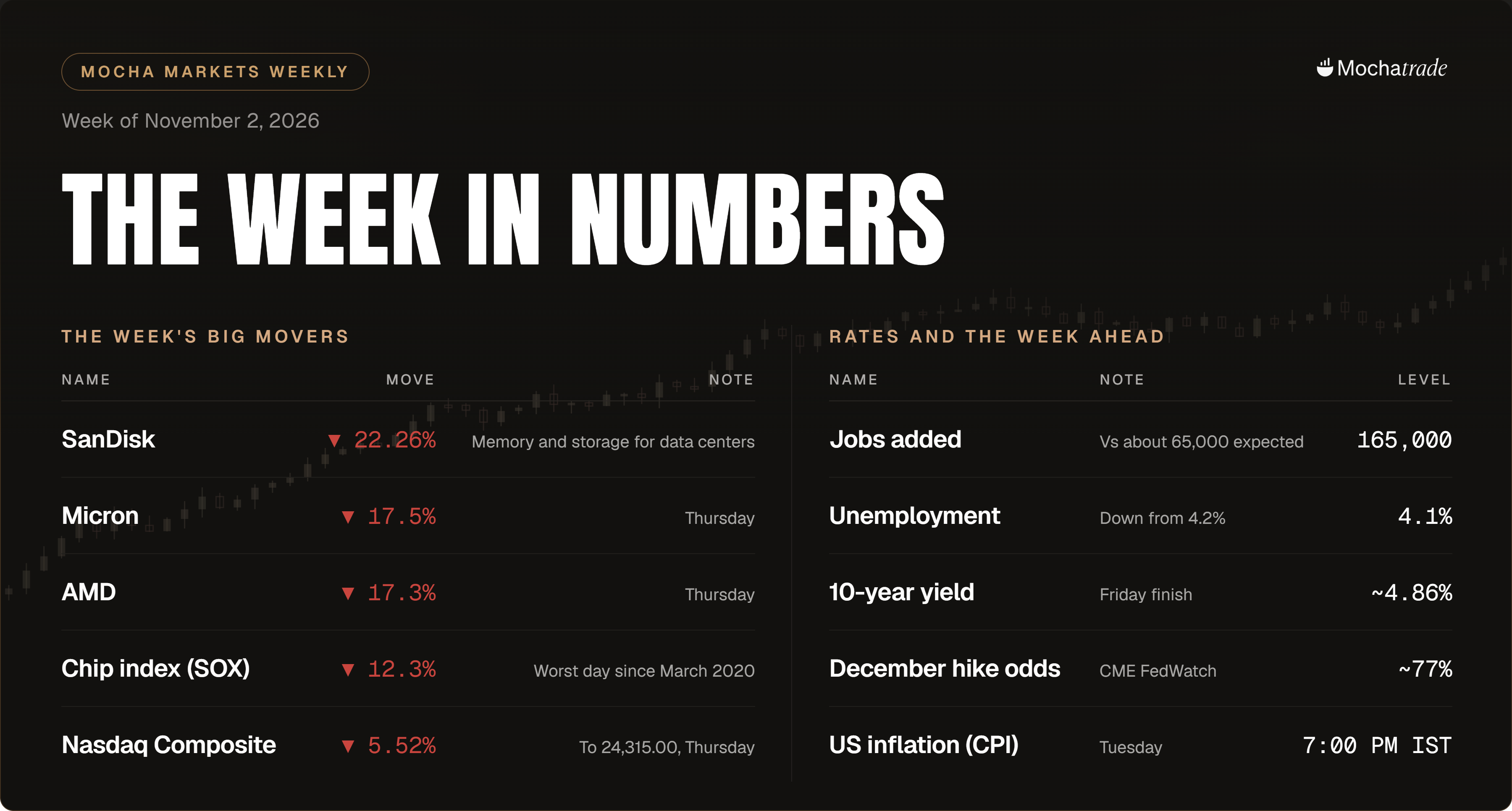
Data summary.
01 The US Week Behind
1. Why Did The Nasdaq Fall 5.5% Right After Wednesday's Rally?
Wednesday's election results lifted the Dow 3.03% (1,569 points) to 53,356.12, because investors read a divided government as a limit on big policy changes. Thursday flipped it. Governors-elect in Texas and Ohio floated limits on new data centers, the buildout that AI chip sales depend on. A Nomura strategist argued that hedge funds were locking in 2026's profits before year-end, and I would hold both readings loosely after one session of data.
The Nasdaq Composite, an index of mostly tech stocks, fell 5.52% to 24,315.00.
The S&P 500, which tracks the 500 biggest US companies, fell 4.36% to 7,353.73, and the Dow, a set of 30 large companies, lost 1,833 points, or 3.4%.
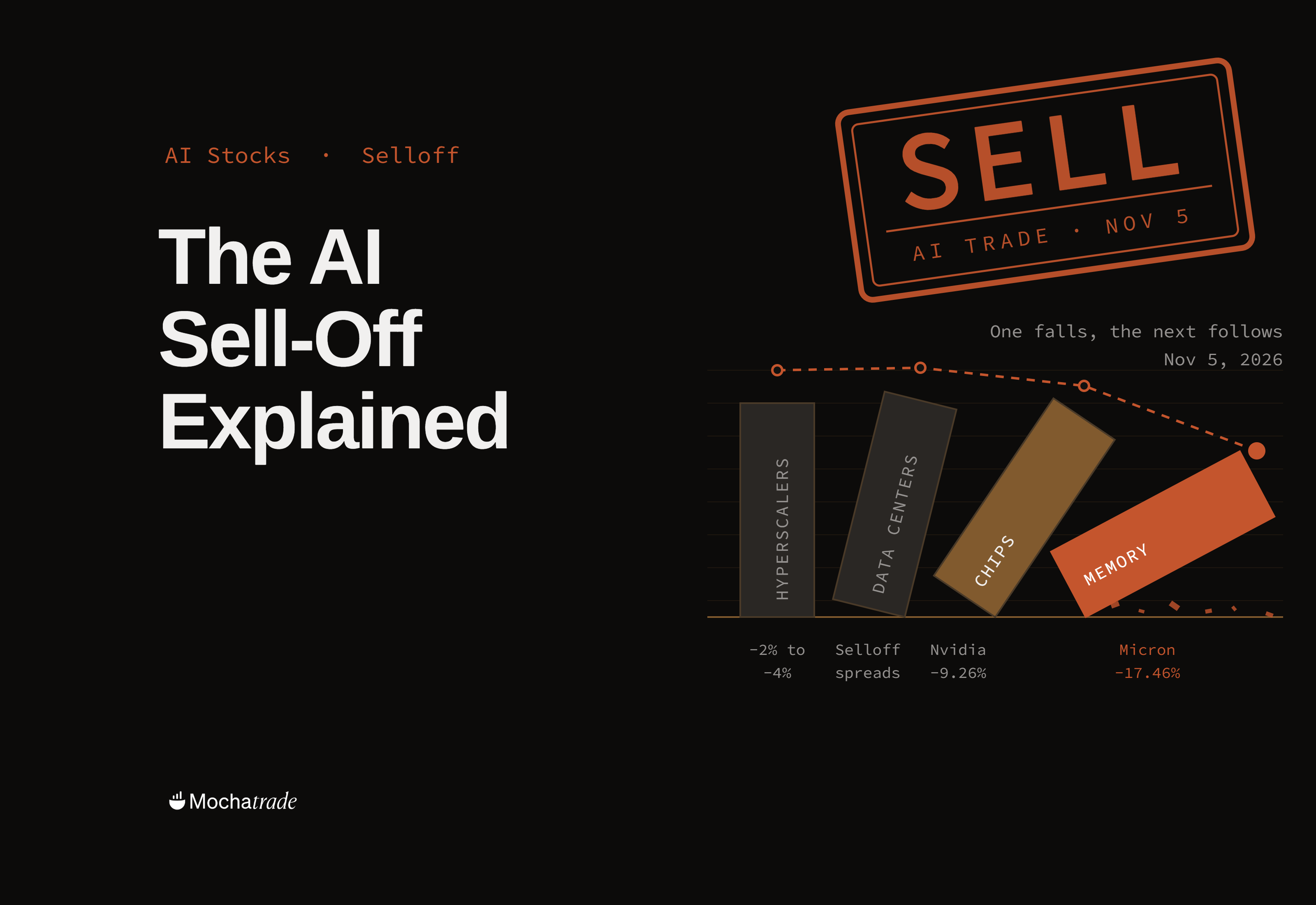
The Philadelphia Semiconductor Index, which tracks chipmakers, fell 12.3%, its worst day since March 2020.
About $2.5 trillion of US stock value disappeared in the session.
Friday's bounce still left every index lower for the week.
The Nasdaq fell 3.37% to 24,579.42, its fourth straight weekly loss.
The S&P 500 fell 2.68% to 7,376.86, and the Dow fell 0.94% to 51,285.73.
The Russell 2000 of smaller companies fell 2.05% to 2,754.11.
2. Which Stocks Took The Hardest Hit?
Chipmakers and data center suppliers fell most. Qualcomm dropped after guiding next quarter's profit below what analysts expected and citing higher input costs across the industry.
SanDisk fell 22.26%, and Micron 17.5%, and both sell memory and storage for data centers.
AMD fell 17.3%, Broadcom 10.4%, and Nvidia 9.3%.
On Friday, the semiconductor index recovered about 4%, and AMD gained 11.04%.
3. Did The Jobs Report Change The Fed's Path?
Friday's October jobs report landed at 7:00 PM IST. Employers added 165,000 jobs against about 65,000 expected, and unemployment fell to 4.1% from 4.2%.
September was revised up to 60,000 jobs from 29,000, and August to 186,000 from 133,000.
Average hourly earnings rose 3.1% from a year earlier, above the 2.9% expected.
The 10-year Treasury yield, the rate on 10-year US government bonds, finished near 4.86%.
CME FedWatch, a free tool that turns futures prices into rate odds, put a December hike at about 77%, up from about 70% before the report.
The Fed held rates at 3.75% to 4.00% on October 28, with two members voting for a hike. Stronger hiring could lead to a hike in December or a longer hold, and Tuesday's inflation report adds to that question.
02 The US Week Ahead
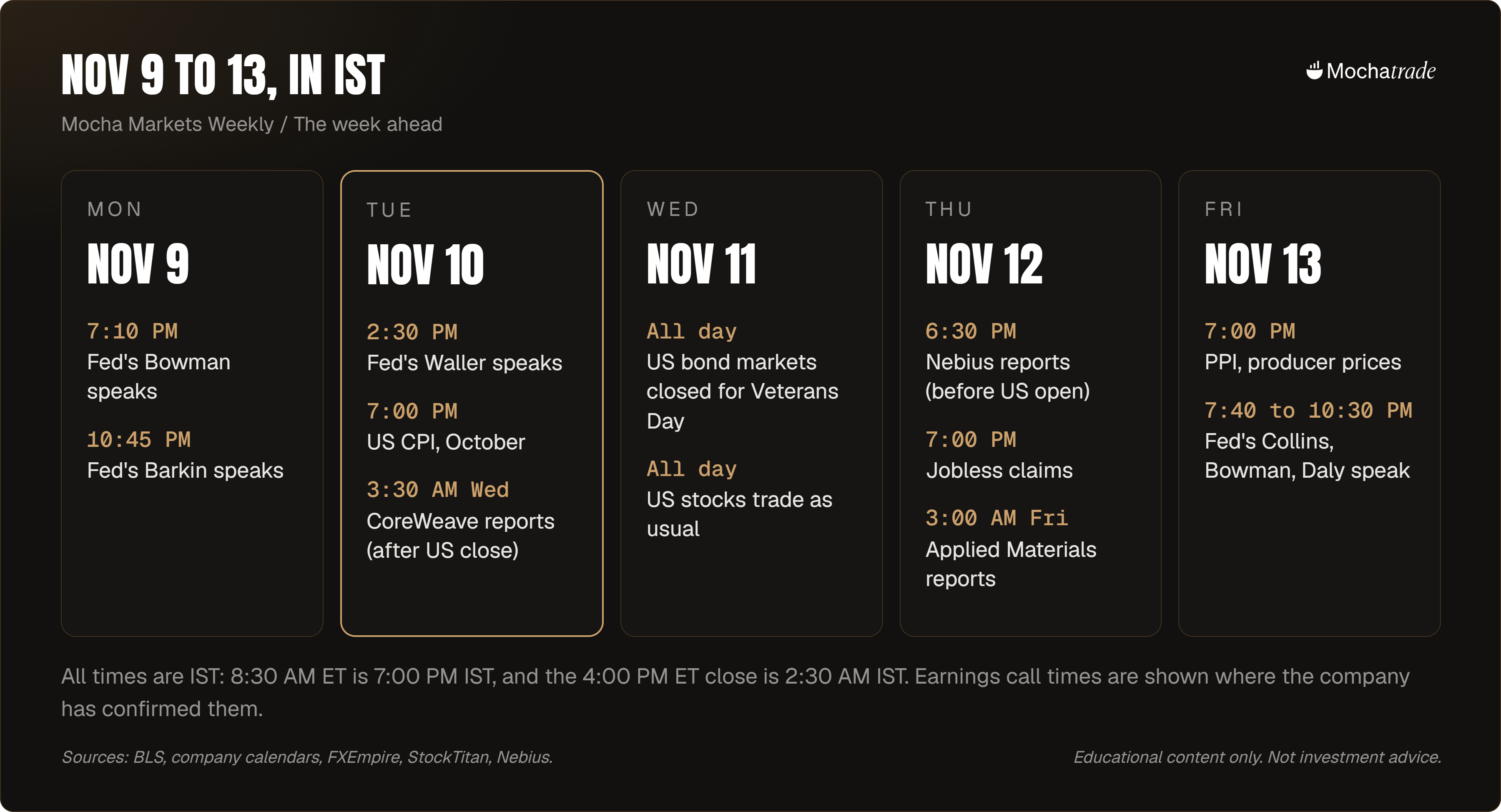
Week-ahead calendar in IST.
1. Tuesday, November 10, 7:00 PM IST: US Inflation Report (CPI), With PPI On Friday
Context. CPI, the Consumer Price Index, tracks how much prices for everyday goods and services changed. Higher inflation gives the Fed more reason to raise rates.
What's happening. The Bureau of Labor Statistics publishes October's figure at 8:30 AM ET. Economists expect:
Headline CPI up 0.3% from September.
Core CPI, which leaves out food and energy, up 0.2%.
Fed speakers, including Waller at 2:30 PM IST, talk the same day.
PPI, the Producer Price Index, tracks what businesses pay for goods and services before they reach shoppers. It lands Friday at 7:00 PM IST, with forecasts of 0.4% headline and 0.3% core.
What to look out for. Core CPI, because it shows where inflation is heading once the swings in food and energy prices are removed.
Why this matters. Futures price in about a 77% chance of a December hike. A hot number pushes that toward certainty, and a soft one reopens the debate.
2. Tuesday, November 10, After The US Close (About 3:30 AM IST Wednesday): CoreWeave Reports
Context. CoreWeave rents AI computing power to other companies, and Nebius does the same. Nebius is down 58% from its 2026 peak.
What's happening. CoreWeave reports after the US close, with its call at 5:00 PM ET. Nebius follows on Thursday before the US open, with its call at 6:30 PM IST. Analysts expect CoreWeave to report a loss for the quarter.
What to look out for. Spending plans and customer commitments, because both companies depend on the data center buildout that the November 5 selloff questioned. I would read those before the loss figure.
Why this matters. They are the first AI cloud reports since the data center worries began.
3. Thursday, November 12, After The US Close (About 3:00 AM IST Friday): Applied Materials Reports
Context. Applied Materials sells the machines that chipmakers use to build chips.
What's happening. It reports after the US close, with its call at 4:30 PM ET. Analysts expect earnings of about $4.06 a share.
What to look out for. Its forecast for next quarter's orders, and any comment on customers delaying purchases.
Why this matters. Equipment orders are placed before chips are made, so its forecast is an early read on whether the chip selloff reflects real spending cuts.
Wednesday, November 11 is Veterans Day in the US. Stock markets stay open, and the bond market closes.
03 One Concept
The Nasdaq closed Thursday in a correction. What does that word mean, and does it tell you what comes next?
A correction is a fall of at least 10% from a recent high, measured on closing prices. The Nasdaq set its record close on October 6, and Thursday's close was 11.6% under it. A bear market, the next label up, starts at a 20% fall.
To check any index:
1. Find the highest closing level in the recent run, the record.
2. Subtract the latest close from the record.
3. Divide the result by the record. If it is 10% or more, the index is in a correction.
A record of 10,000 and a close of 9,000 gives 1,000 divided by 10,000, which is 10%. Friday's 1.1% bounce left the Nasdaq about 10.6% below its record (my calculation from the 11.6% figure), so it is still in a correction.
You will hear that corrections are chances to buy. The record backs that up loosely.
The Nasdaq has fallen at least 10% from a high on 10 occasions in the last decade, about once a year.
Twelve months after the first correction close, the average return was 21%.
The range ran from a 24% loss in January 2022 to a 54% gain in February 2020.
An average built on 10 events with a spread that wide says little about any one of them. Whether this correction ends like February 2020 or like January 2022 is still open. My read: the word measures a fall that already happened.
04 One Chart
Daily change in closing level for the S&P 500 and the Nasdaq Composite, Monday to Friday.
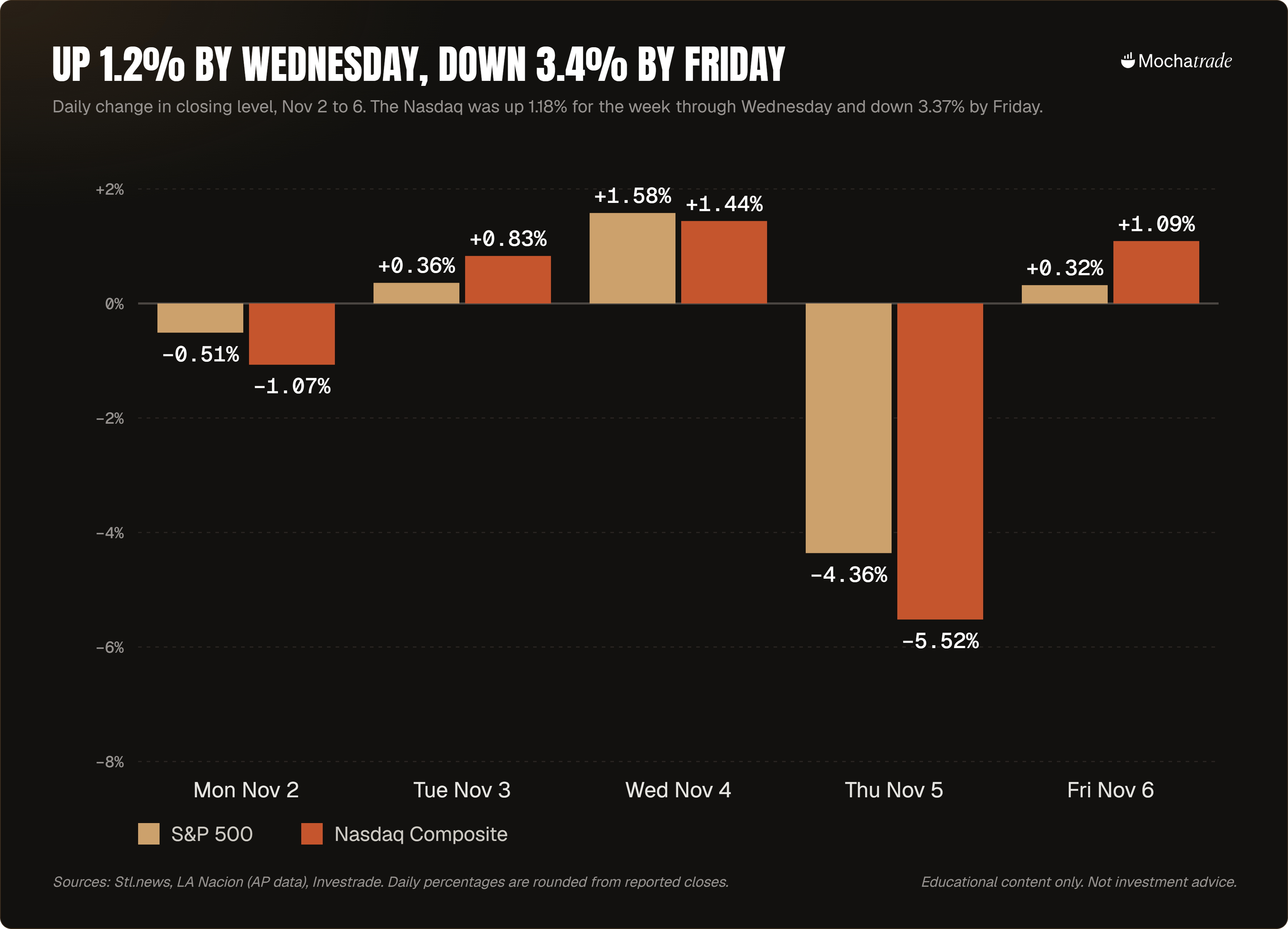
Chart: S&P 500 and Nasdaq Composite daily change, Nov 2 to 6. Source: Stl.news, LA Nacion (AP data), Investrade.
Through Wednesday, the Nasdaq was up 1.18% for the week and the S&P 500 up 1.43% (my calculation).
Thursday's 5.52% Nasdaq drop was larger than the other four days added together, ignoring direction (my calculation).
Friday's 1.09% bounce recovered about one fifth of that loss (my calculation).
A weekly figure of down 3.37% hides this shape: four days of moves under 1.5%, then one very large one.
What to take from this week
1. A correction is a fall of at least 10% from a recent high, measured on closing prices.
2. One session can decide a week: the Nasdaq was up through Wednesday and down 3.37% by Friday.
3. Tuesday's CPI report feeds into the odds of a December hike, so it can move tech stocks.
CPI lands at 7:00 PM IST and CoreWeave reports at about 3:30 AM IST, so Indian traders see both as they happen. Trade those hours, in rupees, at Mochatrade. Join the waitlist.
Educational content only. Not investment advice.
MochaLearn is a free A to Z course on understanding and trading US stocks and commodities, built for Indian traders.
Educational content only. Not investment advice.
MochaLearn is a free A to Z course on understanding and trading US stocks and commodities, built for Indian traders.
Terms in this story
- NASDAQNasdaq is the American exchange that began in 1971 as one screen showing every dealer quote side by side, the first…
- S&P 500The S&P 500 is about five hundred of the largest American companies, weighted by market value, and the number money is…
- CPICPI, the consumer price index, is the monthly US measure of what a basket of goods and services costs households…
- Russell 2000The Russell 2000 is about two thousand smaller American listed companies, the standard measure of US small caps. They…
- Average hourly earningsAverage hourly earnings is the wage growth number in the US jobs report. Wages are the bridge from jobs to prices…
- 10-year Treasury yieldThe ten-year Treasury yield is the benchmark long rate that mortgages, company debt and stock valuations are priced…
- Treasury yieldA Treasury yield is the annual return on a US government bond at today's market price; when the price falls, the yield…
- CME FedWatchCME FedWatch turns futures on the overnight rate into a probability for each outcome at every Fed meeting. It is what…
- PPIPPI, the producer price index, measures the prices businesses receive, which makes it inflation upstream of the shop…
- Core CPICore CPI is CPI with food and energy removed, the volatile parts that interest rates cannot fix. The market often…