November 9, 2026 · Mochatrade · 8 min read
Anthropic IPO Explained: Loss, Compute Bill and Valuation
Anthropic's $80.7B half-year loss is mostly a non-cash charge, and the other side of that charge is a gain for holders such as Amazon.
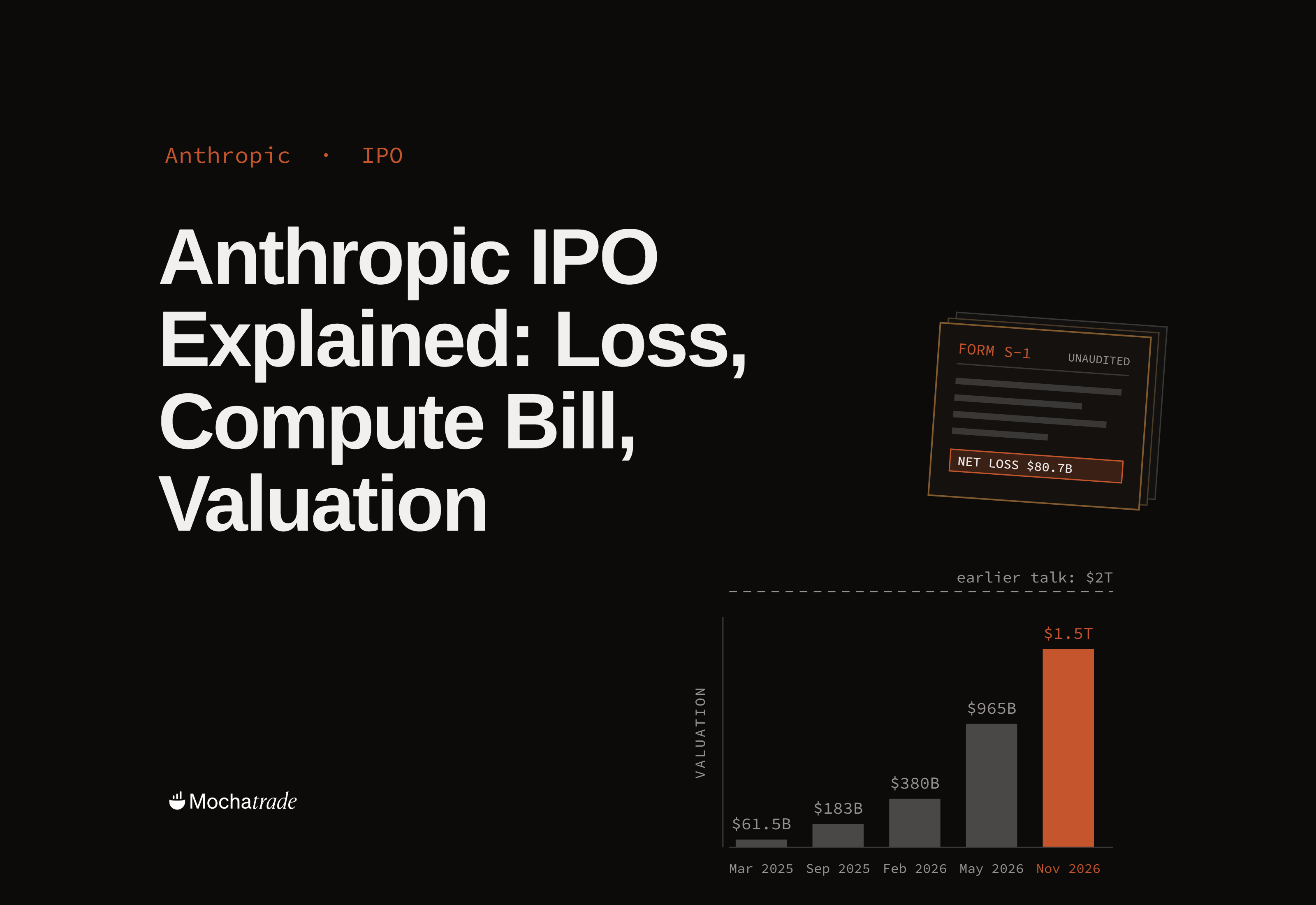
Anthropic, the company behind Claude, has filed to sell shares to the public on Nasdaq, and its paperwork shows a net loss of $80.7 billion (about ₹7.7 lakh crore) for the first half of 2026. This post covers how a fast-growing company books a loss that large, and who gains when its shares start trading.
The order is the filing, the accounting rule behind the loss, the business and its bills, and finally who owns what. Terms are defined where they first appear.
What Has Anthropic Filed For?
Anthropic has filed to list on the Nasdaq under the ticker ANT, but it has not set a price or a date. An IPO, or initial public offering, is the first time a company sells shares to ordinary investors. Before that, it files a registration form with the US regulator, called an S-1, that lays out its finances and risks. Anthropic filed publicly on October 26 and amended the S-1 on November 2 to add third-quarter results; the first version stopped at June 30.
The shares would trade on the Nasdaq Global Select Market under ANT, per the filing.
No date is set. Reports point to a roadshow in the week of November 9, which is not confirmed.
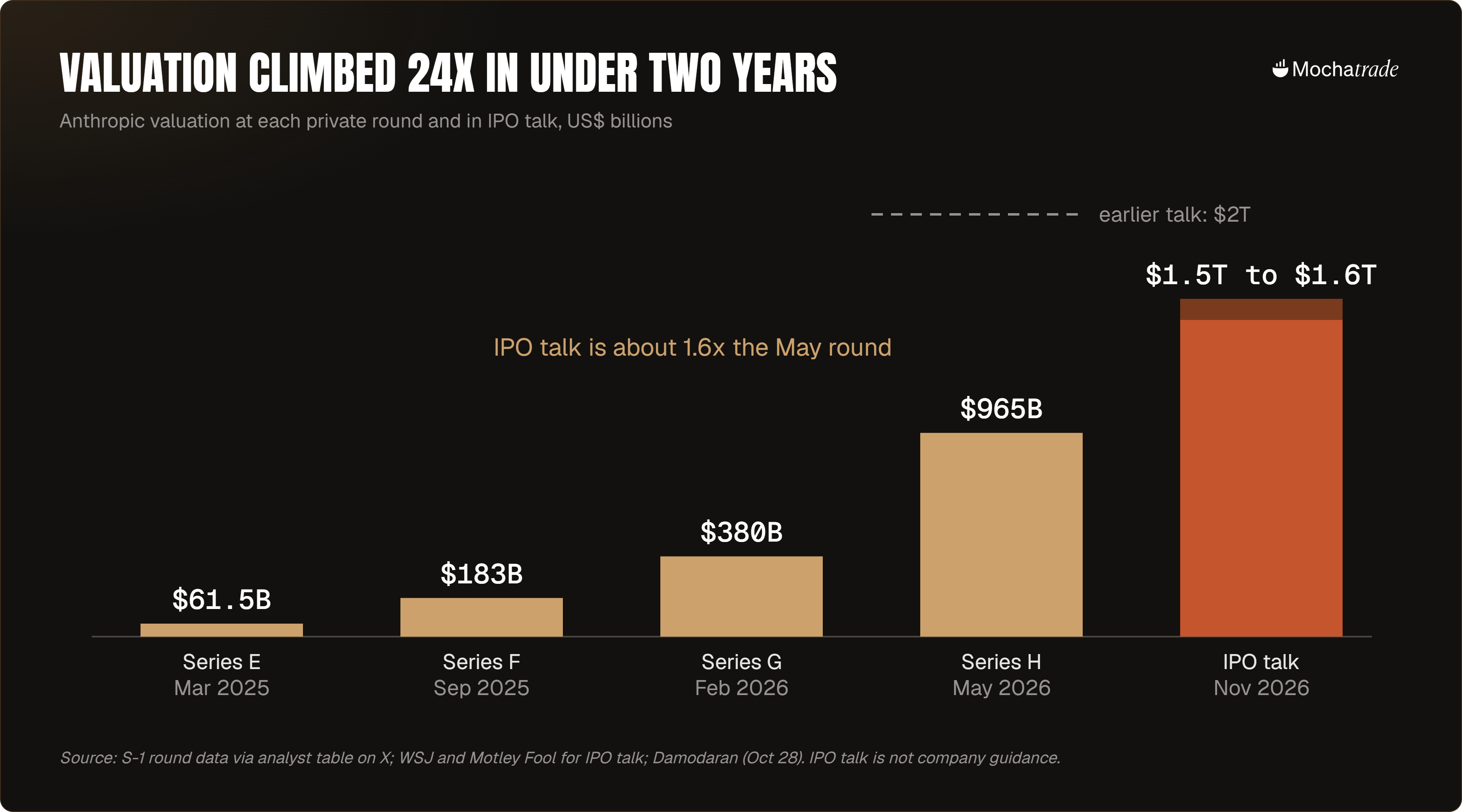
The Wall Street Journal reported that some investors want $1.5 trillion to $1.6 trillion, below earlier talk of $2 trillion. The S-1 states no valuation.
Twenty-two banks are underwriting, led by Goldman Sachs and Morgan Stanley.
Why Does Anthropic Report an $80.7 Billion Loss?
Because $72.4 billion of it is a non-cash charge on convertible notes and similar instruments: an entry on paper, with no money leaving the bank. A convertible note is a loan the lender can later swap for shares at a set price, which makes it part debt and part bet on the company.
Accounting rules treat the shares a company has promised as a liability, revalued every period. When the valuation climbs, those shares are worth more, the liability grows, and the increase is booked as a loss.
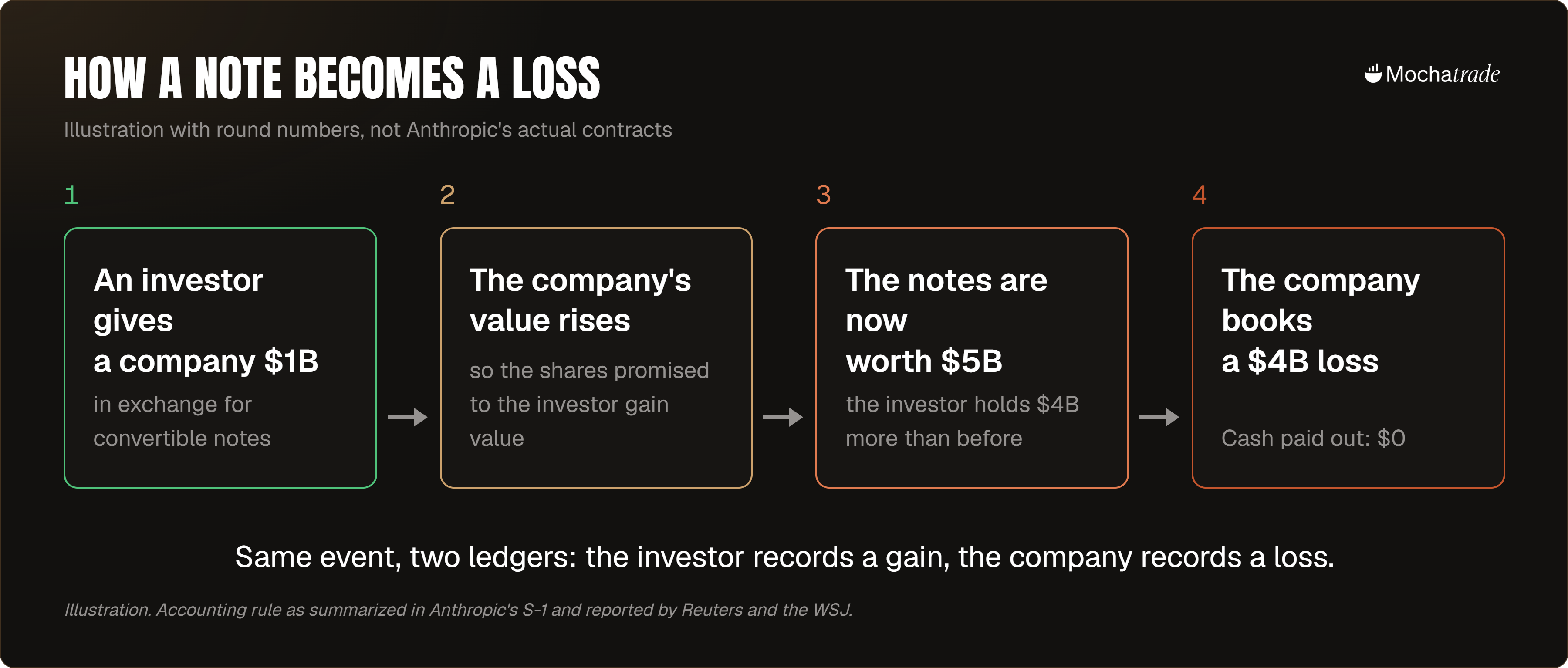
Illustration. Rule as described in Anthropic's S-1 and reported by Reuters and the WSJ.
Anthropic's valuation went from $61.5 billion in March 2025 to $965 billion in May 2026, so those notes kept getting marked up. The S-1 shows what that did to the first half.
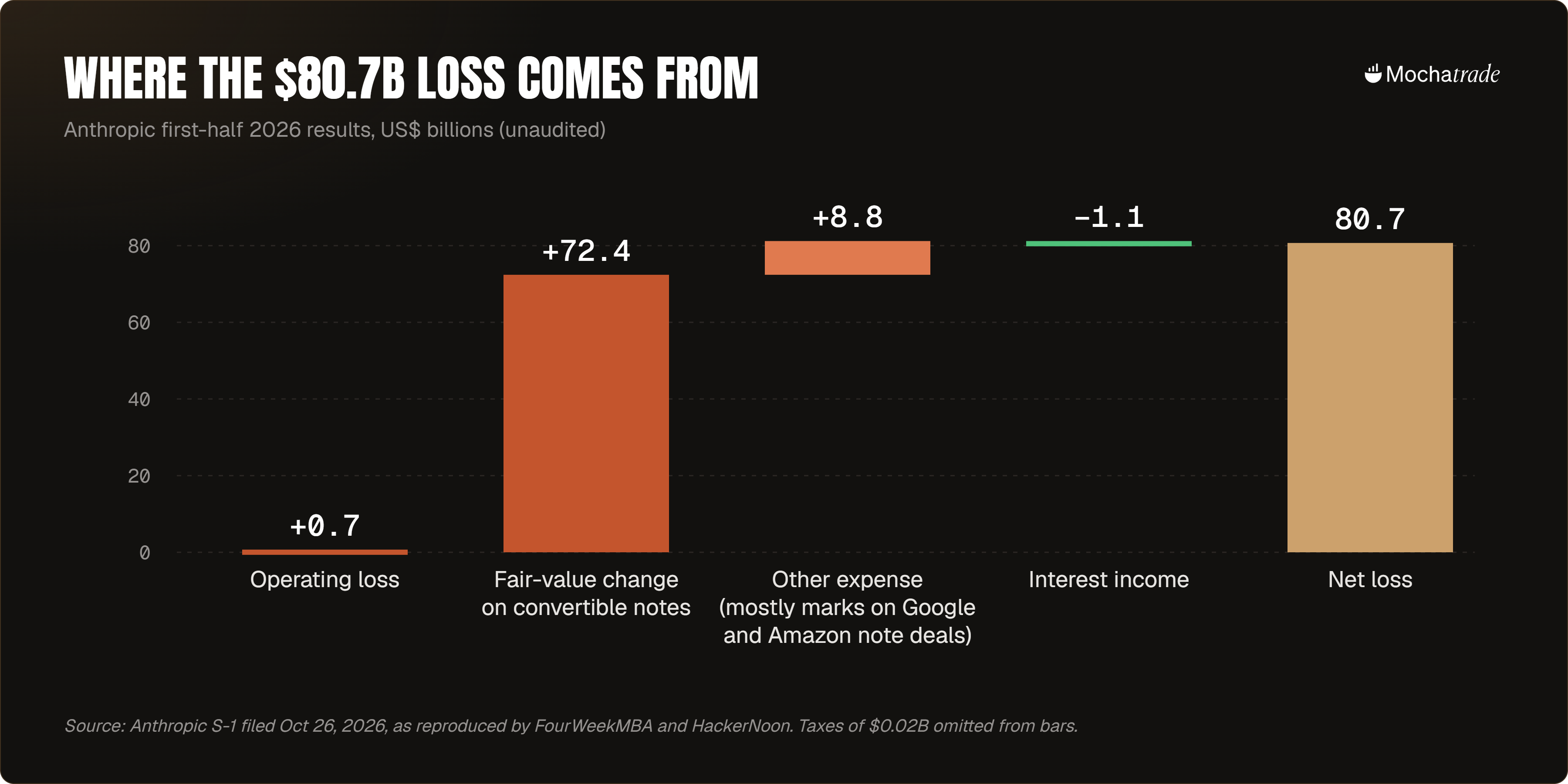
Source: Anthropic S-1 via FourWeekMBA and HackerNoon.
Separate from those revaluations, the operating loss was $693 million on $16.3 billion of revenue (unaudited). The company also reports adjusted net income of $2.7 billion. That figure drops stock pay and other items, and the company picked the definition, so it deserves less weight than the reported figures.
Calling it only accounting misses the dilution. The notes convert into shares, and each new share shrinks everyone else's slice. The charge books that cost before the shares are issued.
The same pattern showed up a year earlier. Reuters, citing the draft prospectus, reported 2025 revenue near $4.6 billion, up 12-fold, and a net loss of about $42 billion that was mostly a roughly $34 billion accounting charge. The operating loss was $8.06 billion, and computing and infrastructure cost $7.33 billion, about three times the 2024 level.
Who Is On The Other Side Of That Charge?
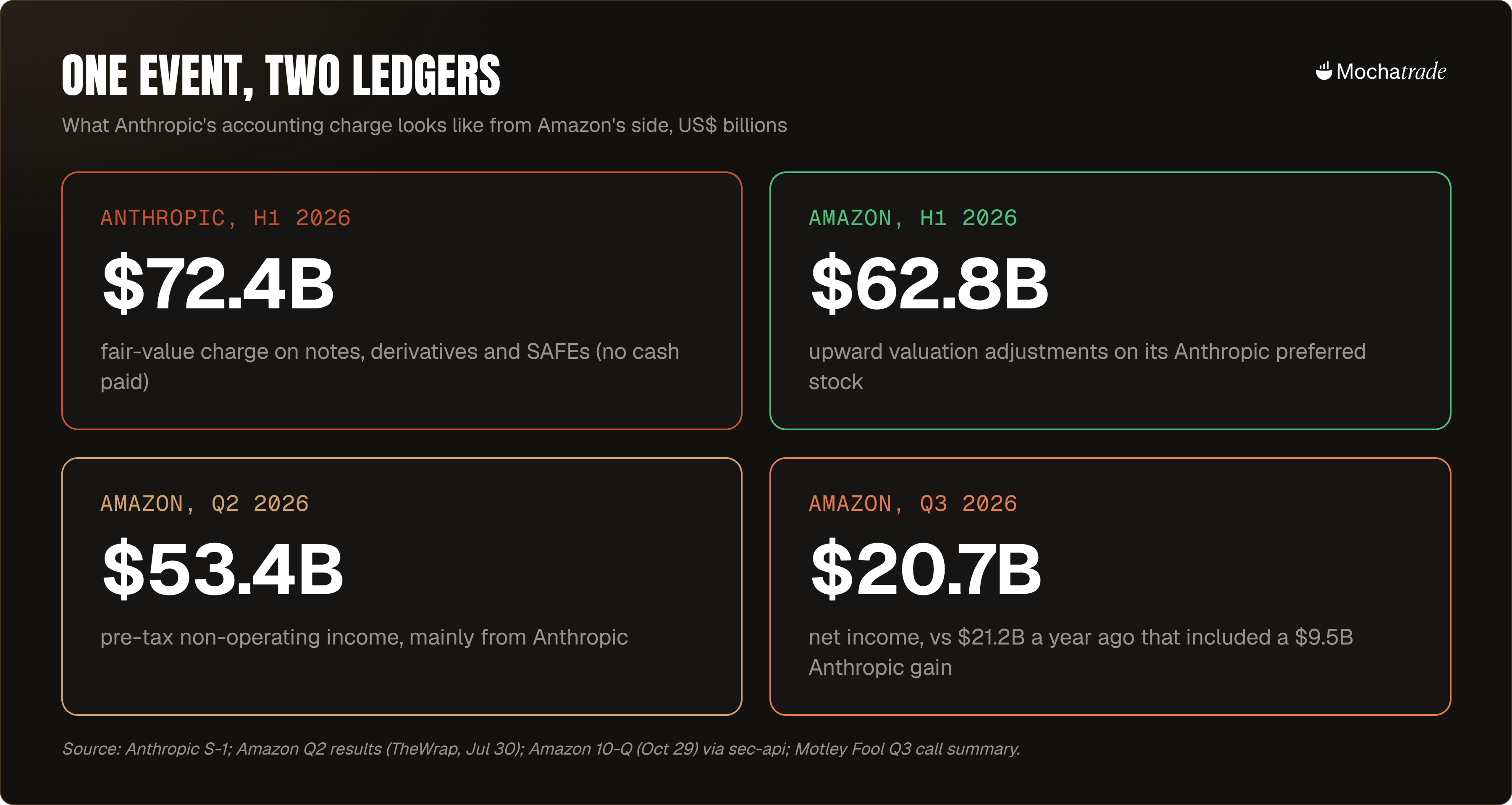
Mostly the note holders, and the largest is Amazon. An analyst thread on X reading the S-1 puts Amazon's total at about $18 billion, split into $8 billion of notes from 2023 to 2025 and $10 billion of preferred stock in the second quarter of 2026. When Anthropic's valuation rises, Amazon books a gain on the same instruments.
Source: TheWrap, Amazon 10-Q via sec-api, Motley Fool.
Amazon's second-quarter profit of $62.6 billion included $53.4 billion of non-operating income, mainly from its Anthropic stake. The two sides do not match to the dollar, since Google and others also hold notes. Amazon also sells Anthropic computing, with $110 billion of commitments, so it is investor and supplier at once.
How Is The Business Doing Now?
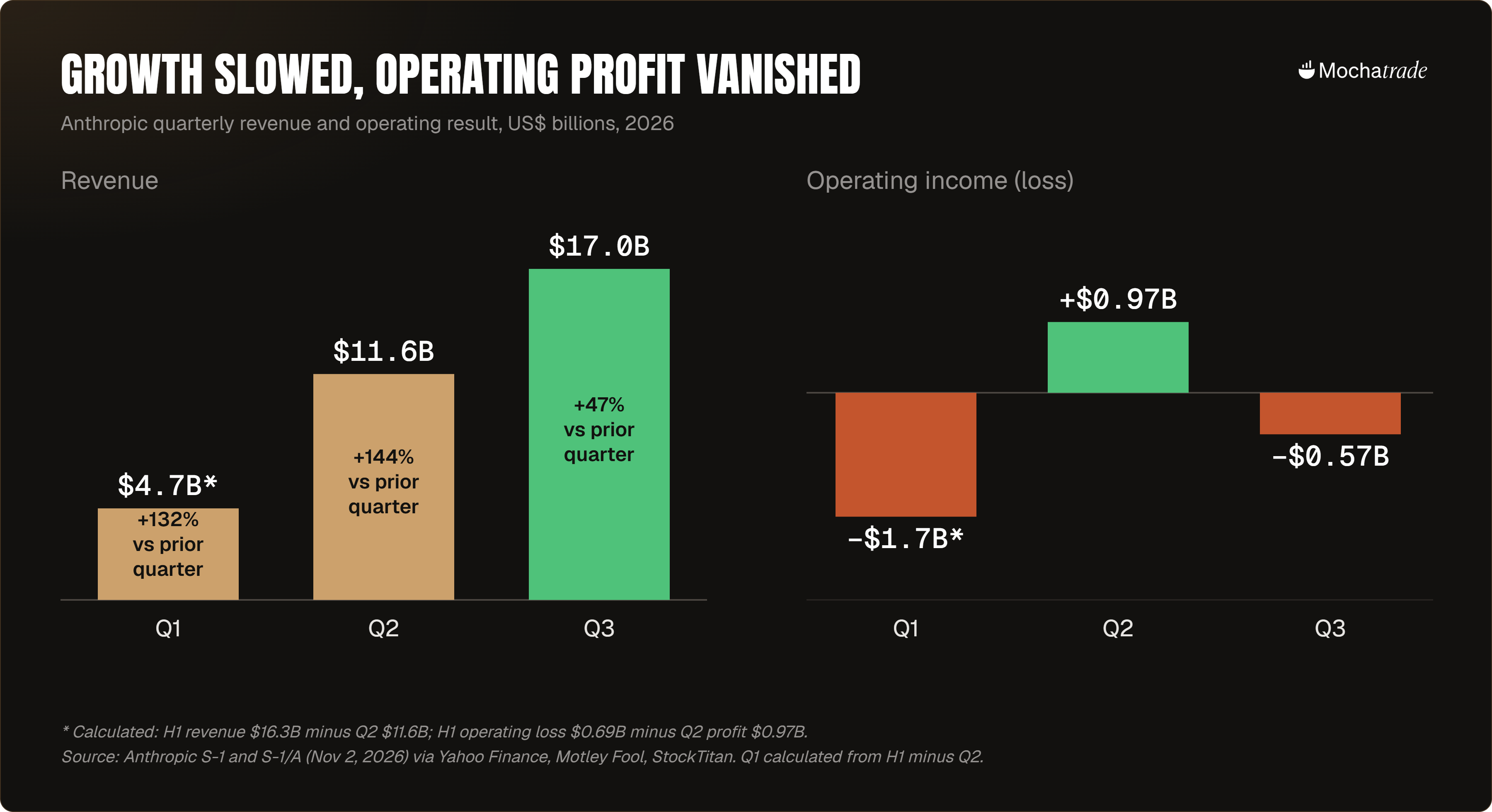
Revenue is still growing quickly, but growth cooled and the operating profit disappeared. Operating income is revenue minus the costs of running the business, before interest and investment revaluations. Third-quarter revenue was nearly $17 billion, up 47% from $11.6 billion in the second quarter and about 12 times a year earlier. Second-quarter growth had been 144%. The talk of a lower valuation came as that pace slowed, and 47% is still fast growth.
Source: Anthropic S-1/A via Yahoo Finance, Motley Fool, StockTitan.
Operating income went from a $974 million profit in the second quarter to a $567 million loss in the third. The filing points to $5.0 billion of short-term computing that costs more than multiyear contracts, and price cuts and discounts took about $600 million off revenue. Calculated from the filing, computing and infrastructure ate 58% of third-quarter revenue ($9.9 billion of $17.0 billion), up from about 48% in the prior quarter per Damodaran.
Before the amendment, CNBC reported that Anthropic expected a second straight quarter of adjusted operating profit. That measure leaves out costs such as stock-based compensation, so it differs from the operating loss above.
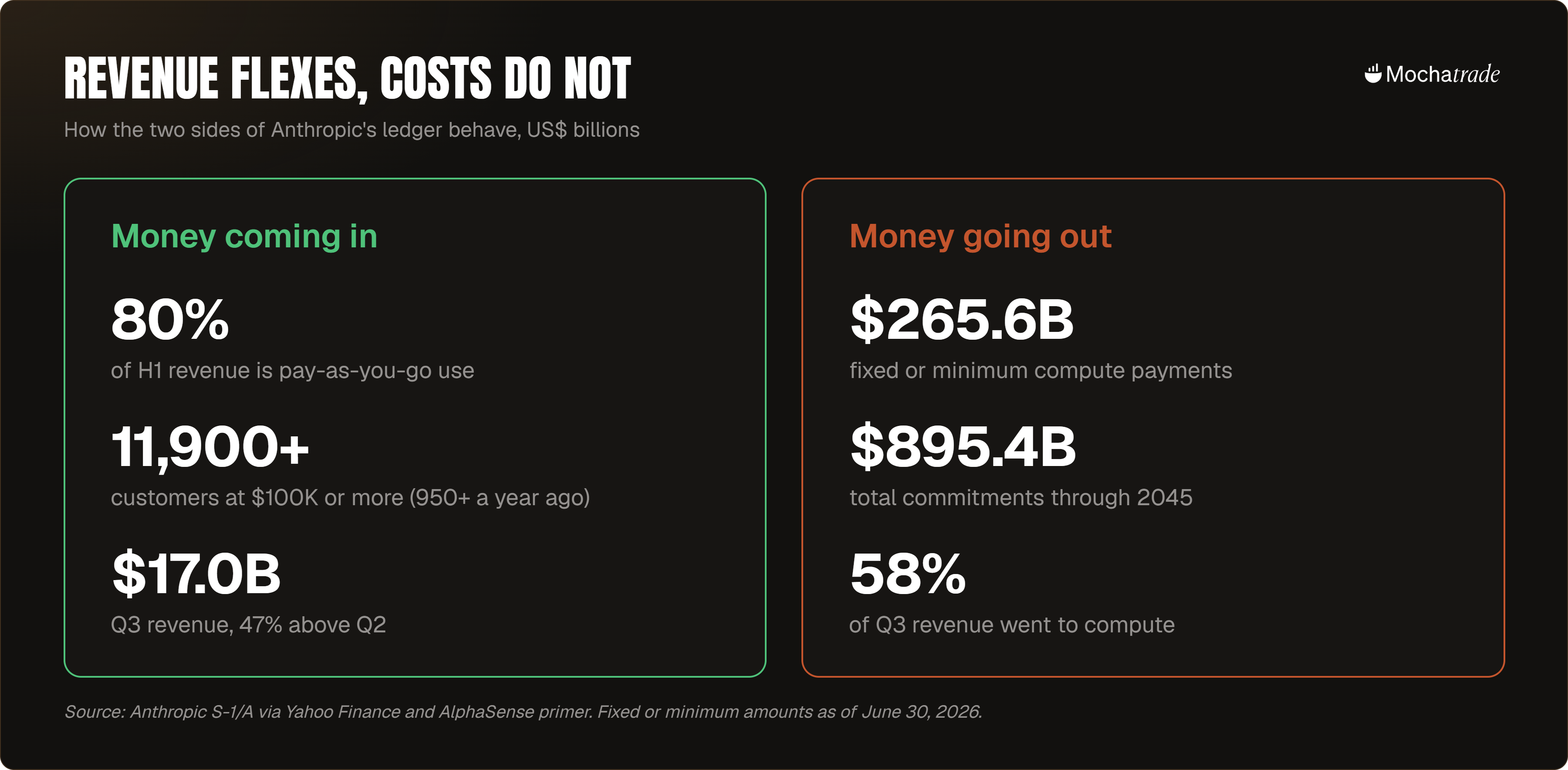
Most of that revenue is pay-as-you-go. Usage-based sales were $13.1 billion, about 80% of first-half revenue, with subscriptions at $3.2 billion. Customers at or above $100,000 a year passed 11,900 at September 30, from about 950 a year earlier, and roughly 250 spend $10 million or more.
What Does Anthropic Owe For Computing?
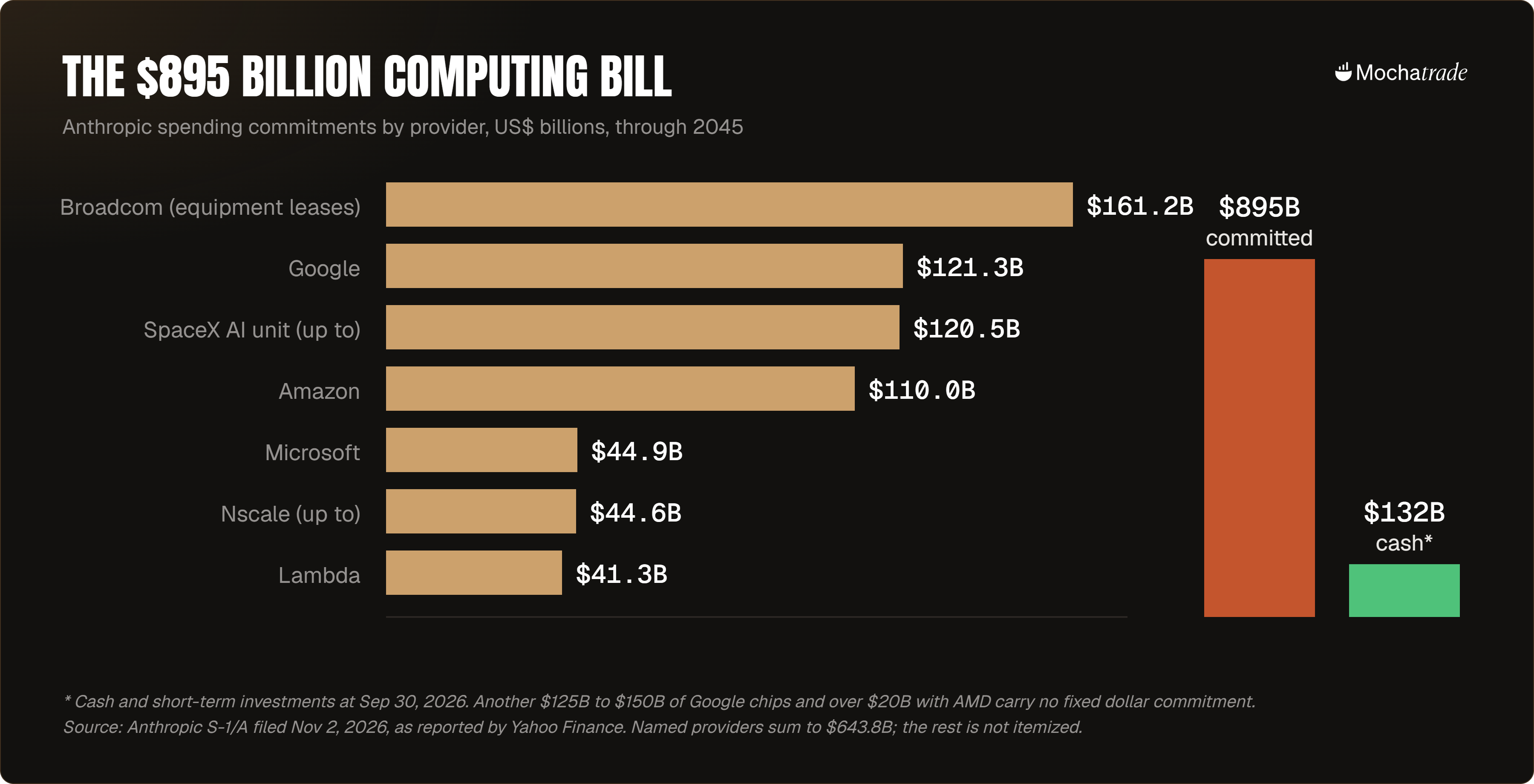
Anthropic has $895.4 billion of spending commitments through 2045, about seven times its $131.8 billion of cash and short-term investments (about ₹85 lakh crore against ₹12.5 lakh crore). A commitment is a contract to buy computing in future years. It stays off the balance sheet as debt, yet the payments are real.
Source: Anthropic S-1/A via Yahoo Finance.
Nearly half falls due by the end of 2030, and about $69.8 billion within 12 months of September 30. Google chips worth another $125 billion to $150 billion and more than $20 billion with AMD carry no fixed dollar amount. NYU professor Aswath Damodaran argues in his October 28 valuation that obligations a company must pay belong in the valuation like debt, discounted back to today.
The commitments differ in how firm they are. The AlphaSense primer counts $265.6 billion as fixed or minimum payments at June 30, owed whether or not Anthropic uses the computing. Google (at least about $114.5 billion) and Amazon Web Services (at least $110 billion) make up most of it. Some Microsoft and SpaceX AI tranches can be canceled. Revenue moves with demand while this bill does not, which is why a growth slowdown matters more here than at a typical software company.
The $895.4 billion figure comes from the November 2 amendment. The original S-1 carried $542 billion to $567 billion.
Source: Anthropic S-1/A via Yahoo Finance and AlphaSense primer.
What Is Anthropic Worth, And Who Gains Most?
Reported IPO talk of $1.5 trillion to $1.6 trillion is about 1.6 times the May private round. Damodaran's own estimate is $1.475 trillion, at the low end of the range, and he says he would sit out at a price well above it. His inputs use first-half data, so they predate the third-quarter amendment.
Source: analyst table on X, WSJ, Motley Fool, Damodaran.
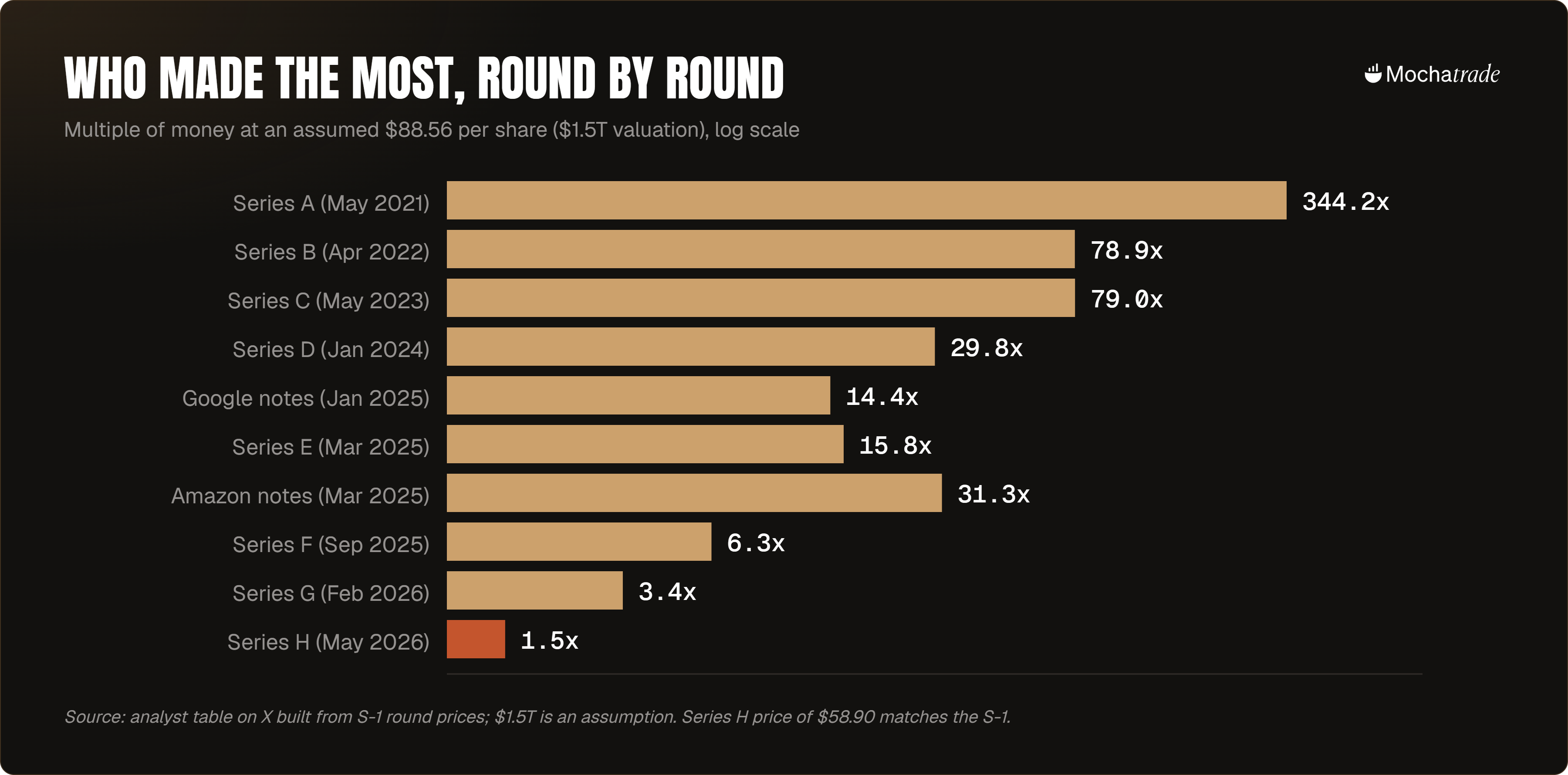
The analyst thread assumes a $1.5 trillion valuation, or $88.56 per share. Series H buyers paid $58.90, so they sit on 1.5 times their money; the earlier the round, the bigger the multiple. Across all rounds, the table shows a blended 6.45 times on about $142 billion invested, or roughly $919 billion of value. The S-1 puts total capital raised at $141.1 billion, so the table is close. Control is separate: a trust elects a majority of the board and a founders' vehicle holds 50.1% of the vote for the other seats, leaving IPO buyers one vote per Class A share.
Source: analyst table on X built from S-1 round prices.
What Do Supporters And Skeptics Point To?
Every IPO invites two readings of the same filing, and this one has material for both. The graphic lists the main points each side makes. None of it predicts how the shares would trade.
Supporters of the listing point to these facts.
Revenue grew about 14 times, from $1.2 billion in the first half of 2025 to $16.3 billion in the first half of 2026.
Customers paying $100,000 or more a year passed 11,900, up from about 950. Those paying $1 million or more passed 1,900.
About 80% of revenue is usage-based, so it rises when customers use more.
Operations produced $6.6 billion of cash in the first nine months. The company reports an adjusted operating margin of 10% for the first half and 11% for the third quarter, a company-defined measure.
Skeptics point to these.
Operating income fell from a $974 million profit in the second quarter to a $567 million loss in the third, and quarterly growth dropped from 144% to 47%.
Commitments of $895.4 billion sit against $131.8 billion of cash, and $265.6 billion of that is fixed or minimum. Computing took 58% of third-quarter revenue, by calculation from the filing.
Many large customers have no long-term contract. Reuters reported that two unnamed customers made up nearly a quarter of 2025 revenue, while another report says no customer passed 10% over nine months.
Amazon, Google and Microsoft supply Anthropic and also sell competing models. Listed risks include the Defense Department's supply-chain-risk label, electricity supply and local opposition to data centers, and FTC subpoenas. Press reports of the filing also describe warnings that advanced AI could pose existential risks to humanity.
A trust elects most of the board, and founders hold 50.1% of the vote.
What Can Readers Watch Before The Listing?
Two items will fill in most of the missing pieces, and each can be checked on SEC EDGAR or in the news.
The next amendment to the S-1, which should add the price range and share count. Compare it with the $58.90 paid in May.
Fourth-quarter revenue growth, set against that $895 billion of commitments. Whether growth holds near 47% or slips further is a useful test of the price talk.
Educational content only. Not investment advice.
MochaLearn is a free A to Z course on understanding and trading US stocks and commodities, built for Indian traders.
Terms in this story
- NASDAQNasdaq is the American exchange that began in 1971 as one screen showing every dealer quote side by side, the first…
- RevenueRevenue is the total money a company takes in from sales before any costs, the top line. Growth companies are judged…
- Operating marginOperating margin is operating profit as a percent of revenue: what is left after making the product and running the…
- SECThe SEC is the US Securities and Exchange Commission, the referee Congress built after 1929 exposed how little buyers…