November 2, 2026 · Mochatrade · 8 min read
Mocha Markets Weekly
Alphabet and Intel paid for their forecasts, Amazon got a pass, and Apple, Palantir and AMD report next.

This week is mostly three things: earnings results (a company's quarterly report card), guidance (the forecast a company gives for its next quarter or year), and the jobs report, which lands on Friday with the Fed's December decision leaning on it. On MochaLearn, US earnings and how the Fed moves markets each get a full lecture built for Indian traders. Start here is for anyone who has never traded a US stock.
01 The US week behind. Alphabet's worst day on record, Intel's 28.6% fall, and a Fed hold.
02 The US week ahead. Apple and Palantir on Monday night, AMD on Tuesday, and Friday's jobs report.
03 One concept. Why a company can beat on profit and still watch its stock fall.
04 One chart. The after-hours move against the next close.
01 The US Week Behind
1. Why Did Alphabet Fall 12.6% While Microsoft Finished Flat?
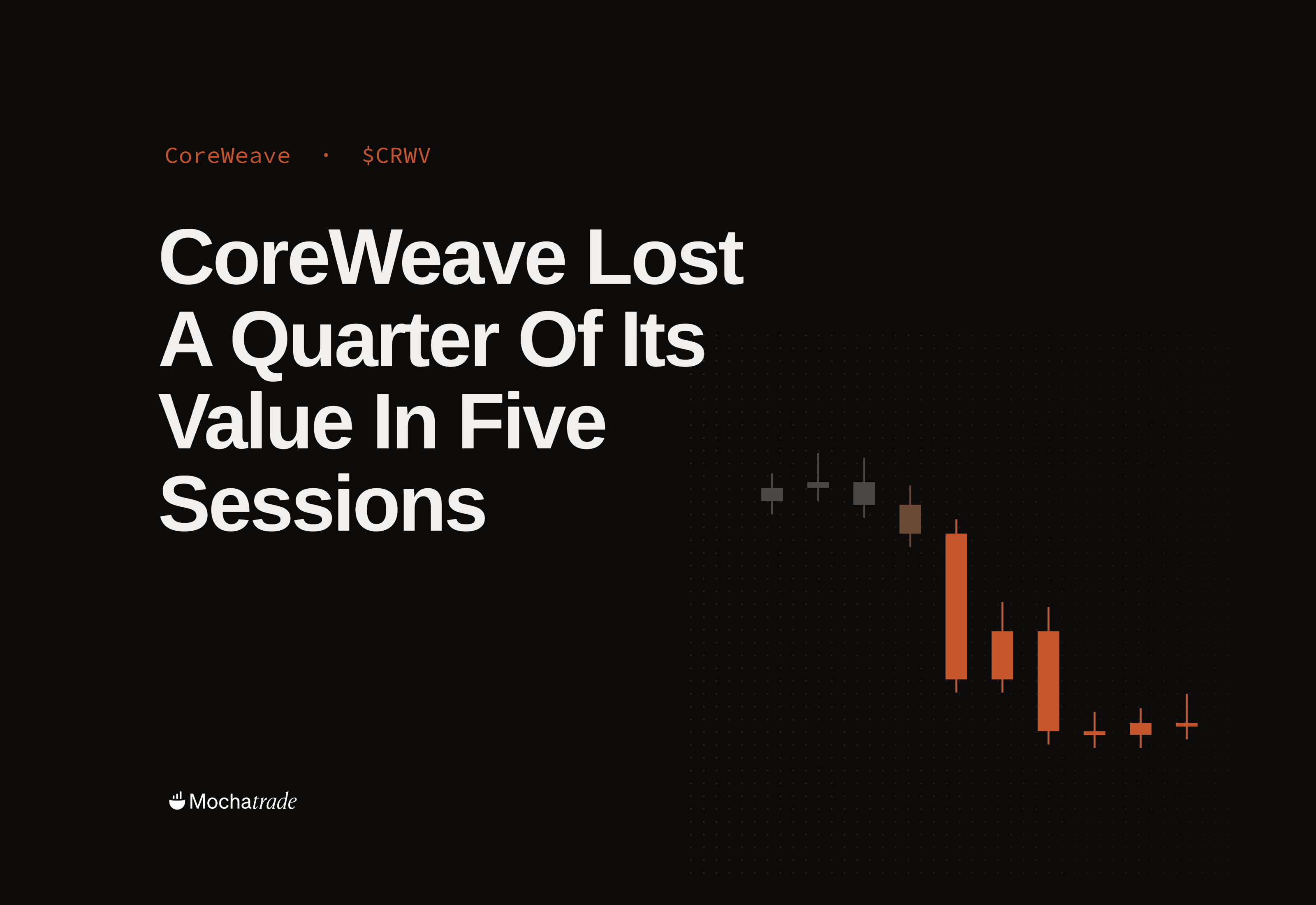
Alphabet and Microsoft both reported on Wednesday night. Alphabet missed what analysts expected on revenue and on earnings per share, and Thursday's 12.6% fall was the biggest one-day drop in its history (Reuters has 13.2%, CNBC 12.6%, and I use the lower figure). Headlines quoted the miss, but capex, the money a company puts into buildings and chips, decided the move.
Alphabet spent $51.4 billion on capex last quarter, more than double the $24.0 billion a year earlier.
It kept its 2026 range at $195 billion to $205 billion and said 2027 spending will increase significantly.
Microsoft's revenue was $92.28 billion, up 19%, and Azure (its cloud business, which rents computing power to other companies) grew 48%.
Its free cash flow, the cash left after paying for those buildings, was $18.6 billion.
Its shares rose about 4% after hours (trading after the 4 PM US close) and finished Thursday down 0.16%.
Smaller AI cloud companies took the hit on Thursday, and software stocks fell with them. Sources disagree on Microsoft's full-year capex guide, so the number is best left out.
CoreWeave fell 4.99% and Nebius 5.68%, as Microsoft's spending came in below expectations.
ServiceNow lost 27.0% and Fortinet 20.1% after their own reports.
2. Why Did Intel Fall 28.6% After Beating on Profit?
Intel reported on Thursday night. The numbers split in two directions.
Adjusted earnings were $0.52 a share, above estimates.
Data center revenue rose to $7.3 billion, almost 80% more than a year ago.
The forecast for the fourth quarter came in well below what analysts wanted, with Intel pointing to a plant shutdown in Israel and weak PC demand.
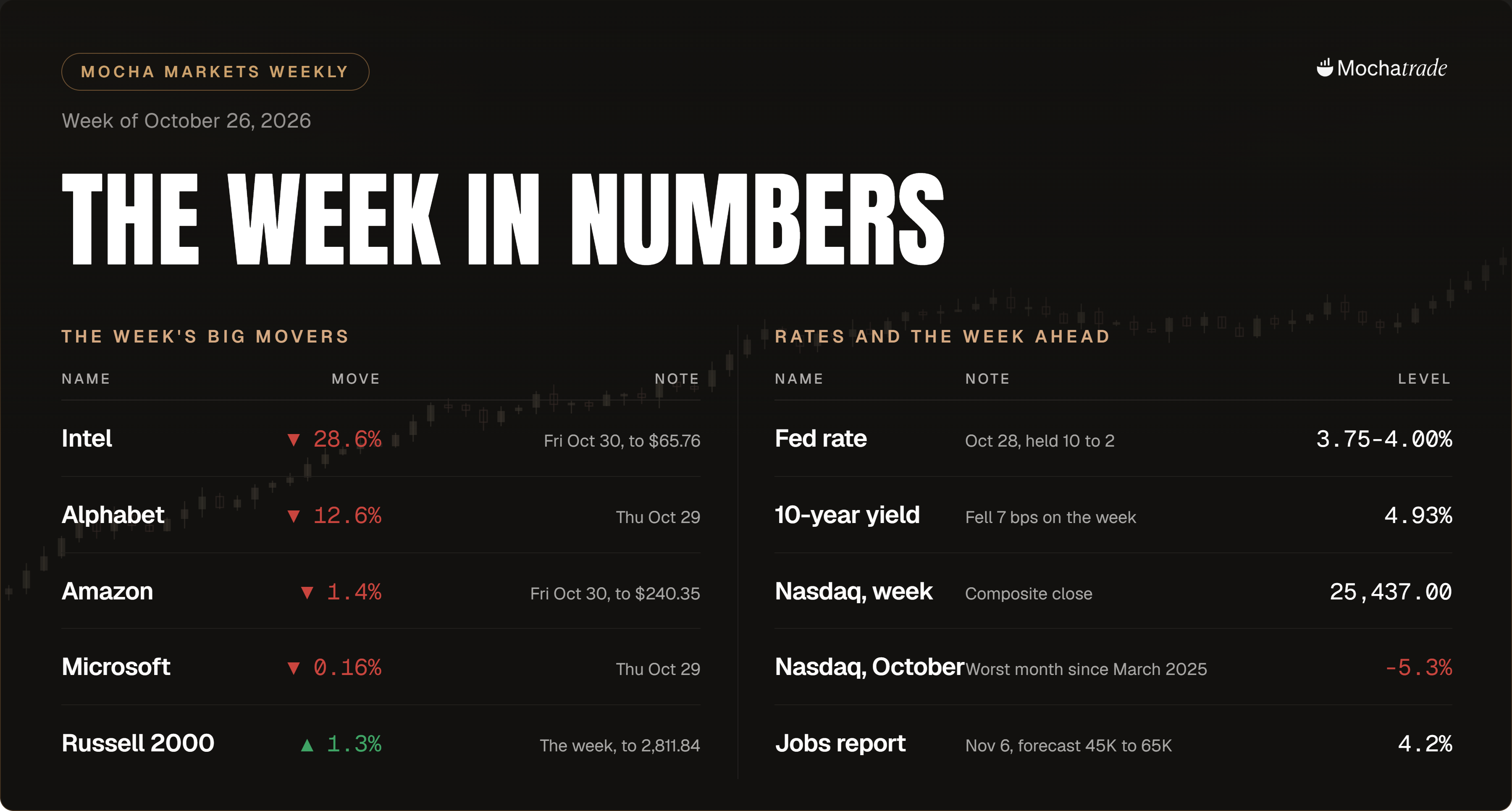
On Friday, the stock fell 28.58% to $65.76 and lost about $140 billion of market value.
3. Did The Fed Explain The Nasdaq's Week?
Not by itself. On Wednesday night (11:30 PM IST) the Fed held its interest rate at 3.75% to 4.00%, with two of its twelve voters wanting a hike, and CME FedWatch, a free tool that turns futures prices into rate odds, now puts a December hike at 82.6%. Falling yields usually help tech stocks, and the 10-year Treasury yield, the rate on 10-year US government bonds, fell 7 basis points (0.07 percentage points) to 4.93%. Tech fell anyway, so rates explain little of this week.
The Nasdaq Composite, an index of mostly tech stocks, fell 2.86% on Friday alone and 2.0% for the week to 25,437.00, its third straight weekly loss.
The S&P 500, which tracks the 500 biggest US companies, fell 0.57% to 7,580.07.
The Dow, a set of 30 large companies, fell 0.85% to 51,770.31.
The Russell 2000 of smaller companies rose 1.3%.
October as a whole cost the Nasdaq 5.3%, its worst month since March 2025.
02 The US Week Ahead
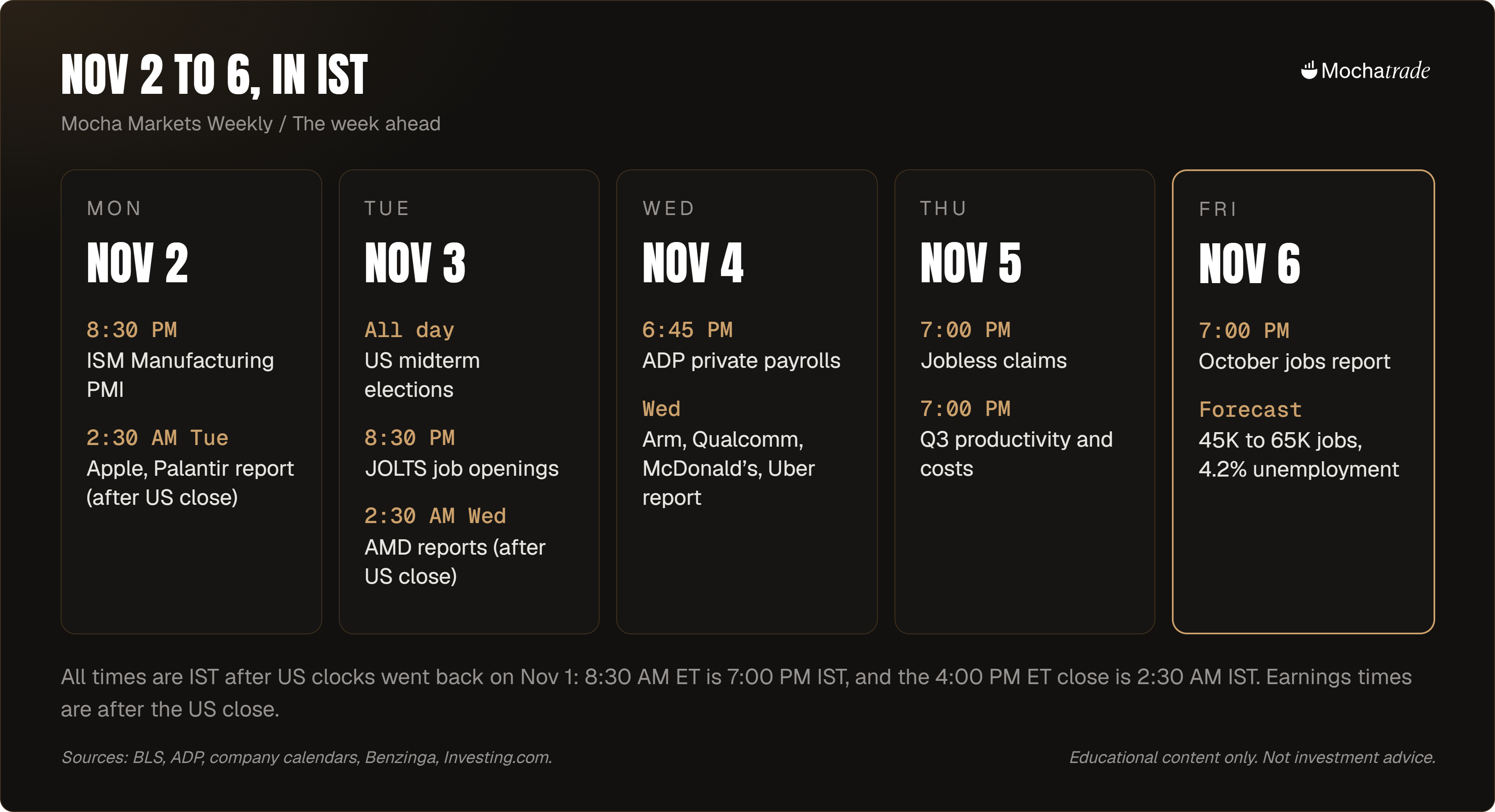
1. Monday, November 2, After The US Close (About 2:30 AM IST Tuesday): Apple And Palantir Report
Context. Apple makes the iPhone, and this is its first report under CEO John Ternus. Palantir sells data and AI software to governments and companies, and its stock stands in for the AI software trade.
What's happening. Both report after the US close, so the market reacts overnight in India. Analysts expect:
Apple to earn $1.99 a share on $113.38 billion of revenue.
Palantir to earn $0.41 a share on $2.18 billion.
What to look out for. The forecast comes before the headline number. For Apple that means supply limits and memory costs, and for Palantir it is next quarter's revenue guide.
Why this matters. Palantir's stock already carries a high bar. Intel just showed what missing one costs.
2. Tuesday, November 3, After The US Close (About 2:30 AM IST Wednesday): AMD Reports
Context. AMD makes chips for PCs and data center servers and competes with Intel. Tuesday is also US midterm election day. AMD reports after the US close, so its numbers land overnight in India.
What to look out for. The fourth-quarter forecast. Intel blamed weak PC demand and a plant shutdown, and AMD's guide hints at how much of that is Intel's own problem.
Why this matters. Intel fell short of its forecast. AMD's is the next data point from the same corner of the chip industry.
3. Friday, November 6, 7:00 PM IST: The October Jobs Report
Context. Each month the Bureau of Labor Statistics counts how many jobs US employers added, known as payrolls. September came in at 29,000, and unemployment rose to 4.2% from 4.1%.
What's happening. The report lands Friday at 7:00 PM IST. Economists expect:
45,000 to 65,000 new jobs, with the middle of the forecasts at 55,000 to 62,000.
Unemployment to hold at 4.2%.
Why this matters. Traders already price in roughly 80% odds of a December hike. A strong number pushes them higher, and a weak one pulls them back.
03 One Concept
Intel beat on profit and lost 28.6%. What does it mean when news is already priced in?
A stock price is a bet on future cash, so when a company reports, the quarter that just ended is old news. Analysts have published estimates, and the price already leans on them, which is why beating them moves the stock only a little. Guidance is the new information. If a company beats and then forecasts a weaker quarter, the price you paid was for something that is no longer coming.
If you have traded Nifty stock options on results day, you have seen it. The premium already holds the expected move, so a stock can beat and still fall. So, priced-in works in two steps.
1. The market subtracts what it expected from what happened.
2. It adds the new forecast, and this second step moves most of the money.
Intel and Amazon show both steps at work. Each had good news and bad news in the same report.
Intel had a profit beat and data center growth of almost 80%, then a weak forecast, and the stock fell 28.6%.
Amazon's free cash flow over the past year was negative $42.4 billion, meaning it spent more than it brought in, and it missed estimates. The stock was down 7.3% after hours on Thursday.
Then Amazon told analysts that AWS, its cloud business, should grow more than 40% in both 2027 and 2028. Friday's close was down only 1.41%, at $240.35.
Nobody can prove the forecast caused Amazon's recovery, but it is the likeliest explanation. Burning cash does not predict the outcome alone, since Alphabet and Amazon both spent more than they earned and ended the week in different places. My read: on results night, open the forecast before the headline number.
04 One Chart
After-hours moves against the next close, and the index moves behind them. Both charts end on Friday, October 30.
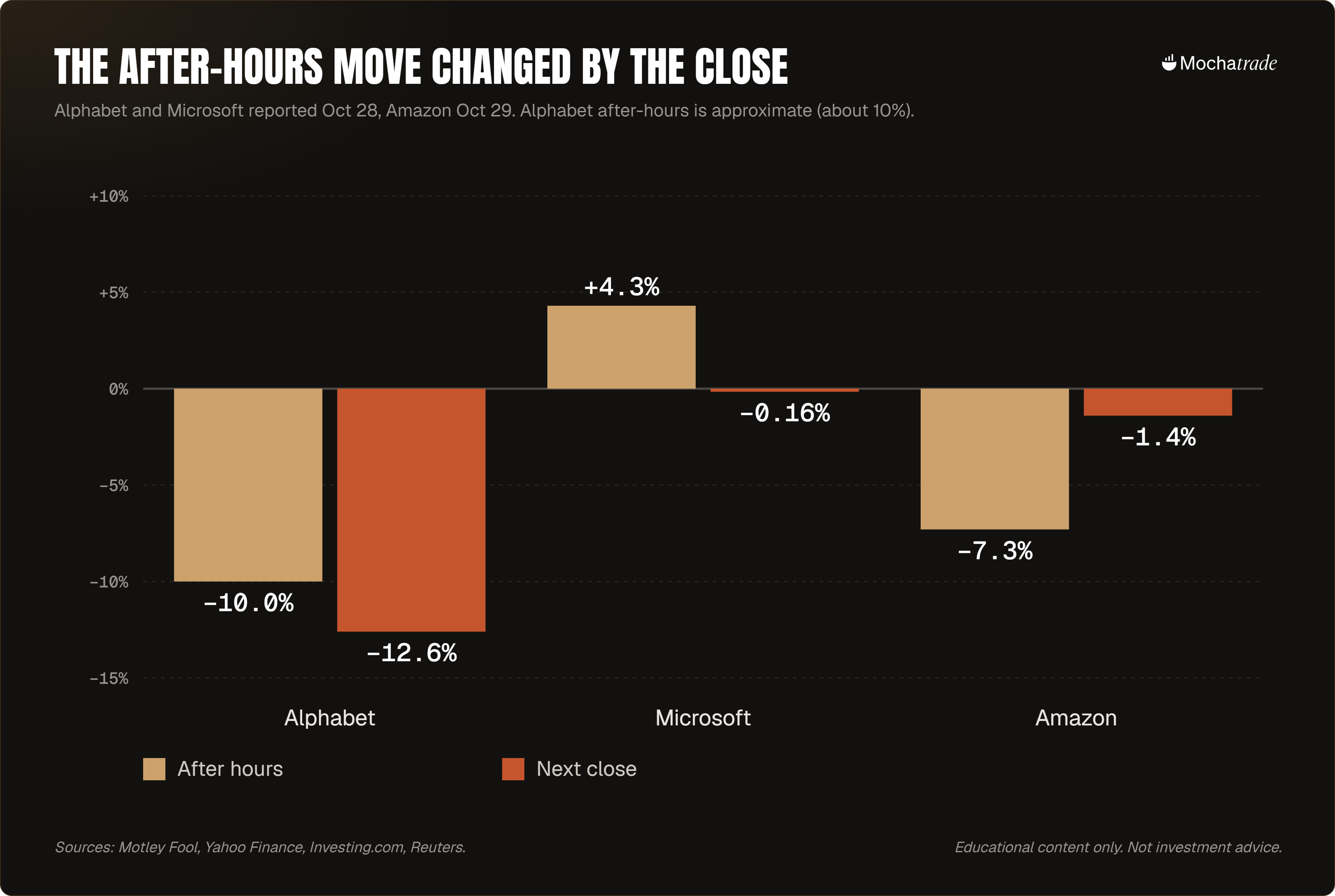
Chart 1: after-hours move against the next close. Source: Motley Fool, Yahoo Finance, Investing.com, Reuters.
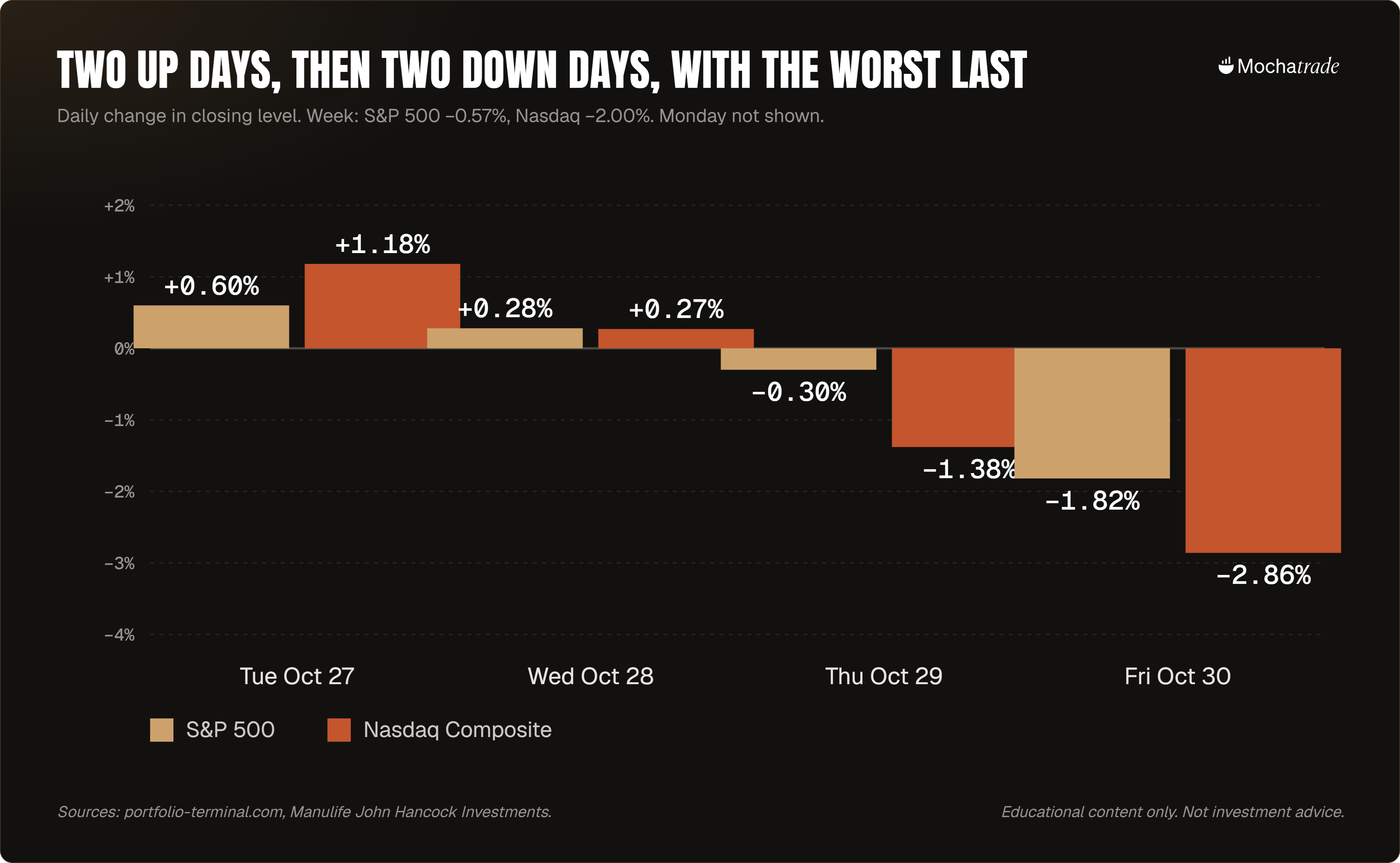
Chart 2: S&P 500 and Nasdaq Composite daily change, Oct 27 to 30. Source: portfolio-terminal.com, Manulife John Hancock Investments.
Chart 1 sets the after-hours move beside the next close. Alphabet and Microsoft reported on Wednesday and Amazon on Thursday, so read each pair on its own.
Alphabet fell about 10% after hours and 12.6% by the close.
Microsoft gained 4.3% after hours and ended 0.16% lower, a swing of about 4.5 points (my calculation).
Amazon dropped 7.3% after hours and ended 1.4% lower.
The earnings call and the forecast came after the first after-hours trades, and the close reflects them. Chart 2 shows the indexes rising on Tuesday and Wednesday, then falling on Thursday and Friday, with the Nasdaq's 2.86% drop the week's largest.
What to Take From This Week
1. A beat-analysts' expectations moves a stock a little. A forecast moves it a lot.
2. An after-hours move can change by the close, in either direction.
3. Friday's jobs report matters because it moves the odds of a December hike.
Apple's and Palantir's numbers land at about 2:30 AM IST, so the market reacts overnight in India. Trade those hours, in rupees, at Mochatrade. Join the waitlist.
Educational content only. Not investment advice.
MochaLearn is a free A to Z course on understanding and trading US stocks and commodities, built for Indian traders.
Educational content only. Not investment advice.
MochaLearn is a free A to Z course on understanding and trading US stocks and commodities, built for Indian traders.
Terms in this story
- RevenueRevenue is the total money a company takes in from sales before any costs, the top line. Growth companies are judged…
- Free cash flowFree cash flow is the cash a business brings in from operations minus what it spends on equipment and buildings.…
- NASDAQNasdaq is the American exchange that began in 1971 as one screen showing every dealer quote side by side, the first…
- CME FedWatchCME FedWatch turns futures on the overnight rate into a probability for each outcome at every Fed meeting. It is what…
- 10-year Treasury yieldThe ten-year Treasury yield is the benchmark long rate that mortgages, company debt and stock valuations are priced…
- Treasury yieldA Treasury yield is the annual return on a US government bond at today's market price; when the price falls, the yield…
- S&P 500The S&P 500 is about five hundred of the largest American companies, weighted by market value, and the number money is…
- Russell 2000The Russell 2000 is about two thousand smaller American listed companies, the standard measure of US small caps. They…
- Expected moveThe expected move is the size of move the options market is pricing for an event: add the at-the-money call and put…
- Earnings callThe earnings call is the conference call where management discusses results and takes analyst questions, usually…