November 9, 2026 · Mochatrade · 8 min read
The AI Sell-Off Explained: Compute, Debt, and Policy
A 4.36% one-day drop in the S&P 500 traces back to chips, free cash flow, borrowing, and a Texas order.
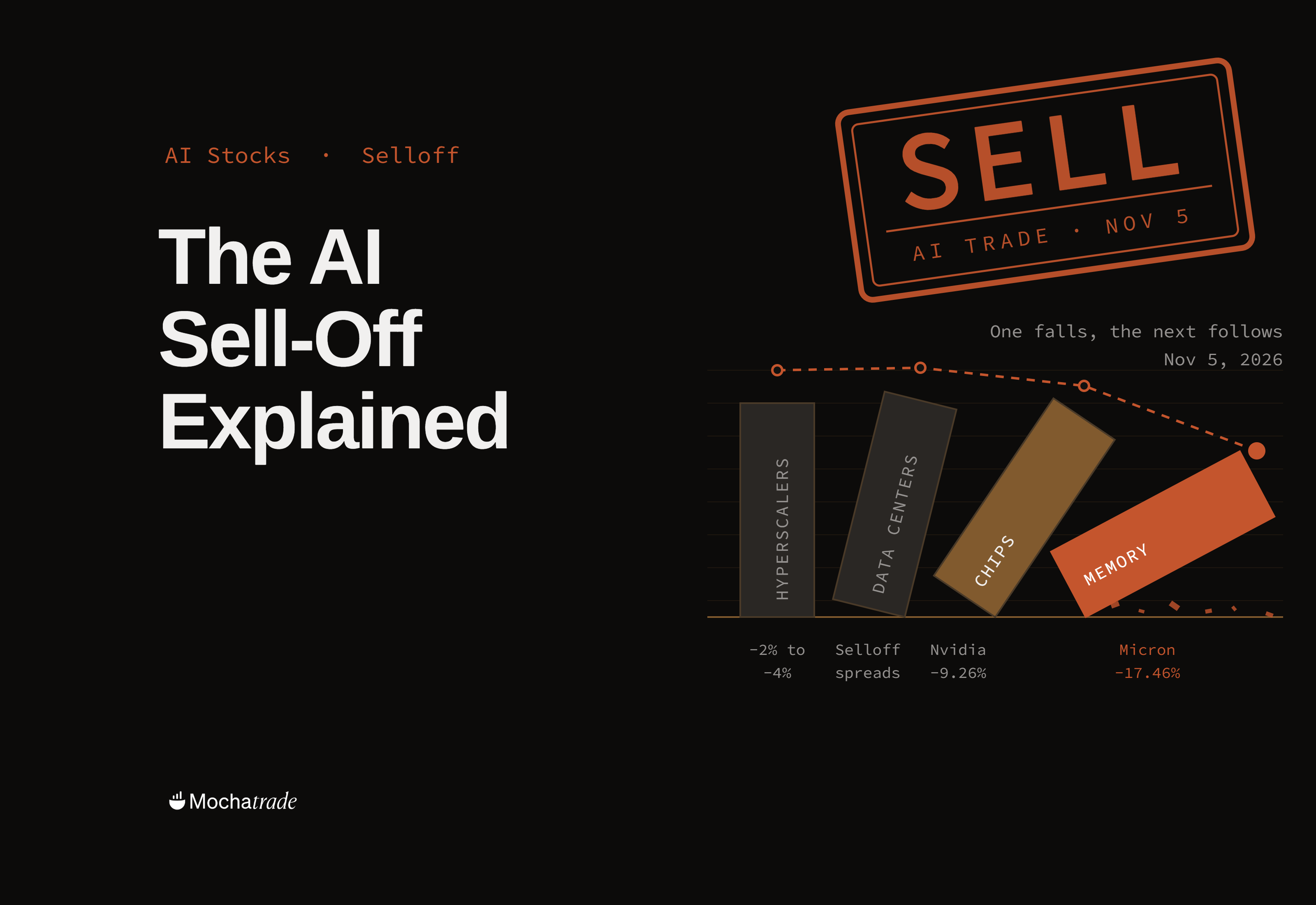
US stocks fell sharply on Thursday, November 5, 2026, and Asian markets followed on Friday. Explaining it takes three pieces: what AI compute is, how the companies buying it pay for it, and how an election and a pause on power connections in Texas reached chip stocks as far away as Seoul. Along the way, the article checks which popular explanations hold up against the data.
What Happened On November 5, 2026?
The S&P 500, an index of 500 large US companies, fell 4.36% on Thursday, its worst day since April 2025. Closing moves, according to a market wrap and a Dow report:
S&P 500: down 4.36%, its worst day since April 2025
Dow Jones Industrial Average: down 1,833 points, or 3.44%, to 51,523.06
Nasdaq Composite: down 5.52%, closing more than 10% below its recent high (a fall of 10% or more from a peak is called a correction)
Philadelphia Semiconductor Index (SOX): down 12.25%; it tracks the largest chip makers and did worst
VIX: up about 66% to 70% to roughly 28, its highest since March 31; it is a gauge of expected volatility, often called the fear index
Sources differ on the exact VIX jump and on whether 28 was the close or the intraday high.
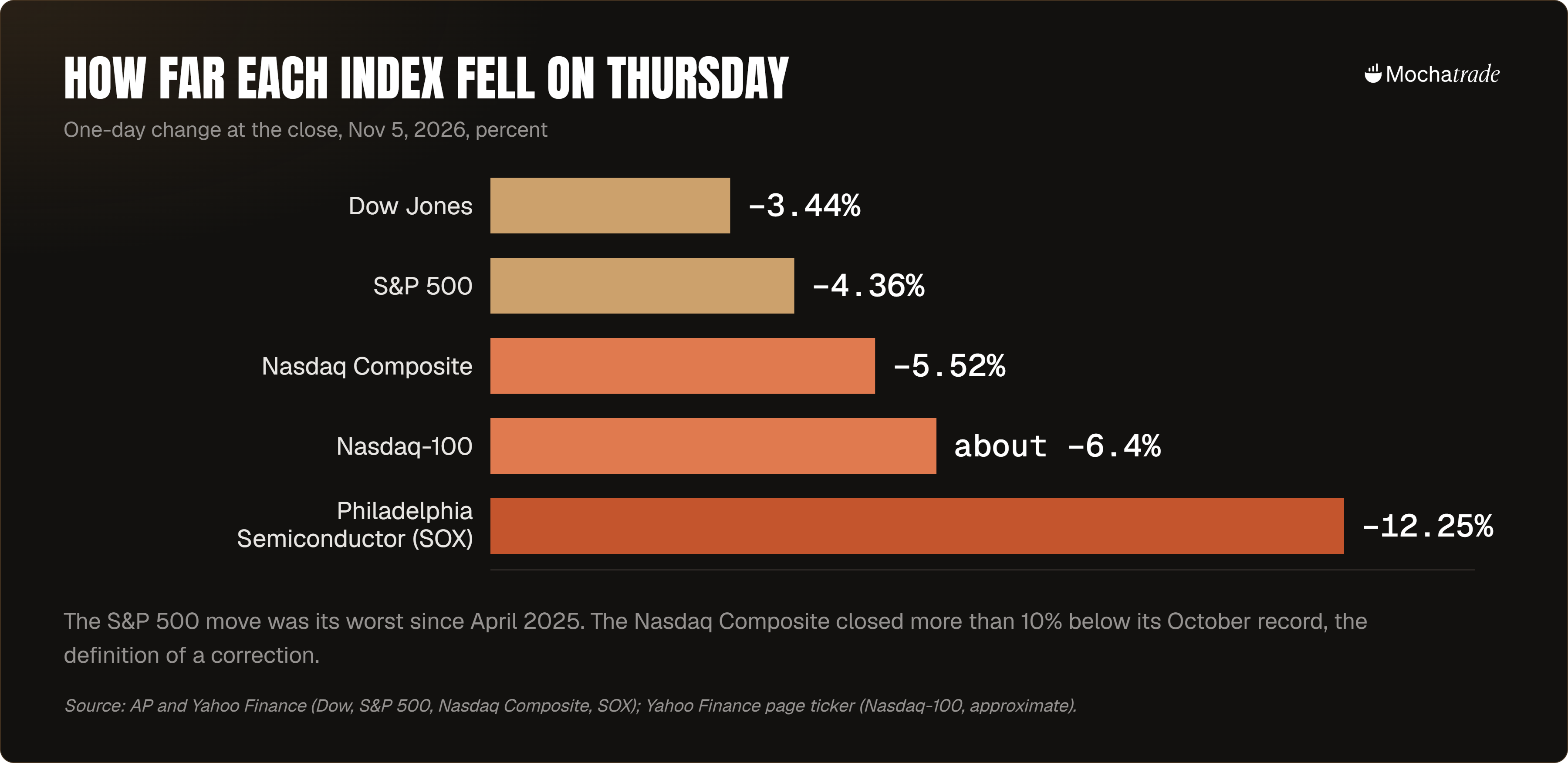
Index moves at the close, November 5, 2026
Thursday reversed a rally. The Dow had gained about 3% on Wednesday, its best day since April 2025, after Democrats won Congress and oil fell about 8%. Thursday's loss was larger than that gain.
Single stocks fell harder, per StockTitan's closing summary and Benzinga:
Micron: down 17.46%
AMD: down 17.26%
Marvell: down 16.43%
Nvidia: down 9.26%, a loss of more than $440 billion (about ₹42 lakh crore) in market value
SanDisk: down more than 22%
The S&P 500 lost roughly $3 trillion in market value (about ₹285 lakh crore), in line with Fortune's report of about $3 trillion for US stocks overall. CNN counted about $2.5 trillion (about ₹238 lakh crore) for Wall Street as a whole.
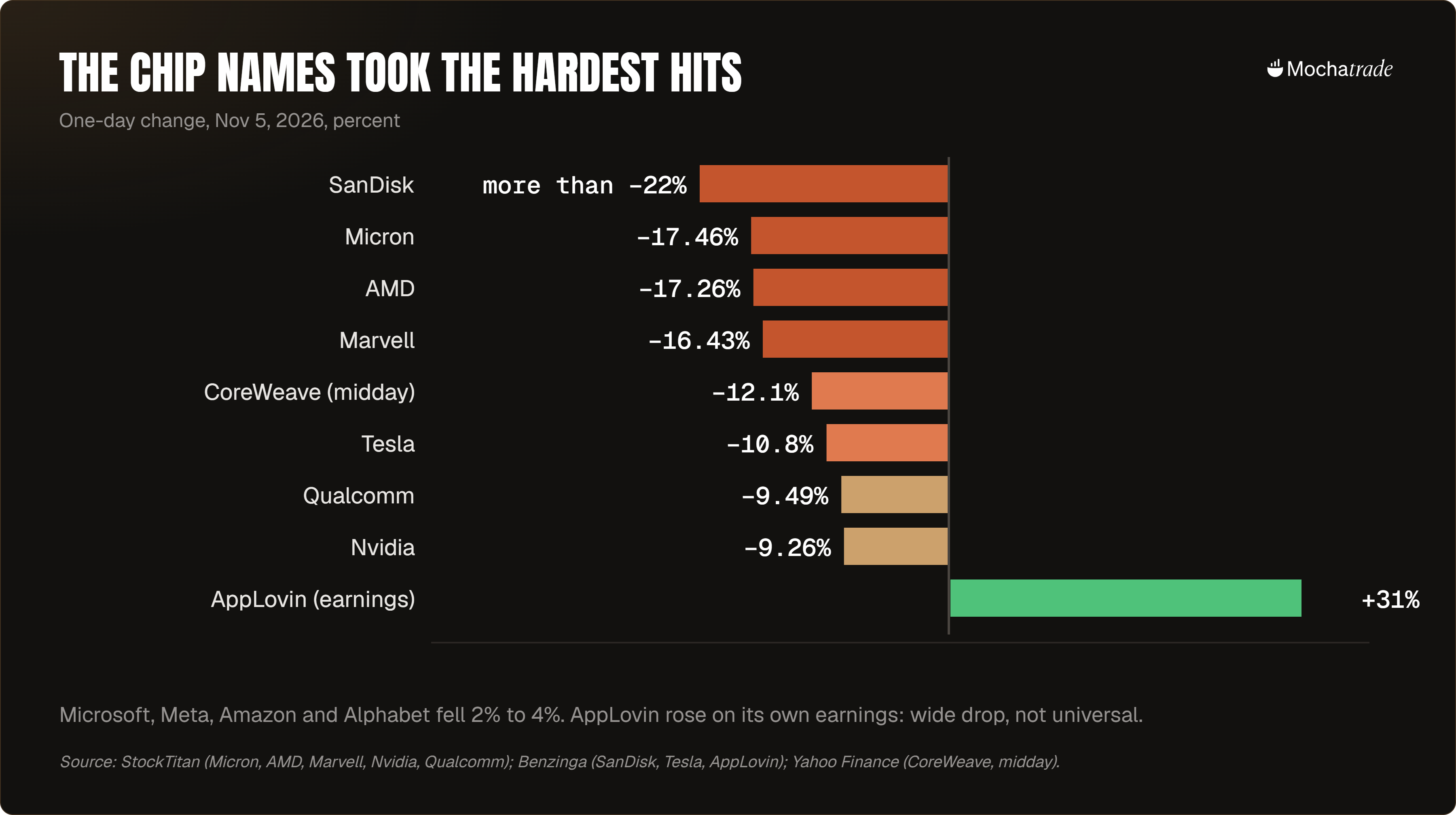
Selected one-day stock moves, November 5, 2026
Asia opened Friday under pressure. South Korea's Kospi index fell more than 8% at the open, and the Korea Exchange halted trading for 20 minutes. By 11:20 a.m. in Seoul (7:50 AM IST), the index was down 4.47% at 5,143.39, with SK hynix down more than 6% and Samsung Electronics down more than 3%, the Korea Times reported.
What Is AI Compute, And Why Does It Move Indexes?
Compute is the processing power that trains and runs AI models. It has three physical parts. Chips such as Nvidia's and AMD's do the arithmetic. Memory chips from Micron, SanDisk, SK Hynix, and Samsung hold the data those chips work on. Data centers house both and need electricity and cooling to run.
The buyers are called hyperscalers: the giant cloud companies, here Amazon, Alphabet, Meta, Microsoft, and Oracle. Their spending on buildings and equipment is called capital expenditure, or capex. One company's capex is the next company's revenue, so a doubt about capex lands first on the sellers of chips, memory, and power equipment.
Indian traders know the pattern from Bank Nifty, where a handful of heavyweights set the index level and a shift in their funding costs reaches the whole group. Here the heavyweights are the chip suppliers and the cloud buyers.
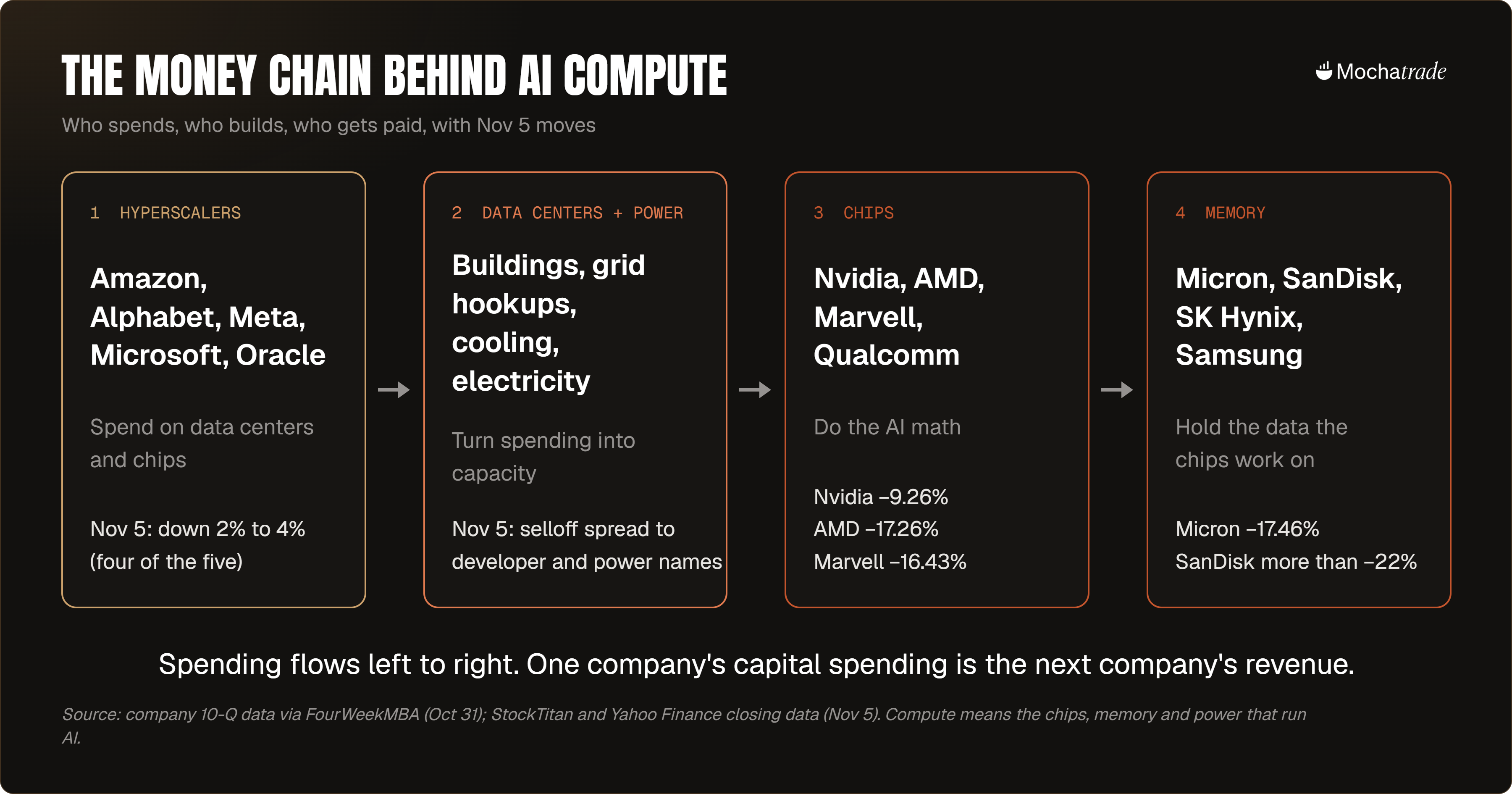
The compute money chain and its November 5 moves
The size of the buildout explains the sensitivity. Economist Jason Furman calculated that information-processing equipment and software made up about 4% of US GDP in the first half of 2025 yet accounted for about 92% of that period's growth. The figure is from 2025, but it shows how much growth has leaned on one kind of spending.
How Is The Buildout Paid For?
The spending is paid for in three stages, and the later ones lean more on lenders' confidence.
First, own cash: profits paid for the early wave. Free cash flow is operating cash flow minus equipment purchases, the money left after the company has paid to keep and grow its machinery. In the latest quarter, the five hyperscalers' combined figures were, according to FourWeekMBA's analysis of their 10-Q filings:
Capex: $230.4 billion (about ₹22 lakh crore), up from $105.8 billion a year earlier
Operating cash flow: $198.6 billion, up from $167.1 billion
Free cash flow: a $31.8 billion deficit, down from a $61.4 billion surplus
Second, debt and share sales. When cash runs short, companies borrow or sell new shares, and lenders and shareholders join the chain. They keep funding only while they believe the returns will arrive.
TThird, neoclouds. A neocloud is a specialist company that rents out AI chips by the hour and borrows heavily to buy them. CoreWeave is the best-known listed example. In October, Reuters reported:
Shares: down more than 15% in a day
Debt: about $50 billion (about ₹4.8 lakh crore)
2031 bond yield: above 16%
Backlog: $104.2 billion of contracted revenue, which the CEO has pointed to in a memo to calm staff
Nvidia has agreed to buy any unsold CoreWeave capacity through April 13, 2032.
Amazon accounts for most of the deficit, with free cash flow of about negative $34.8 billion, and Microsoft was the only one of the five with a surplus, about $18.6 billion.
A bond yield near 15% to 16% means lenders demand far more than they do from stable companies, showing the third stage is getting more expensive.
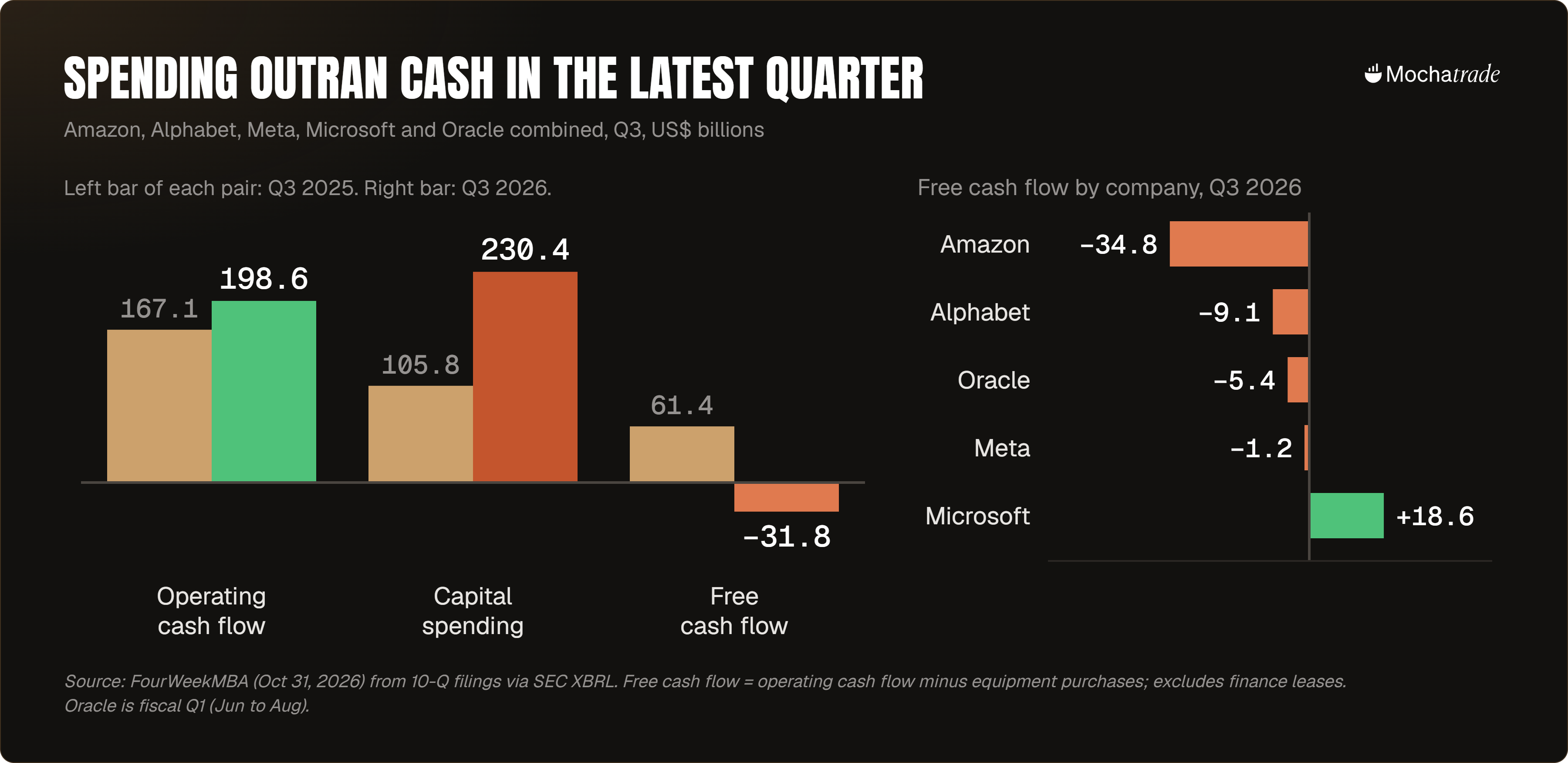
Capex against cash flow, five hyperscalers, Q3 2026 versus Q3 2025
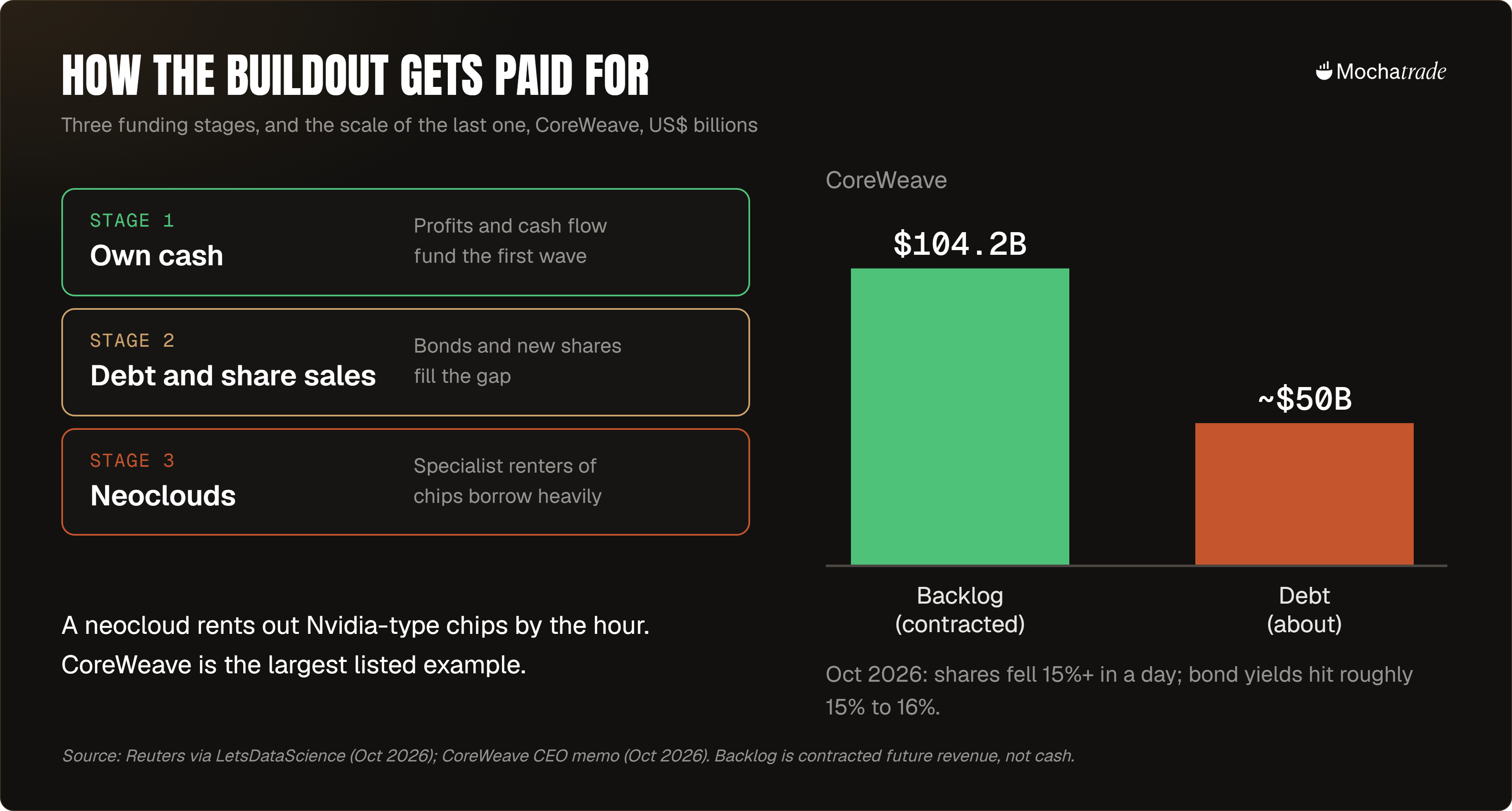
How AI infrastructure is funded, with CoreWeave's backlog and debt
Why Did A Midterm Election Reach Chip Stocks?
Cash and credit explain the pressure, and an election supplied the timing. On November 3, Democrats won both chambers of Congress, and Democrat Gina Hinojosa won the Texas governorship over incumbent Greg Abbott. Investing.com reported that investors feared stricter AI regulation and rotated out of AI-linked shares. Wednesday's rally reflected relief. Thursday brought a second look at what a Democratic Congress could mean for the buildout.
Texas is the link to physical data centers. On July 23, Hinojosa asked for a pause on new data centers until the Legislature sets rules. On August 3, Republican Governor Abbott paused new grid connections for data centers pending a statewide audit. The scale, according to Utility Dive's summary of BloombergNEF research and a Kiwoom Securities analyst quoted by the Korea Times:
Pause size: about 49.8 gigawatts, putting about 20% of the entire US data-center pipeline at risk of delay
Grid operator queue: about 474 gigawatts of requests, with Abbott saying roughly 90% of new power requests are data centers
Texas share of US data-center construction: about 27%, an analyst estimate and the source of the 27% that circulates online
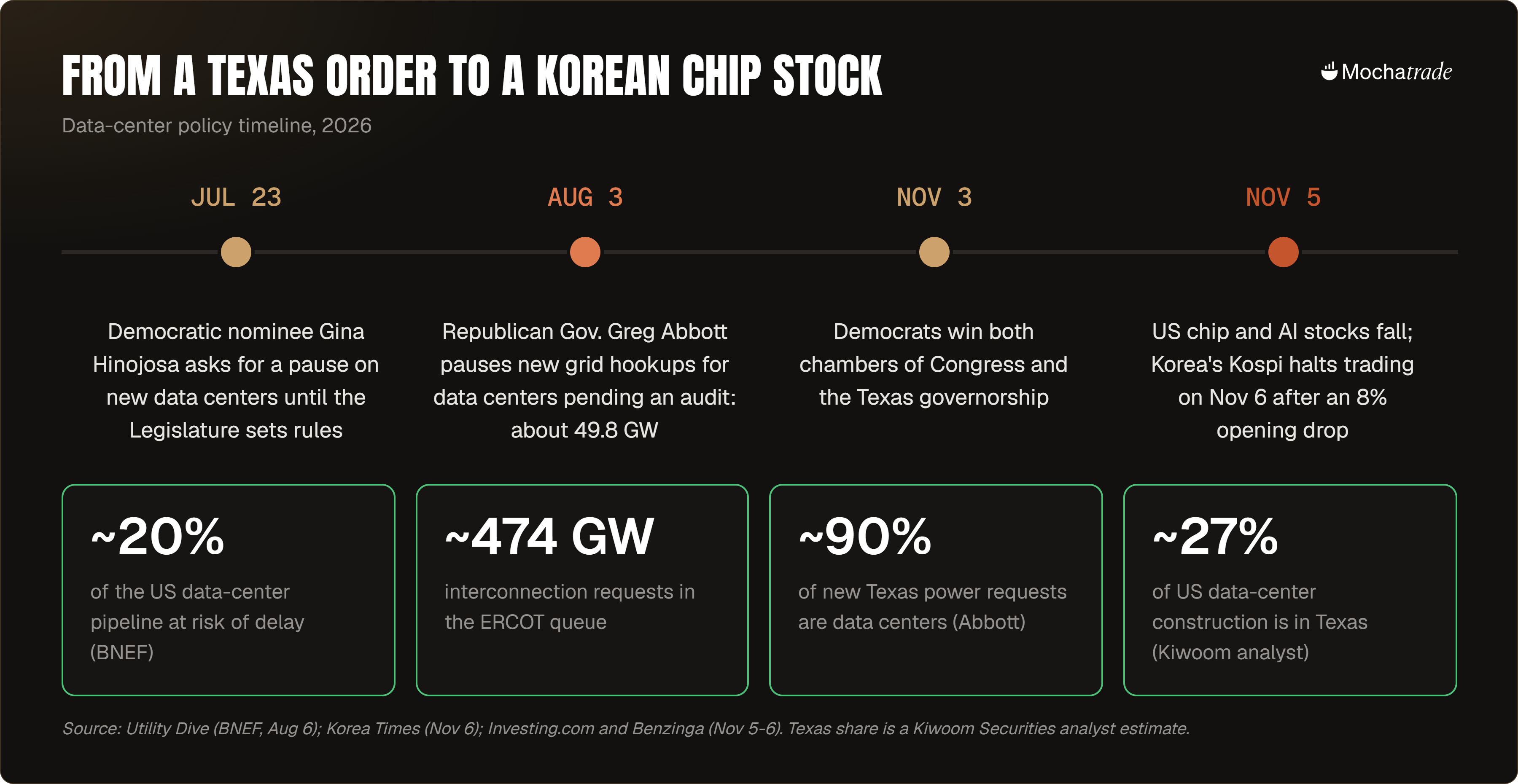
Texas data-center policy timeline and scale, 2026
BloombergNEF estimated that data-center revenue losses could reach $8 billion by the first quarter of 2027, assuming 60% of the delayed capacity is AI-related, and that the risk grows if the pause extends into the 2027 legislative session. The claim that Texas is ending data-center development goes beyond the record: the measures on file are a pause and an audit, and the first one came from a Republican governor.
A pause in Texas matters in Seoul because memory chips are sold to the companies that fill those buildings. Fewer new buildings mean fewer future orders for Samsung and SK hynix.
Why Does Tech's Weight In The S&P 500 Matter?
The S&P 500 is weighted by company size, so bigger companies move it more. Two figures show how concentrated it is:
Ten largest listings: about 39% of the index, mostly the chip and cloud names under pressure (Slickcharts data, October 10)
Technology sector: 37.9% at the end of August, according to S&P Dow Jones Indices
Both figures predate the sell-off, and the two dates differ. So a day led by chip and cloud names can pull a 500-stock index down 4.36%.
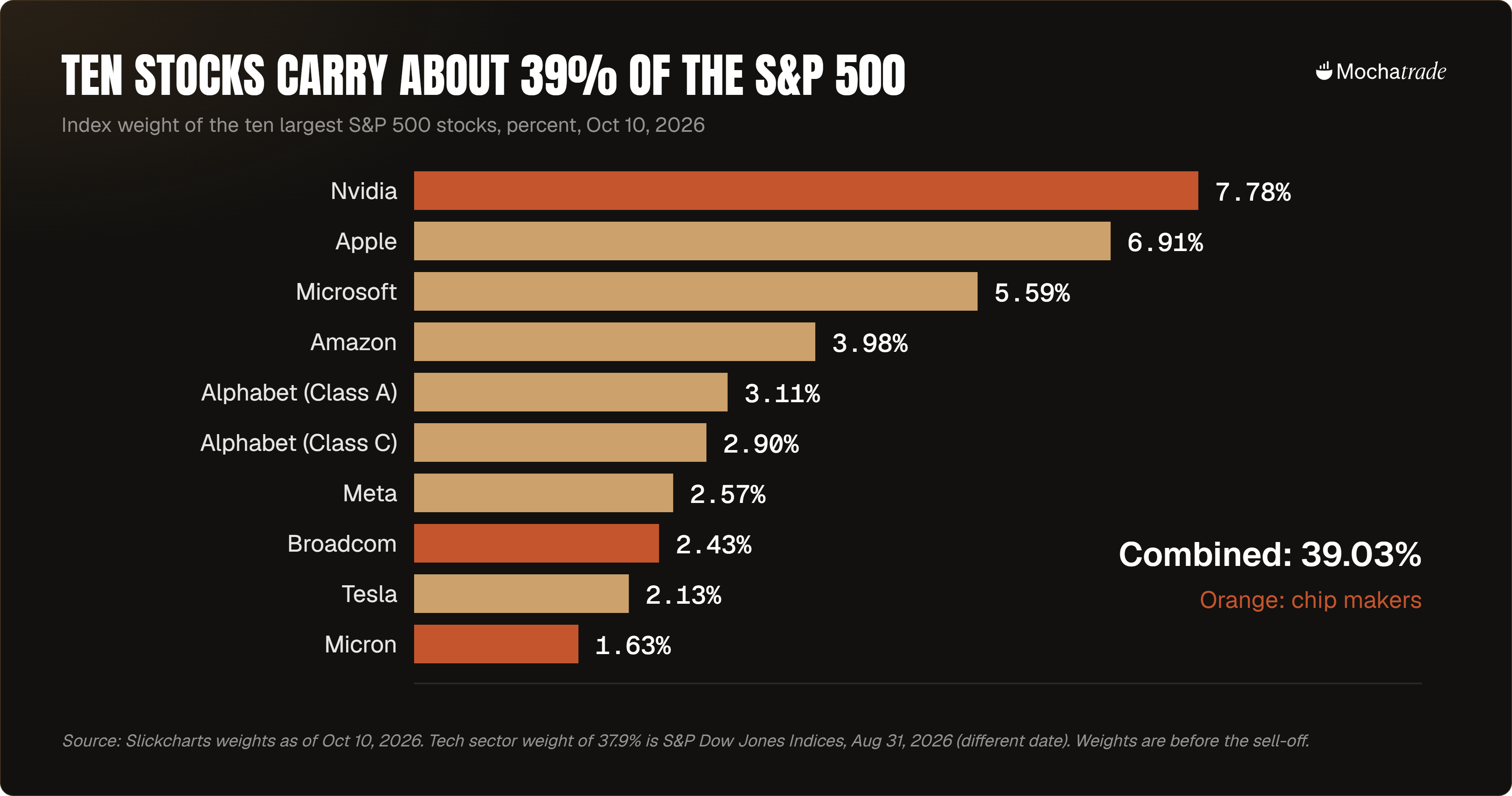
Weights of the ten largest S&P 500 stocks, October 10, 2026
How Rare Was The Drop?
The S&P 500's percent drop was its worst since April 2025, while Investing.com described the day's dollar loss as the largest since March 2020. The two rankings use different yardsticks, which explains the gap.
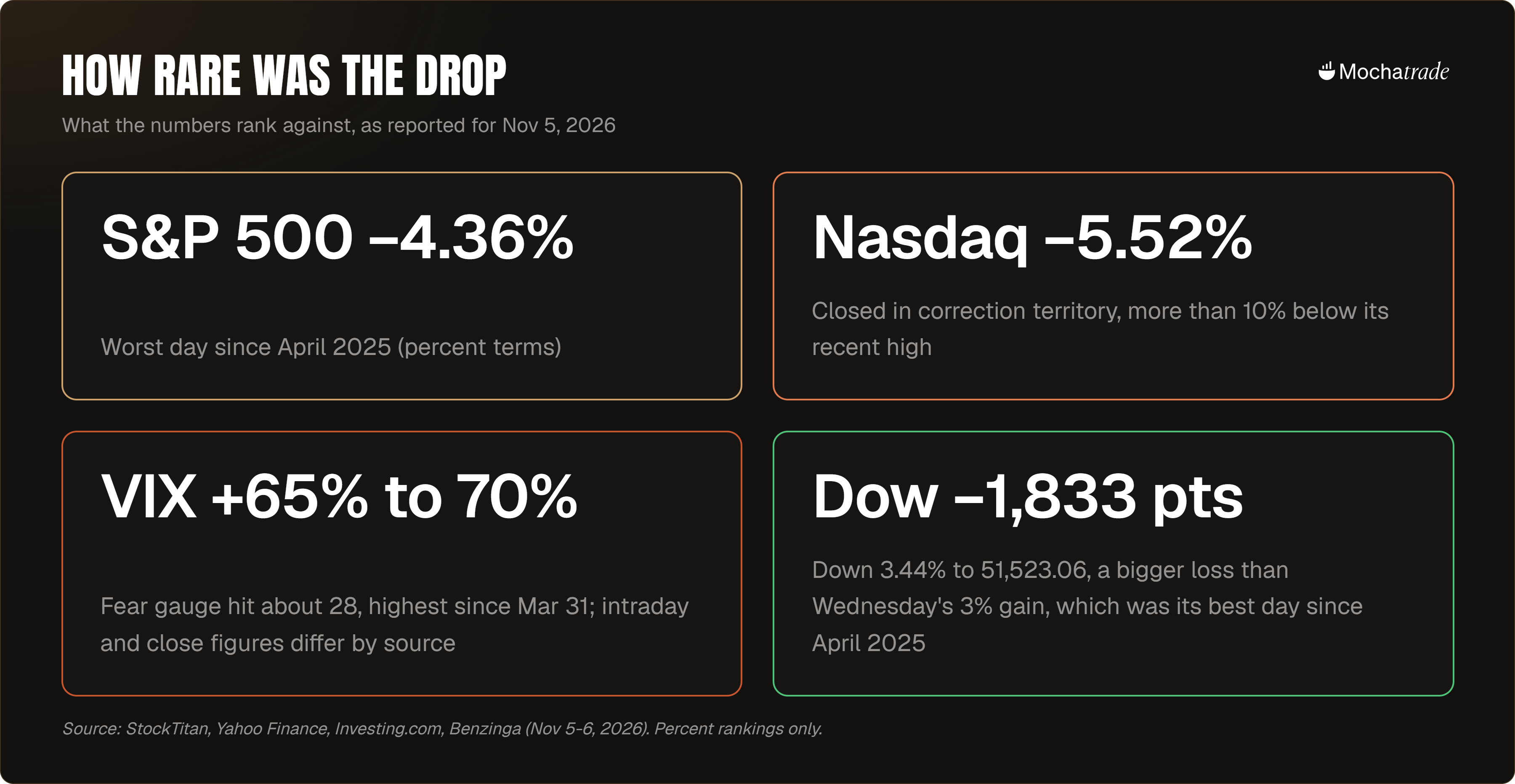
Rankings of the November 5 drop in percent and dollar terms
Is This An AI Bubble?
A bubble means prices have run well ahead of the profits that can justify them. The Thursday data fits that story in places. Hyperscaler free cash flow turned negative, CoreWeave's borrowing costs spiked, and Capital Economics economist Joe Maher described the boom as being in its "final innings."
Reporters named five competing explanations, and the article has touched on each:
AI spending doubts: hyperscaler free cash flow turned negative, CoreWeave's borrowing costs spiked, and Capital Economics economist Joe Maher described the boom as being in its "final innings."
Policy: Democrats won Congress, and Texas paused new data-center grid connections.
Rates: The Federal Reserve raised its target rate by 0.25 percentage points in September, and CME FedWatch showed about a 70% chance of another hike in December, though pricing for one eased after the sell-off.
Oil and war: Brent crude rose 3.9% to $98.29 on fresh tanker attacks in the Gulf, after an 8% fall on Wednesday.
Company news: Qualcomm gave a weak forecast, and a Wall Street Journal report, relayed by Investing.com, said investor pushback could cut Anthropic's IPO valuation talk from about $1.5 trillion to about $1 trillion
No single explanation captures these causes, and they may overlap. The cash flow figures come from company filings, while the policy link rests on how investors read events. AppLovin rose 31% on its own earnings the same day, Nvidia fell about half as much as AMD.
Educational content only. Not investment advice.
MochaLearn is a free A to Z course on understanding and trading US stocks and commodities, built for Indian traders.
Terms in this story
- S&P 500The S&P 500 is about five hundred of the largest American companies, weighted by market value, and the number money is…
- Dow Jones Industrial AverageThe Dow Jones Industrial Average is thirty large American companies averaged by share price, not by size, since 1896.…
- NASDAQNasdaq is the American exchange that began in 1971 as one screen showing every dealer quote side by side, the first…
- RevenueRevenue is the total money a company takes in from sales before any costs, the top line. Growth companies are judged…
- GDPGDP is the total value of goods and services an economy produces. The BEA publishes US GDP quarterly, first as an…
- Free cash flowFree cash flow is the cash a business brings in from operations minus what it spends on equipment and buildings.…
- Federal ReserveThe Federal Reserve is the US central bank, built in 1913 after the 1907 bank runs were stopped by one banker. It sets…
- CME FedWatchCME FedWatch turns futures on the overnight rate into a probability for each outcome at every Fed meeting. It is what…