October 22, 2026 · Mochatrade · 6 min read
Eos Energy: What Google's Coal Mine Deal Changed
Google’s Solar Deal Put Eos Energy in the Spotlight, but Margins, Cash Burn, and Funding Risks Still Loom
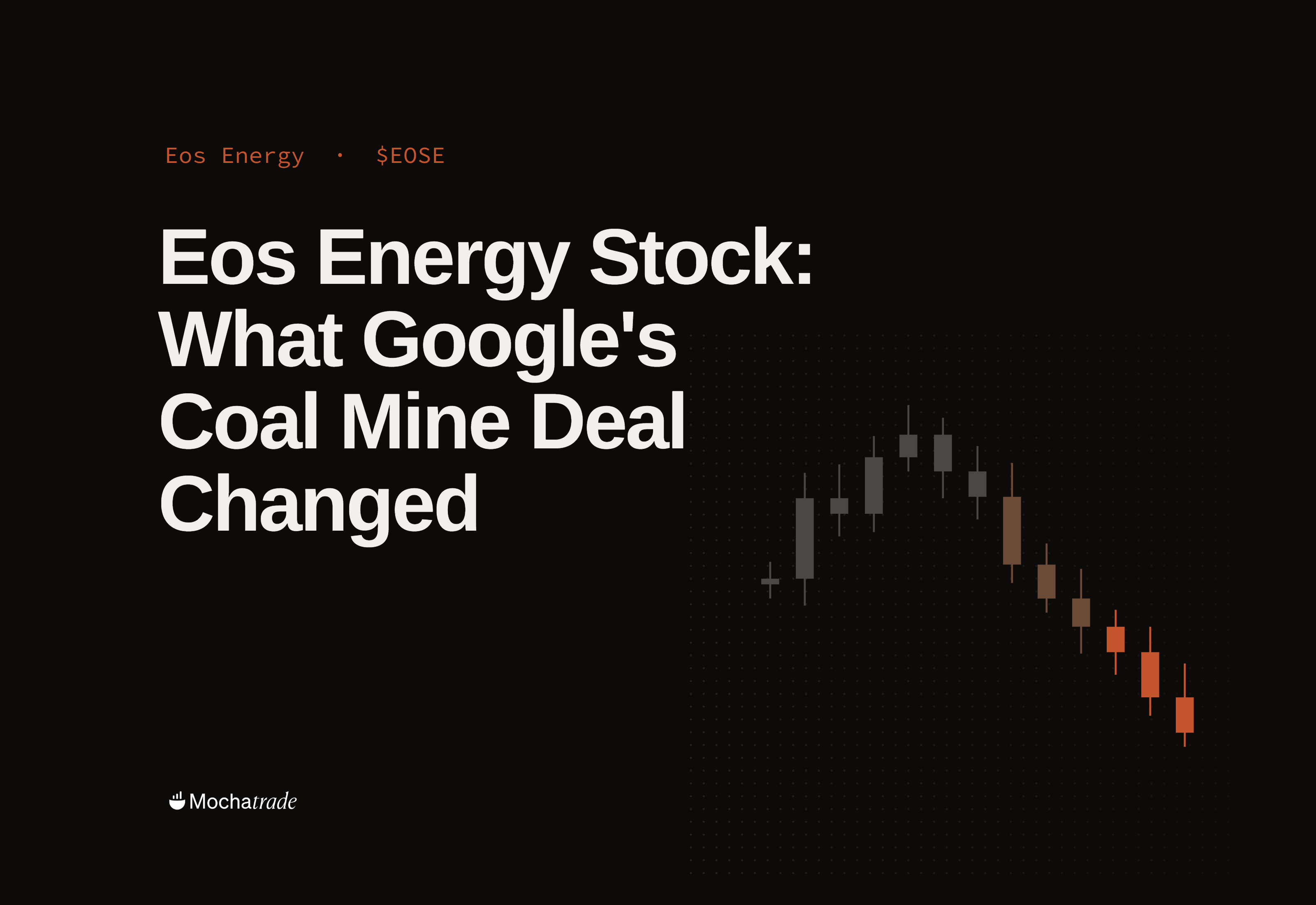
When Google agreed to buy power from a solar and battery project on a former West Virginia coal mine, Eos Energy stock jumped 19% on September 2. By October 21, it was trading near $1.68, below where it started.
The deal is real, but it is smaller and more indirect than the headlines made it sound. It also landed while Eos still needs outside money to fund its growth, and the stock has since given back the whole gain.
The Short Version
Google buys the power, while Eos sells zinc batteries to the developer, MN8 Energy, and covers about a quarter of the project's storage.
The zinc system comes online last, in 2030, so any payoff is a long way off.
The stock closed at $3.61 on September 2 and $1.95 on October 21, below its pre-announcement close of about $1.68.
Eos's 2025 net loss of $969.6 million was 77% non-cash, yet it still cost more to build its batteries than it earned selling them.
About 80% of second quarter revenue came from a single project that was later contributed to Eos's Frontier Power USA joint venture.
What The Google Deal Involves
On September 2, Google, MN8 Energy, and Eos announced Mammoth Solar, a project on a reclaimed coal mine in Kanawha County, West Virginia. MN8 will own and operate it. Google will buy the energy, capacity, and clean energy attributes under a long term agreement. MN8 puts the investment at up to $350 million.
The project includes:
86 MW of utility-scale solar
70 MW/280 MWh of lithium-ion storage, a four-hour system
10 MW/100 MWh of Eos's Z3 zinc storage, built to discharge over 10 hours
Solar is due in 2028, lithium-ion in 2029, and zinc in 2030. It is Google's first project using Eos's Z3 technology and the first deployment under the 750 MWh master supply agreement MN8 and Eos signed in October 2025. Eos's 100 MWh is about a quarter of the project's 380 MWh of storage.
Eos's customer is MN8, a developer working under a master supply agreement, so Google's name on the project gives Eos a strong reference without making Google a battery customer.
Why Pair Lithium-Ion With Zinc?
Solar panels produce power while the sun is up, but data centers draw it around the clock, and storage has to fill the gap. No single battery type covers all of it.
Lithium-ion responds fast and works well for a few hours at a time, which suits the evening window when solar output falls and demand stays high. A 10-hour zinc system covers the longer stretch, including overnight, where extending lithium-ion gets costly.
MN8 says the result turns intermittent solar into a single dispatchable resource matched to a data center's load. That is an engineering claim with a long timeline: Eos's part only pays off if long-duration storage holds up against lithium-ion, and with a 2030 start date we will not find out for years.
Is Eos Energy Stock Worth Watching After The Google Deal?
We think it is worth watching, though the deal alone does not settle the case. The shares closed at $3.61 on September 2, up 18.75% on 74.7 million shares traded. By October 22 they were below their pre-deal level.
Closing prices along the way:
September 1: about $3.04, implied by the September 2 gain
September 2: $3.61
September 22: $4.06
October 1: $3.14
October 9: $2.52
October 22: $1.70
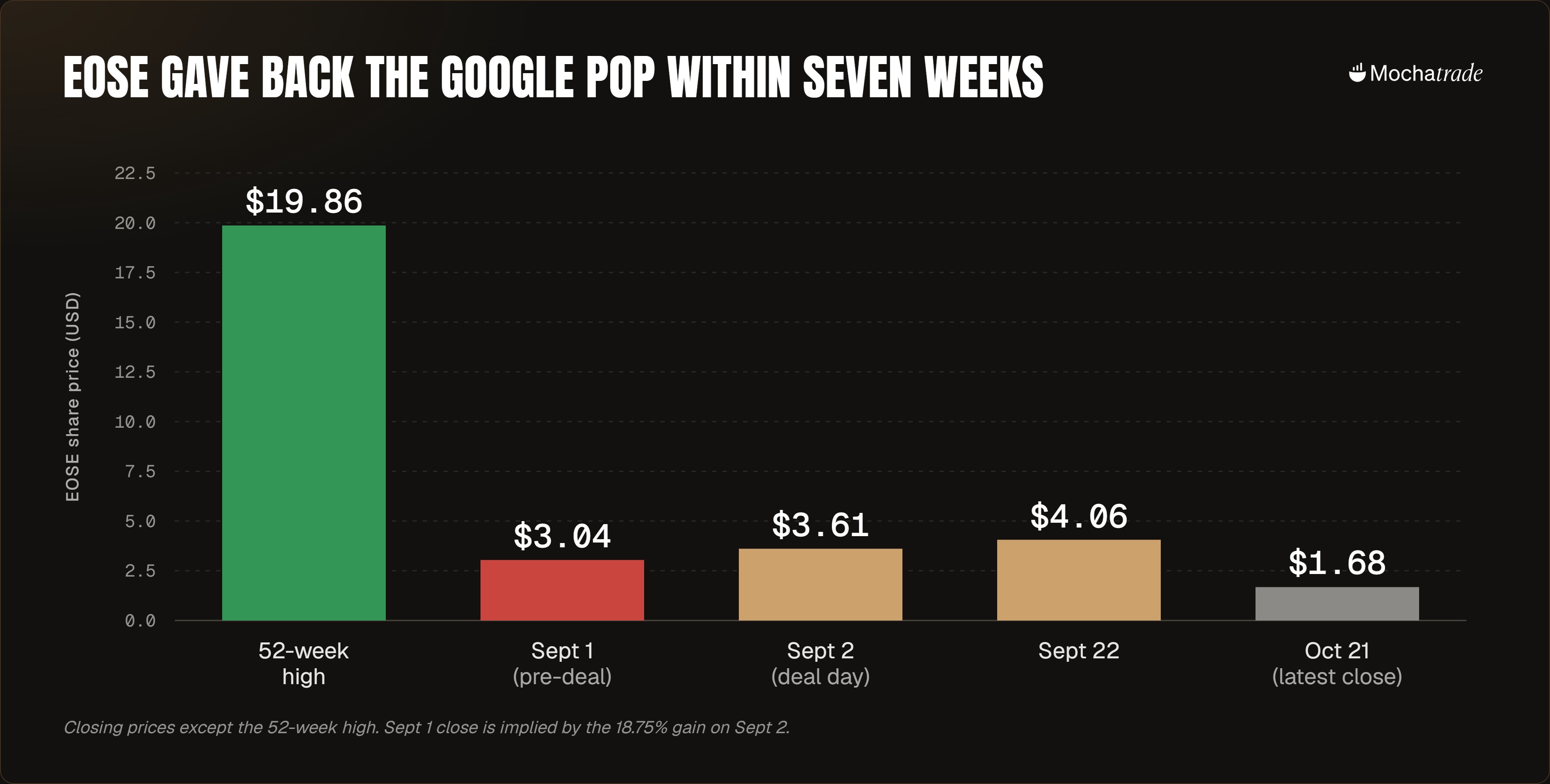
EOSE closing prices around the Google announcement, against its 52-week high
No single cause explains the slide. Eos raised equity to fund its stake in Frontier Power USA. Needham trimmed its price target from $11 to $10 on September 15, and B. Riley cut its target to $5.
Securities law firms have also put out a run of announcements since mid-September about shareholders who bought before November 5, 2025. Each says a firm is investigating, which is a different step from a lawsuit or a finding.
Analysts are far more optimistic than the market. The 11 covering the stock have a median target of $5, with a range of $4 to $10, against a share price near $2. Targets tend to lag a falling stock, so do not read too much into the gap.
The Financial Picture Behind The Stock's Fall
Eos grew revenue from $15.6 million in 2024 to $114.2 million in 2025. Net loss attributable to shareholders rose from $685.9 million to $969.6 million over the same period.
The headline loss overstates the cash drain. Eos says $746.8 million of it, or 77%, was non-cash, mostly fair value accounting and capital structure changes. Adjusted EBITDA loss was $219.1 million and operating activities used $211.2 million of cash, according to the full year 2025 results.
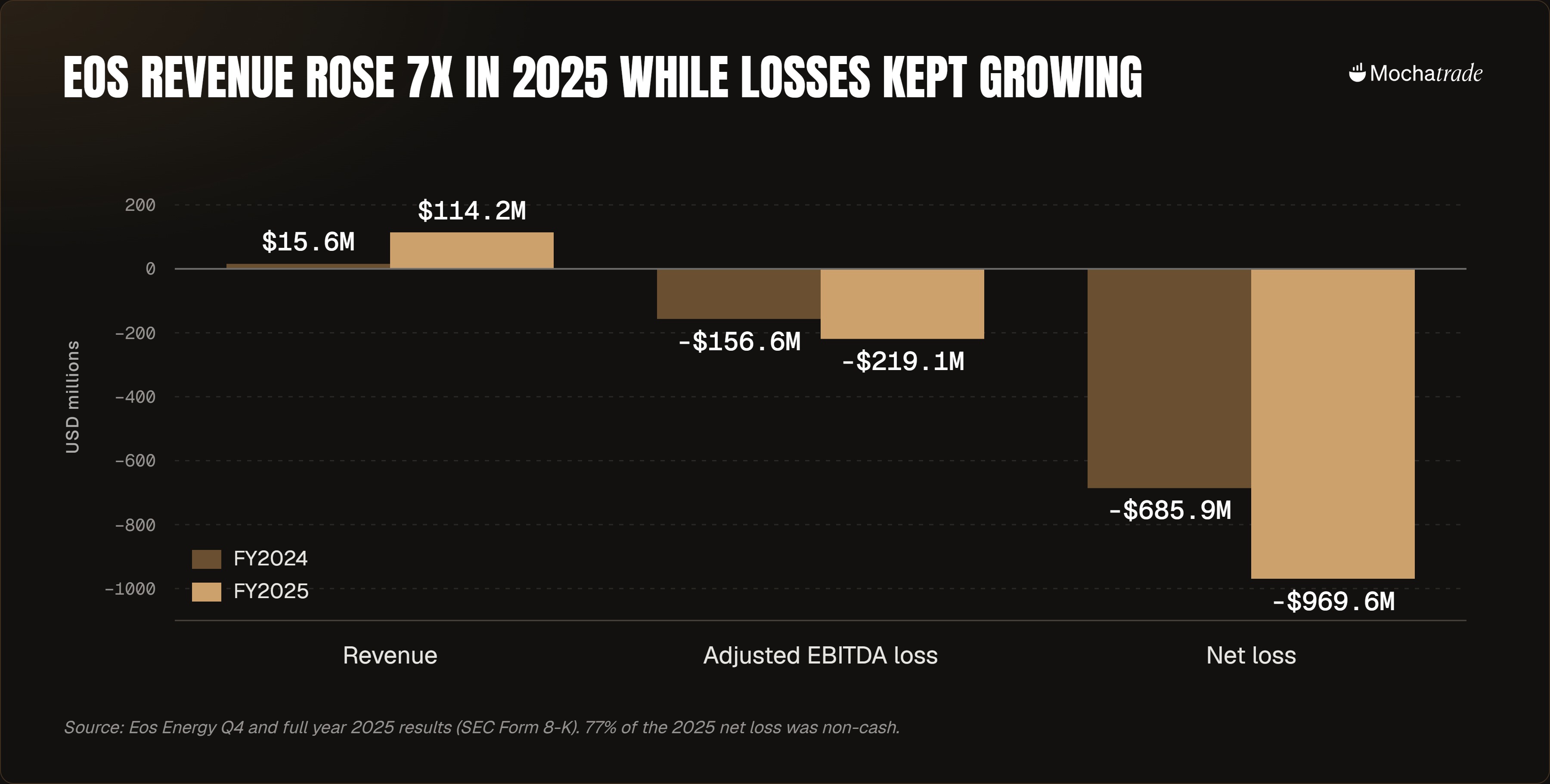
Eos Energy revenue, adjusted EBITDA loss, and net loss, FY2024 versus FY2025
The bigger issue is gross margin. Eos spent $258.0 million on cost of goods sold to generate $114.2 million of revenue, a gross margin of negative 126%. The fourth quarter improved to negative 94%, and that trend has to continue as volume grows.
What Changed In 2026
Revenue picked up fast this year. Eos reported $57.0 million in the first quarter and $68.8 million in the second, so first-half revenue of about $126 million already beats all of 2025. Backlog hit a record $807 million, or 3.4 GWh, at June 30, according to the second quarter results.
About $55 million, roughly 80% of second quarter revenue, came from one project financed by a Cerberus affiliate before the Frontier Power USA joint venture closed on August 4. That project and the joint venture together make up 49% of backlog. We would check that share first in the next filing: growth that leans on one financing partner is easier to disrupt than growth spread across many customers.
Eos narrowed its 2026 revenue outlook to $300 million to $350 million. With about $126 million booked in the first half, the second half needs $174 million to $224 million, and the results expected on November 11 will show whether Eos is on track.
Cash, including restricted cash, fell from $624.6 million at the end of 2025 to $364.1 million at June 30, against $453.8 million of long-term debt. Eos did draw an $87 million advance on its Department of Energy loan in September, which brings the total drawn to about $178 million. The money goes to its Thorn Hill factory in Pennsylvania.
What To Watch Next
Third quarter results, expected November 11, and whether full-year guidance of $300 million to $350 million holds.
How much revenue in the second half comes from customers outside the Frontier Power USA joint venture.
Gross margin, which was negative 94% in the fourth quarter of 2025, as production consolidates at Thorn Hill.
New orders beyond Mammoth Solar under the 750 MWh MN8 agreement.
Any further equity or debt raise, and any movement in the law firm investigations.
Our View
Mammoth Solar gives Eos a credible reference for its zinc technology, with Google's long term power purchase behind it. But it is one project. Eos supplies only about a quarter of its storage, and the zinc system is not due online until 2030.
From September 2 to October 14 the stock fell about 46%, which fits a market focused on funding and unit costs. We would put more weight on gross margin and the second-half revenue mix than on the next headline.
Educational content. Not investment advice. Other figures come from company filings and press releases. Do your own research.
Educational content only. Not investment advice.
MochaLearn is a free A to Z course on understanding and trading US stocks and commodities, built for Indian traders.
Terms in this story
- RevenueRevenue is the total money a company takes in from sales before any costs, the top line. Growth companies are judged…
- EBITDAEBITDA is earnings before interest, taxes, depreciation and amortisation: operating profit with debt costs and…
- Gross marginGross margin is revenue minus the direct cost of making the product, as a percent of revenue. It shows pricing power…
- VolumeVolume is how many shares or contracts changed hands in a period. About half of US stock volume is filled off exchange…