Module 1: US market structure
Seven lectures on the US market itself: the institutions and their history, how a stock's price forms across exchanges, who moves prices through policy and through trading, and how the Fed, inflation, jobs and earnings reach a position. Each is a short video from the Mochatrade channel with notes, key takeaways and a quiz.

Lectures
- Lecture 1.1 · 8:11US Stock Market Jargon and History explained: Start HereWho does what in the US market — the Treasury, the Fed, the SEC, the exchanges — told through the problems each was built to solve.
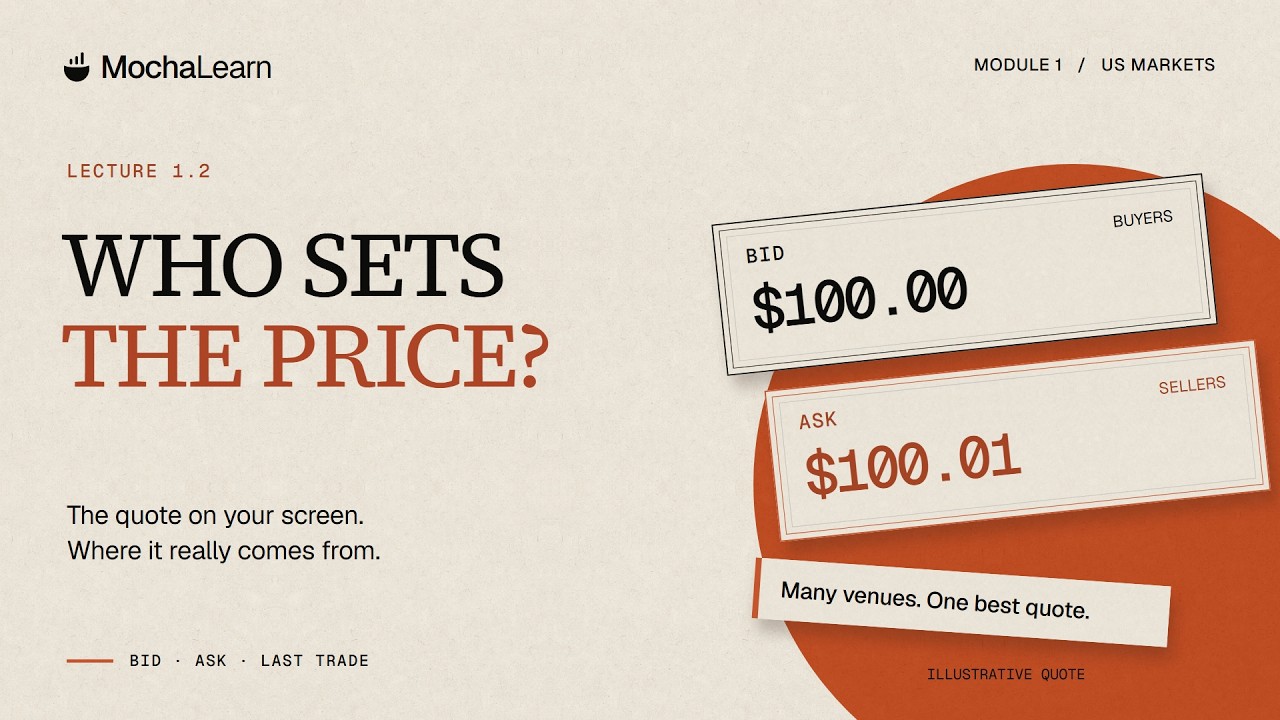
- Lecture 1.2 · 8:12How US Stock Prices Form: Order Books & ExchangesFrom the order book to the consolidated quote: how one stock trades across many venues, and when the US session falls in India.
- Lecture 1.3 · 9:16US Government Structure: Regulators & Market MakersThe institutions that shape the market through policy, and the participants that move it through trading.
- Lecture 1.4 · 14:48How the Fed Moves Markets: Rates, Expectations & FOMCThe federal funds rate, how expectations reach Treasury yields and stock valuations, and why a cut can be quiet while a sentence moves prices.
- Lecture 1.5 · 12:59US Inflation Explained: CPI, PPI & PCE for TradersThe inflation releases traders follow, how to compare a print with what was expected, and how it reaches a stock position.
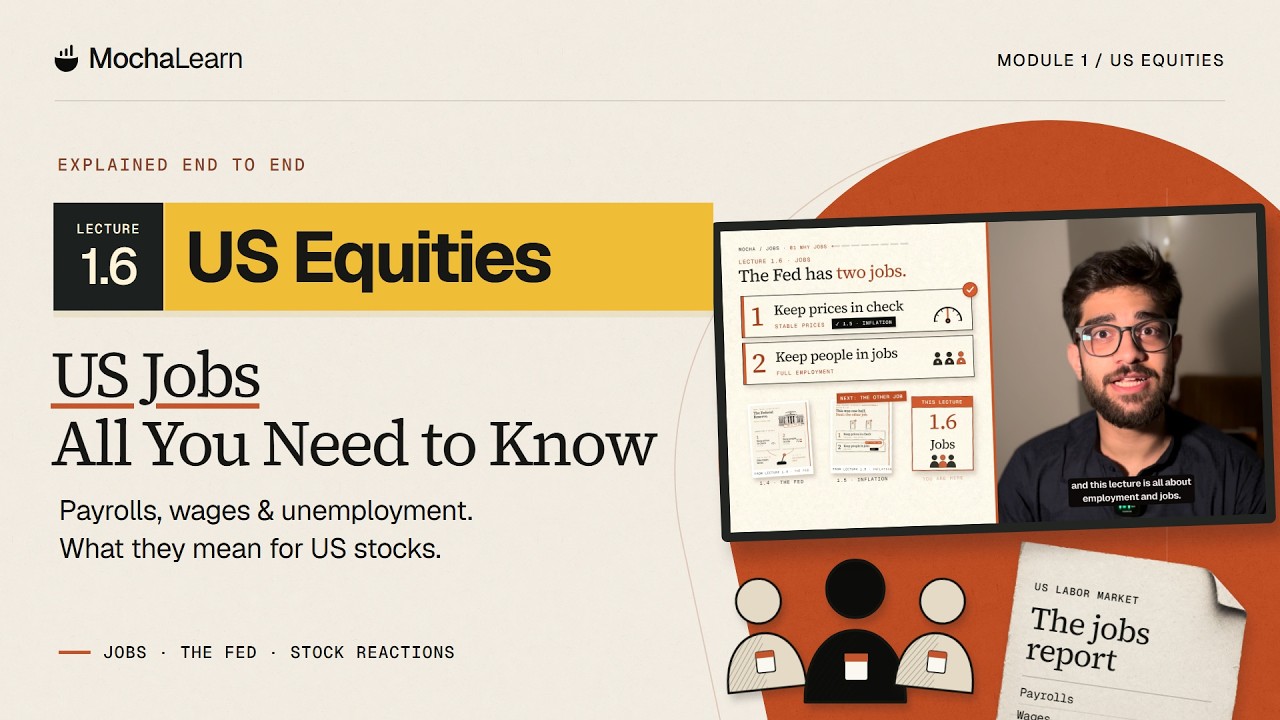
- Lecture 1.6 · 14:11US Jobs Report Explained: NFP, Unemployment & WagesThe BLS employment report, the two channels through which jobs reach stocks, and why good news can be bad news.
- Lecture 1.7 · 12:34US Earnings Explained: Reports, Guidance & Market ExpectationsEarnings season's documents, a practical order for reading results, and why a beat can still fall.


Terms in this module
- Average hourly earningsAverage hourly earnings is the wage growth number in the US jobs report. Wages are the bridge from jobs to prices…
- Dual mandateThe dual mandate is the Fed's job as Congress wrote it: stable prices and maximum employment. The 2% inflation target…
- Federal ReserveThe Federal Reserve is the US central bank, built in 1913 after the 1907 bank runs were stopped by one banker. It sets…
- Index futures (E-mini S&P 500)Index futures are futures on a stock index, like the E-mini S&P 500 on the CME. They trade almost round the clock, so…
- Market cap categories (mega/large/mid/small)Market cap categories group US companies by size: mega above $200 billion, large $10 to $200 billion, mid $2 to $10…
- NASDAQNasdaq is the American exchange that began in 1971 as one screen showing every dealer quote side by side, the first…
- NYSEThe NYSE is the New York Stock Exchange, started in 1792 when twenty four brokers agreed to trade only with each…
- QQQ ETFQQQ is the Invesco ETF tracking the Nasdaq 100, technology-heavy and concentrated in a few giants. It sits on the…
- Retail salesRetail sales is the Census Bureau's monthly count of what US shops and online stores sold. Consumer spending is about…
- US ETFA US ETF is an exchange-traded fund on a US exchange that holds a basket, usually an index, and trades all day like…
- US TreasuryThe US Treasury is the government's borrower and the oldest name on the US market map: it issues bonds to cover the…
- 10-K and 10-QA 10-K is the audited annual report a US listed company files with the SEC; a 10-Q is the unaudited quarterly version.…
- 10-year Treasury yieldThe ten-year Treasury yield is the benchmark long rate that mortgages, company debt and stock valuations are priced…
- BetaBeta measures how much a stock has moved relative to the market: 1.5 means it has historically moved 1.5% for each 1%…
- Bid-ask spreadThe bid-ask spread is the gap between the best price to sell (bid) and the best price to buy (ask). Buy at the ask…
- Blue chip US stocksBlue chip US stocks are large, long-established, profitable American companies like Apple, JPMorgan or Johnson &…
- Bull and bear marketA bull market is a sustained rise in prices; a bear market is a fall of 20% or more from a recent high, the convention…
- Closing auction (official close)The closing auction is the single matched trade at 1:30 AM IST, 2:30 AM in winter, that sets each US stock's official…
- CME GroupCME Group is the Chicago exchange where futures on US stock indices, interest rates, gold, oil and copper trade…
- Consensus estimateThe consensus estimate is the average analyst forecast for a company's earnings or an economic number. Markets price…
Glossary
Every term the course uses, defined in a paragraph, in the MochaLearn glossary. The rooms this module lives in: